










































Analysing the Impacts of Individual Factors on Decision Making and Strengthening Positive Attitudes on Vaccination
University of Zenica (Karakas); Institute for Public Health of the Central Bosnia Canton (Karakas, Paklarcic, Kukic); Clinical Center of the University of Sarajevo (Zukic)
"Exact vaccine acceptance measuring is important, especially in these conditions when disinformation can increase public concern and politicize vaccination policy."
In light of dramatic increases in vaccine reluctance in recent years in many countries due, in part, to the spread of misinformation about vaccines on the internet, this paper analyses the knowledge and attitudes on immunisation, subjective perceptions of risk, and decision-making about vaccination among a specific population of women in the Federation of Bosnia and Herzegovina. Its purpose is to help inform efforts to strengthen positive attitudes on vaccination.
The research was conducted during 2018. Four thousand female respondents ranging in age from 20 to 50 years were classified according to their place of living (urban/rural) and whether they were a parent or not. An 18-item questionnaire was answered by 2,504 parents with experience of immunisation decision-making for their children, as well as 1,496 future parents, who expressed their attitudes toward immunisation.
Most of the respondents (71.2%) who already have children claim they have vaccinated their children completely; 2.0% respondents from urban areas and 1.3% from rural areas explicitly refuse to vaccinate their children. The rest of the respondents (25.4%) claim they partially vaccinated their children or that they are not familiar with the vaccination status of their children. Respondents without children mostly plan to vaccinate their children fully (63.0%).
The research reveals that more than 25% of parents and 16% of future parents are indecisive about vaccines. Hesitancy indicators suggest that 52.4% of respondents think that vaccines cause temporary acquired immune deficiency, while 26.5% think that vaccines cause autism. Also, a majority of respondents (61.0%) support the claim that getting more than one vaccine at the same time increases the risk of side effects and can overload the immune system. "Reasons for indecision or hesitancy vary in different countries and are context specific, which implies that there is a necessity for strengthening capacities of national programs for identification of locally relevant factors and development of adjusted strategies for solutions."
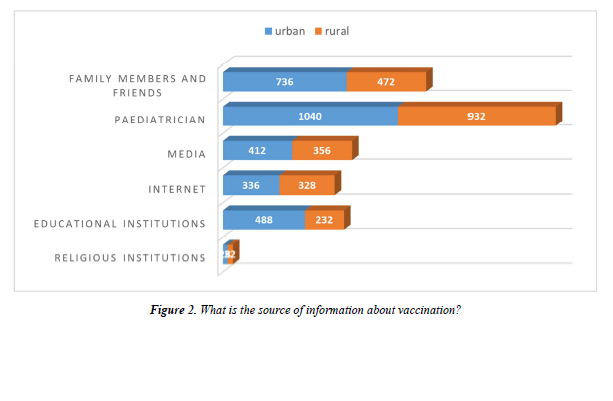
The research shows that parents are mostly informed about vaccinations and immunisation by paediatricians (36.6%). Parents usually want to hear that paediatricians and family doctors also vaccinate their own children, and they want to talk about their experience. Medical professionals are generally in favour of vaccination; however, some of them may be a part of the group who are indecisive when it comes to vaccines. This research also suggests that respondents show a great deal of reluctance and scepticism towards some medical workers and that only 40.6% of respondents unconditionally trust their doctor. With regard to vaccine safety, 18.8% of urban respondents claim they completely trust vaccines; in rural areas, 36.2% of respondents trust them.
Respondents (22.4%) say they rely on the vaccination information they get from family members or friends. "Personal experience and mutual trust are the key factors for sharing information about vaccination importance. It is necessary to encourage parents who have already vaccinated their children to talk about their decision and to become members of an online community with positive stories about immunisation....Besides this, those stories about people who got diseases that could have been prevented by vaccines should be a part of the public discourse again."
Regardless of the hypothesis that the internet and social networks have a crucial impact on the respondents' opinion about accepting vaccination, the research showed that social networks and the internet are in the fifth place on the sources of information scale (16.6%), after medical workers, family members, media, and educational institutions. "However, it is important to point out that anti-vaccine information dominates on the Internet. Many anti-vaccination campaign websites post pictures and stories in order to convince people that they should not get vaccinated."
In conclusion, the researchers reiterate that vaccination hesitancy is an individual behaviour, but it is also the result of wider social impacts and should always be analysed in a historical, political, social and cultural context in which vaccination takes place. "Considering the lack of information about public health intervention effects, it is inevitable for the public health [community] to keep searching for effective strategies that could regain vaccination trust."
American Journal of Pediatrics. Vol. 5, No. 3, 2019, pp. 116-24. doi: 10.11648/j.ajp.20190503.17
- Log in to post comments