











































Applying a Gender Lens to Social Norms, Couple Communication and Decision Making to Increase Modern Contraceptive Use in Ethiopia, a Mixed Methods Study
Johns Hopkins Bloomberg School of Public Health, Center for Communication Programs (Kapadia‑Kundu, Tamene, Ayele, Dana, Heliso, Velu, Berhanu, Leslie, Kaufman); United States Agency for International Development (USAID)/Ethiopia (Alemayehu)
"The promotion of gender equity in couple communication and decision making is critical if women's voices are to be heard in the context of family planning."
Ethiopia's unmet need for family planning is 22%, indicating that services have yet to reach couples in need of contraceptive products. Conducted as part of a broader study assessing the determinants of behaviours of an integrated health promotion programme, this research sought to identify determinants of contraceptive use in four regions of Ethiopia and to explore the relationship between social norms, gender-equitable norms, couple communication, and contraceptive use.
The mixed-methods study included a survey in Amhara, Oromia, Tigray, and the Southern Nations, Nationalities, and People's Region (SNNPR), followed by an in-depth sociocultural qualitative study. Data for the quantitative study were gathered from 2,770 women of reproductive age (15-49 years) in August-September 2016; the qualitative data were collected (via 8 rapid assessments, 16 in-depth interviews (IDIs), 24 key informant interviews (KIIs), and 16 focus group discussions, or FGDs) in July-August 2017. The qualitative approach draws from grounded theory, whereby researchers assess lived experiences that include intertwined household and societal influences to identify interconnections between influencing factors associated with modern contraceptive use.
The current use of modern family planning for the respondents (minus currently pregnant women) is 41%, but regional variations persist. About one-half the sample of women knew of 4-8 family planning methods, and 40% knew at least 1-3 family planning methods, which indicates that women have average to high levels of family planning knowledge. Overall, women in the sample reported high self-efficacy for family planning, with 46% agreeing to their ability to use family planning methods and another 37% strongly agreeing to use family planning. Outcome expectancy refers to a person's understanding of the benefits of an action. Women have moderate (46%) to high (41%) outcome expectancy for contraceptive use.
Data on gender-equitable norms indicate that 64% of women supported a moderate level of gender-equitable norms; only 17% of the women in the sample were high on the gender equitable norm scale. About 19% of the sample was low on the gender equitable men (GEM) scale, which was adapted in this study for female respondents.
Logistic regression analysis found that:
- Knowledge of three or more family planning methods had a significant association with current family planning use, with contraceptive use twice as likely among women with sufficient knowledge of family planning use compared to women with insufficient knowledge.
- Women with high family planning self-efficacy were twice as likely to use contraceptives compared with women with low to moderate self-efficacy for modern family planning use.
- Women with at least primary education were 1.5 times more likely to be currently using family planning methods compared to women with no formal education. Age, religion, and region are other socio-demographic factors associated with family planning.
- Women who listened to the radio at least once a week were 1.4 times more likely to be currently using family planning methods compared to women who did not listen to the radio.
- Current family planning use was more likely to have been found among women with moderate (adjusted odds ratio (AOR) 1.3, 95% confidence interval (CI) 1.06-1.77) to high (AOR 1.4, 95% CI 1.06-2.06] gender-equitable norms compared to women with low gender-equitable norms.
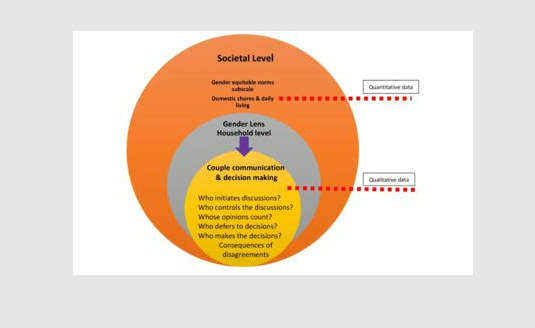
Qualitative data indicate that the timing of contraceptive use is linked to the social norm of the desired family size of 4-5 children. While social norms reflect the pressures that compel spouses to conform, couple communication is a process that provides opportunities for change. However, gender inequity is evident in couple communication, with men controlling decision making even if women initiated conversations on family planning. A key finding based on an inductive analysis of qualitative data indicates that the micro-processes of couple communication and decision making are often dictated by male advantage. Fear of violence can lead many women to accede to the man's viewpoint. The study identified six micro-processes (see the questions in the figure above) that lead to gender inequity, which the researchers say need to be further examined and researched.
Reflecting on the findings, the researchers note that the new dimension added by this study is highlighting the need for a gender lens for viewing couple communication and decision making. They explain that, "unless we examine couple communication and decision making from a gender equitable perspective, equalizing the inherent gender imbalance in these constructs will be difficult....Steps towards operationalizing these findings into strategic behavior change programs include conducting more nuanced research on the gender power imbalance in couple communication and decision making."
Based on the contextual findings of that research, "interventions can be designed specifically to address the gaps in equitable couple communication and decision making related to contraceptive use. For example,...men and young boys need to be an integral part of gender-centered initiatives to promote gender equitable norms..." Such programmes should promote respect for women's decision-making abilities and equitable couple communication.
Reproductive Health (2022) 19:138. https://doi.org/10.1186/s12978‑022‑01440‑8
- Log in to post comments