










































Measuring behaviour change through story sharing
Summary:
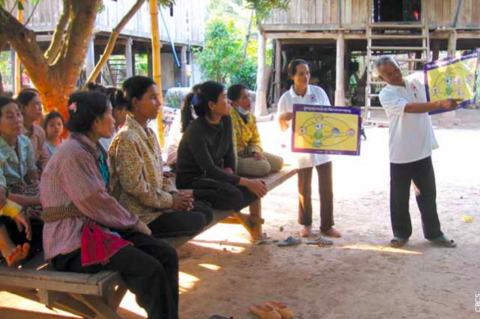
Community based health and first aid (CBHFA) is the Red Cross Red Crescent approach to empower communities and volunteers to take charge of their health. By using simple tools adapted to the local context, communities are mobilized to address priority health needs. To generate insights that will help communities to prevent, respond to health problems and reduce their incidence, it is essential to monitor and evaluate this new approach during its entire implementation by getting feedback from the communities reached. Our ultimate aim is to generate community-centred evidence. To do so, we used a novel research tool, SenseMaker. SenseMaker allows to collect mixed methods data regarding the underlying behavioural change factors with the goal of gaining insights into how to improve the community's health habits. (It will allow people reached by eCBHFA in communities, to interpret or give meaning to their own stories and to convey their importance.) In contrast to conventional qualitative research methods, this approach removes the role of the researcher as the interpreter of insights (e.g., needs, risks, desires) and places participants at the centre of insight generation and of recommendations for improved humanitarian response. The study design will not only identify common themes, but also allow to get a more nuanced understanding of the extrinsic and intrinsic determinants of individual behavioural change.
Background/Objectives:
eCBHFA has the added advantage of serving as an important gateway for incoming disaster response teams which need critical information about existing health systems and services, stakeholders and most importantly, the needs of the community pre-disaster and immediately after the disaster. eCBHFA identifies which health determinants are significant within communities and volunteers deliver behaviour-change-based interventions. SenseMaker was used to answer two questions:
1. What gaps are present in community members health knowledge and skills?
2. What are the perspectives and priorities of community members about their health and what activities that contributed to their experience?
Description of Intervention and/or Methods/Design:
SenseMaker combines the objectivity of numbers with the persuasiveness of stories to measure behaviour change. People exchange micro-narratives with each other short, open-ended stories about their experiences creating and sharing new knowledge, inspiring others to action. People type, record or post a picture of a key moment on a specially-configured app or webpage. SenseMakers original tagging method lets those who know the context best add layers of meaning to their own narratives. Tags provide hard quantitative data that reveal meaning without machine interpretation of text or expert analysis.
Results/Lessons Learned:
We used a modified framework of the Risks, Attitudes, Norms, Abilities, and Self-regulation (RANAS) model, encompassing the following components: 1. Behavioural factors are grouped into four blocks (Risks; Attitudes; Norms; and, Abilities). 2. Behaviour change determinants correspond to the blocks and to the Doer/Non-Doer Analysis tool used by eCBHFA volunteers. WASH was the most frequently discussed topic in the respondents stories with the majority of stories about behaviours in using structural measures (latrines and wells), followed by improved behaviours for maternal and newborn child health (55%).
Discussion/Implications for the Field:
Health promotion is often believed to be difficult and/or expensive to measure, assuming considerable time is necessary to show changes in behaviour. The use of the Sensemaker evaluation tool in Cambodia is innovative in measuring behaviour change through story sharing and quantitative data in as little as six months of implementation. Our evaluation results show that behaviour change can be measured with considerable insights into who is changing behaviours and what triggers changes through analysis of firsthand stories and key quantitative data about their stories.
Abstract submitted by:
Nancy Claxton - International Federation of Red Cross and Red Crescent Societies (IFRC)
Chansana Hang - IFRC
Approved abstract for the postponed 2020 SBCC Summit in Marrakech, Morocco. Provided by the International Steering Committee for the Summit. Image credit: IFRC