











































Characterizing HPV Vaccine Sentiments and Content on Instagram
Drexel University (Kearney, Hauer); Thomas Jefferson University (Selvan, Leader)
"Integrating narrative into Instagram posts that focus on evidence-based HPV vaccine information may increase post popularity, through likes and shares, but also further engage parents or caregivers and lead to pro-vaccine decisions."
Reports suggest anti-vaccine organisations and bots may be leveraging anti-vaccine sentiments to legitimise the vaccine debate and advance anti-vaccination policies. In light of the increasing number of people, including adolescents, who turn to social media platforms for health information, and the implications for health behaviours and outcomes, this research examined how information about the human papillomavirus (HPV) vaccine is communicated on Instagram. The hope is that, by equipping pro-vaccine advocates with concrete recommendations to improve the engagement, via likes, of their Instagram content, the research may inform efforts to combat vaccine hesitancy in general, an emerging and global health threat.
Research questions included: What are the visual, textual, and user characteristics of Instagram posts that mention HPV vaccination? How do visual, textual, and user characteristics vary between posts with pro- and anti-HPV vaccine sentiments? Which post characteristics are associated with the popularity of (user engagement with) a post, measured by likes?
The final analytic sample included 360 Instagram posts by 292 Instagram users. Select findings:
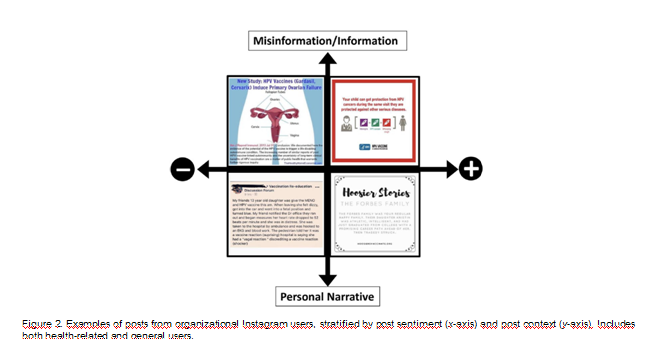
- More posts contained actionable information/resources (63.9%) than personal narrative elements (36.1%).
- Less than one in three posts (30.0%) came from health-related sources.
- Pro-vaccine posts were more prevalent than anti-vaccine posts (55.8% vs. 42.2%, respectively).
- The majority of posts from organisational sources were either pro-vaccine information (55.6%) or pro-vaccine narratives (11.7%), and the majority of posts from individual sources were either anti-vaccine information (27.8%) or anti-vaccine personal narratives (26.0%).
- Compared with pro-vaccine posts, anti-vaccine posts more often included web links (p < .001) and were more likely to omit a user's location.
- Videos and combinations of text and imagery express significantly more anti-vaccine sentiments than posts that were image-only, text-only, or infographics (p < .001).
- Posts with faces were more negative than positive (51.1% vs. 48.9%; p = .0052).
- Images showing males separately or males and females combined were more anti-vaccine than pro-vaccine, and posts with females separately were more commonly pro-vaccine than anti-vaccine (p = .0073).
- Pro-vaccine narratives portrayed individuals who received the vaccine, but provided limited details on vaccine experiences, contrasting with the depth of details in anti-vaccine personal narrative posts.
- Pro-HPV vaccination posts were liked significantly less than anti-vaccination posts (24 vs. 86 likes; p < .001).
- Personal narrative posts received nearly twice as many likes as informational posts (70 vs. 39 likes; p = .0268).
Based on the findings, the researchers offer some recommendations for HPV vaccine content creators on Instagram, as well as health educators and promoters, including:
- Explore the impact of negative emotional appeal and how this can be applied constructively toward strengthening HPV vaccine uptake.
- Consider using a visual combination to increase initial appeal for users who do not read post captions, such as users scrolling through their Instagram feed on mobile devices.
- Frame the absence of available features, such as missing location data, as an indicator of social media misinformation in educational materials.
- Convey organisational credibility and trustworthiness by taking advantage of existing social media features, including location and other platform credentials.
- Continue to provide the necessary information and evidence to advance HPV vaccination uptake, yet integrate elements of narrative storytelling, such as highlighting individuals, families, and communities, and their stories.
With regard to the role of social media platforms themselves, as of April 2019, Facebook, YouTube, Amazon, Pinterest, and Twitter are considering and implementing stronger enforcement mechanisms for regulating the prevalence and reach of misinformation on their platforms.
In short, this study identifies "an opportunity to create pro-HPV vaccine narratives that could be disseminated broadly as a mechanism to counter the prevalence of anti-HPV vaccine narratives. Testing and evaluation of narrative-based health communications on social media may be a promising direction for public health advocates to create counternarratives to anti-vaccine misinformation while increasing uptake of the HPV vaccine....With sufficient resources, organizations such as patient advocacy groups, health departments, and government agencies could create a portfolio of positive pro-vaccine narratives with accompanying visuals (e.g., photo) to disseminate, filling an essentially unoccupied field of Instagram content."
Going forward, the research team plans to use large-scale data to determine whether narrative Twitter posts increase HPV vaccination more effectively than non-narrative posts.
Health Education & Behavior 2019, Vol. 46(2S) 37S-48S. DOI: 10.1177/1090198119859412 - sourced from "Trying to help parents decide to vaccinate kids against HPV? Consider storytelling", November 19 2019 - accessed on November 22 2019.
- Log in to post comments