










































A Cluster Randomized Trial to Determine the Effectiveness of a Novel, Digital Pendant and Voice Reminder Platform on Increasing Infant Immunization Adherence in Rural Udaipur, India
Harvard Medical School (Nagar); Georgetown University School of Medicine (Venkat); University of Miami Miller School of Medicine (Stone); University of Chicago (Engel); Yale School of Medicine (Sadda); India Institute of Health Management Research (Shahnawaz)
"Novel, culturally appropriate community engagement strategies are worth exploring to close the immunization gap."
Driven by supply-side factors, demand-side factors such as vaccine hesitancy, and gaps in data collection, under-immunisation in the rural region of the Udaipur district of Rajasthan, India, is a problem: The full immunisation coverage rate is only 37.2%. This study seeks to systematically evaluate an mHealth intervention - a digital NFC (Near Field Communication) pendant worn on black thread and voice call reminder system - with regard to its adoptability by mothers and potential to drive behaviour change around immunisation timeliness, with the primary objective of increasing diphtheria-tetanus-pertussis (DTP3) adherence in the first 180 days after childbirth.
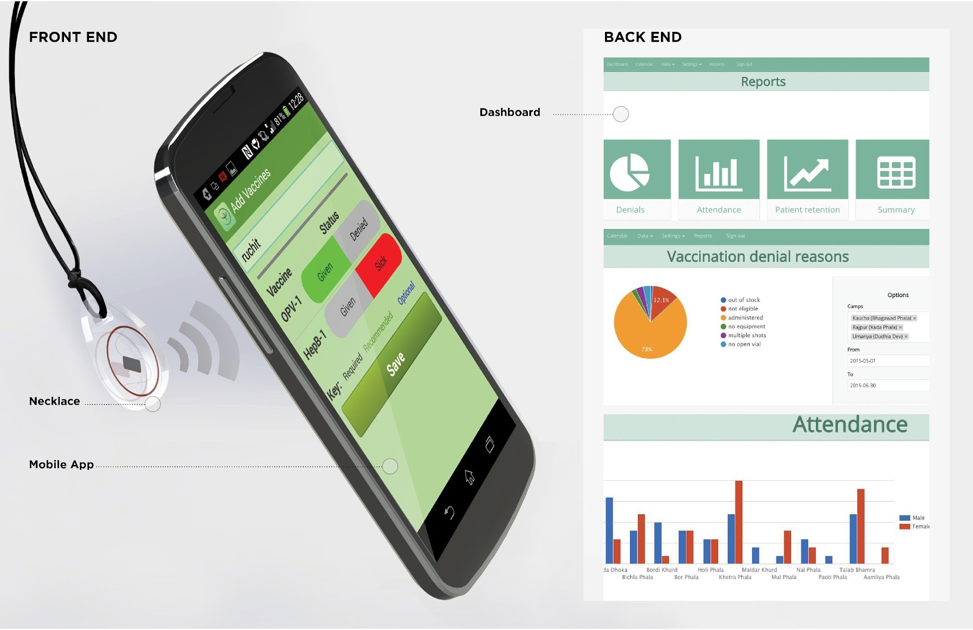
As is detailed at Related Summaries, below, the m-Health platform Khushi Baby (KB) provides a streamlined digital data collection system for frontline health workers that is designed to support community engagement around child immunisation. This platform tracks child immunisation history using a mobile application and a durable NFC-powered necklace worn by the child, designed to retain its data for years. The Khushi Baby pendant is culturally tailored, as the black thread on which it is strung is commonly believed to ward off evil spirits in the Udaipur community and many tribal regions of India. Health workers are equipped with NFC-enabled devices that contain the KB mobile application. When a child is brought to a given immunisation camp, the health worker scans his or her necklace to automatically bring up the child's immunisation history on the mobile application. The child's vaccination data is then synced to a cloud-based database when cellular connectivity is available. With the KB cloud-dashboard, health administrators can send automated voice call reminders in the local dialect to the patient's family.
Infants in the research cohort were tracked from the onset of registration into the KB system. In this first camp visit, the child receives the first DTP shot, meaning that 2 additional DTP shots would be required to complete the series. From August 2015 to April 2016, a cluster randomised controlled trial (RCT) was conducted in which 96 village health camps across 5 blocks in the Udaipur District were randomised to 3 arms:
- Control Arm: NFC stickers were placed on the existing immunisation card. These stickers serve as a digital record of the child's immunisation while retaining the paper card that the mother currently uses. The sticker can be updated via the KB app and allows for consistent methodology of immunisation data collection.
- Pendant Only: The immunisation record was digitally stored on a pendant with black thread, worn by the child.
- Pendant + Voice Call Reminders: Children received the pendant, and mothers received voice call reminders the day before and the day of the camp, along with a missed camp message for mothers who failed to attend.
The researchers expected to see the pendant + voice arm increase DTP3 timeliness for the average mother, after controlling for confounding factors, when compared to both the pendant only arm and the sticker arm. The rationale for this hypothesis was that the necklace could act as a social tool for engagement, and that the voice call reminders could lead to fewer missed immunisation appointments, especially for enrolled mothers who presented with low health awareness.
However, in terms of the 3 primary outcomes related to DTP3 adherence, point estimates show conflicting results. Two tests failed to show a significant effect of treatment arm on DTP3 vaccination adherence. DTP3 completion within 2 camps after DTP1 showed higher adherence in the control (sticker) (74.2%) arm compared to the pendant (67.2%) and pendant + voice arms (69.3%). Likewise, the estimate for DTP3 completion within 180 days of birth in the control (sticker) (69.4%) arm was higher than estimates in the pendant (57.4%) and pendant + voice arms (58.7%). However, one outcome displayed higher adherence in the intervention. DTP3 completion within 2 months from the time of registration was higher in the pendant (37.7%) and pendant + voice arms (38.7%) compared to the control (sticker) arm (27.4%). In all primary outcomes, differences in adherence were statistically insignificant both before and after controlling for confounding factors.
To assess the influence of the KB necklace on community discussion, user satisfaction, and visibility, the researchers analysed the results of post hoc survey questions. The proxy for measuring discussion level in the communities was the response to the question: "How many people did you show or discuss the necklace with?" To assess general satisfaction around the data collection tools, the researchers analysed responses to the survey question: "What is your general reaction to the necklace/sticker?" Assessment of visibility included analysis of the following 2 questions: "Has the grandmother of the family seen the necklace?", and "Has the father of the family seen the necklace?" The results suggest that providing a necklace generated significant community discussion (H = 8.8796, df = 2, p = .0118), had strong satisfaction among users (χ2 = 26.039, df = 4, p < .0001), and resulted in increased visibility within families (grandmothers: χ2 = 34.023, df = 2, p < .0001, fathers: χ2 = 34.588, df = 2, p < .0001).
The researchers indicate: "With vaccination programs, the process of contextualizing and adapting formal program rules to local socio-cultural conditions is intended to lessen the challenges of vaccine hesitancy....Services must be accessible and affordable, rigorous adherence must be maintained, and trust must be established to decrease perception of vaccination harm and mitigate factors attributed to vaccination hesitancy....While the KB system cannot address all of these implicit structural barriers, it does present a new kind of social incentive, as well as a reminder, to reinforce good health behaviors."
In short, neither the NFC necklace nor the necklace with additional voice call reminders in the local dialect directly resulted in an increase in infant immunization timeliness through DTP3, the primary outcome. However, the results suggest that "the novel, culturally specific NFC necklace promotes discussion and increased satisfaction with the data collection tool amongst mothers in rural Udaipur. [The] findings further demonstrate that the necklace is more likely to be retained than the paper card (3/141 mothers needed replacement necklaces, whereas 7/62 mothers required replacement cards through the DTP3 follow-up), demonstrating adoptability and portability....with general implications for long-term adoptability of the NFC necklace as a health record in rural India."
Specifically, the evidence from the study indicates that the NFC necklace is likeable and promotes discussion, which "has general implications for its future use as a dialogue-based incentive. Indeed, the fact that the necklace works at least as well as the sticker control, but with less information loss and high levels of acceptability, may alone justify its use. This is especially true in rural regions, where data loss is a heightened risk compared to areas with high vaccination rates."
Follow-on work will seek to examine whether positive behaviour change towards vaccines can be fostered with earlier engagement of this platform beginning in the prenatal stage, under a continuum of care framework. "The challenge moving forward is to implement innovative yet locally appropriate strategies to increase positive behavior change toward immunization in these communities and beyond."
Vaccine Volume 36, Issue 44, 22 October 2018, Pages 6567-6577. https://doi.org/10.1016/j.vaccine.2017.11.023 Image credit: Stories of UNICEF Innovation
- Log in to post comments