










































Community Health Workers as Rights Defenders: Exploring the Collective Identity of the Mitanins of Chhattisgarh, India
"It is unusual to see state-funded actors mobilizing around the denial of people's social, political, and economic rights, or taking action to defend those rights; Mitanins are thus an exception to the norm."
Published by the Accountability Research Center (ARC), this working paper discusses the Mitanin programme, a state-run community health worker programme in the economically poor state of Chhattisgarh, India. Mitanins ("female friends" in the local language) have become more than health workers, supporting community members in advocating for the rights to health care, food security, and freedom from gender-based violence. The paper looks at the role of collective identity in that process. It is based on a year-long reflection and action research exercise by the implementing organisation, the State Health Resource Centre (SHRC), which includes members of government and civil society.
As detailed in the working paper, under the Mitanin programme, there are 72,048 women community health workers, who reach around 24 million people across 20,000 villages and 20 major cities. Mitanins provide healthcare services and health education to communities and link them with government services. Each Mitanin serves around 200 to 300 people. Almost 50% of Mitanins come from Scheduled Tribes and Scheduled Castes, and around 44% belong to Other Backward Classes. Mitanins are selected through a process that was built on the cultural and social sensibilities of their local community. Selection is approved by local panchayats (statutory elected village councils). This involvement of members of the local community from the outset was important in garnering the support and interest of people living in the villages.
Training is an important element of the Mitanin programme and adopts a rights-based approach, highlighting the importance of addressing the social determinants of health. Training is implemented through a cadre of around 4,000 Mitanin trainers - former Mitanins who have been promoted by and who receive training from SHRC in order to supervise Mitanins, ensuring that their work is underpinned by a common mission: to engage extensively with issues beyond health rights.
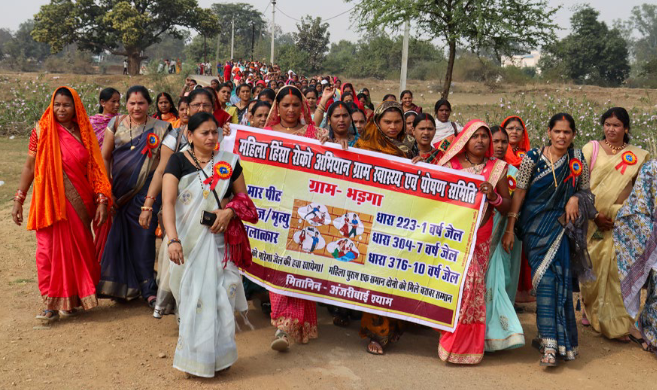
Mitanins often write songs and slogans about their experiences and activism, which they perform during public rallies and public hearings and at Mitanin meetings and trainings. Mitanins use song to convey their lived experiences of the challenges of activist work, mobilising action against unfair practices. The songs on gender-based violence make a strong social and political commentary that is itself a form of resistance. As part of the research, Mitanins were asked to submit any songs they had written. The researchers received 30 songs written in Chhattisgarhi, Halbi, and Sadri. Of those 30, they selected 10 that focused on rights-based work for content analysis, using them as a tool to understand the relationship between collective identity and collective action.
In addition to the song analysis, between March and June 2022, the researchers conducted a state-wide survey, along with focus group discussions and in-depth interviews. The survey (n=558) aimed to establish what proportion of Mitanins are involved in multi-issue activism. It found that in the preceding three years, 84% had taken rights-based action in at least one of three domains: food security and nutrition (68%); health care (56%); and gender-based violence (21%). They refer to these actions as "rights-based" because they involve negotiating with and confronting local elites and government officials, as well as writing formal complaints to government officials. Mitanins also provide information to community members about their rights and entitlements to health programmes, food security, and nutrition under government programmes.
The researchers propose a composite definition of the collective identity of Mitanins based on the words that several of them used during interviews and discussions: "A sense of solidarity that all Mitanins share with the community they serve, and belong to, and a feeling of sisterhood with other women and each other. It is the shared experience of being a group of empowered women with a common mission who must use their knowledge and compassion to support the people they serve, especially the marginalized, in every aspect of their life. The value system underpinning their mission dictates that people should not be denied their rights, and marginalized people should not be treated unfairly by the state."
The paper argues that the collective identity of the Mitanins is central to their work defending the social and economic rights of their community. Collective identity often plays an important role in social movements for people's economic and political rights. However, government-funded workers rarely get involved in such movements. (At the inception of the Mitanin programme, Mitanins were considered volunteers - honorary, unpaid community-based mobilisers and health educators - and not government employees. In 2005, with the introduction of the National Rural Health Mission, Mitanins started getting paid, yet "this did not negatively influence their autonomy as they were still not government employees".)
The qualitative data showed that the Mitanins' collective identity is layered. They are more than just frontline health workers in a government-run programme; they are also problem-solvers (addressing the problems facing people in their community, and showing solidarity with the most marginalised sections of society) and activists (struggling for the rights of the people they serve). For example, the songs show that Mitanins feel people's suffering deeply and share a sense of solidarity with them. Health-related slogans that Mitanins have written also emphasise the right to free health care and motivate everyone in their communities to exercise this right. The songs also assert people's right to dignity and respect in healthcare settings and when interacting with health workers. Interview data also show that Mitanins believe that people view them as community leaders who are equipped with knowledge and information about entitlements and rights that is otherwise difficult to access. Mitanins find their activist work meaningful, explaining that it gives them a sense of purpose. They draw this meaning from the concept of solidarity, which they share with the community that they serve and to which they belong.
The researchers argue that the Mitanins' collective identity was formed due to two main factors:
- The programme's movement-building approach - Two aspects of the movement-building approach were critical to building the Mitanins' collective identity: the selection process, which encouraged community participation and ownership; and the focus during training on a rights-based approach (rather than a biomedical approach) to health and its wider determinants. From the beginning of the program, women who cared about the well-being of the community, showed interest in working for people's welfare, and displayed leadership skills were the ones who volunteered to work for the people, as community health workers. Over time, this approach meant that Mitanins were able to gain the trust and respect of the community.
- The degree of autonomy enjoyed by Mitanins - The voluntary nature of their work allows them to retain their autonomy vis-à-vis the health system bureaucracy. Mitanins believe they are available to the community 24/7, because they are not bound by fixed hours of work. They describe themselves as linked to government but not government employees. However, the voluntary nature of their work makes their working conditions highly precarious.
Furthermore, the Mitanins' collective identity is strengthened through:
- The support they derive from their supervisors, training sessions, formal meetings, committees, and the forums for collective learning. For example, annual training sessions conducted by SHRC usually take place in government buildings across the state, when between 300 and 400 Mitanins meet at district level and stay together for more than a week, creating an atmosphere of solidarity and allowing for sharing of collective struggles, in addition to technical learning. Each annual training event includes at least one session on rights-based work. Mitanins also mentioned the role of formal meetings like para-baithaks and sankul-baithaks (habitation- and cluster-level meetings), and the information about health entitlements that is shared during those meetings, as something that empowers them to continue advocating for people's right to health.
- The fact that Mitanins are all women, as are the majority (90%) of trainers. The Mitanin programme is also run and coordinated largely by women. Mitanins have been able to forge solidarity with each other, their female supervisory cadre, and other women in their communities. However, the notion of sisterhood between Mitanins is not free of prejudice and discrimination.
The researchers observe that, over the past 21 years, the Mitanins' activism in the various domains they engage with has gradually evolved. Often, Mitanins work with other Mitanins and their supervisors who offer support to bring up contentious issues in front of local elites, the panchayat. This has been possible because of a sense of trust and sisterhood among Mitanins. They also receive support from community members (villagers), particularly on matters of food security. However, Mitanins have not been able to have a similar impact on issues of gender-based violence. They find it challenging to address gender-based violence due to stigma, and hence the lack of community support on this issue.
In conclusion: "The Mitanins' evolving collective identity shows that when community-based workers (health workers in this case) are viewed as more than link workers, and supported to combine their work with rights-based advocacy, they can defend community rights, and even become community leaders."
- Log in to post comments