










































Effects of an E-Reader Intervention on Literacy, Numeracy and Non-Verbal Reasoning among Adolescent Girls in Zambia: Evidence from a Randomised Controlled Trial
Population Council (Mensch, Haberland, Jackson-Hachonda, Chelwa, Nyirenda, Chuang, Polen, Psaki, Kayeyi, Mbizvo); consultant (Soler-Hampejsek); University of California (Digitale)
"...e-readers with engaging books along with facilitated book groups have the potential to enhance basic literacy and non-verbal reasoning ability in the short term with possible longer-term consequences for the health and wellbeing of young women in a low-income setting."
Data from the Adolescent Girls' Empowerment Programme (AGEP) in Zambia indicate a low level of literacy even among girls who finished primary school. One likely factor is that, as of 2011, only about one-fifth of students in each district of Zambia had access to a textbook in English, which is the language of instruction starting in Grade 5. The primary research question this 3-arm randomised control trial (RCT) attempted to answer is whether GirlsRead! Zambia - an e-reader intervention embedded in a "safe space" platform for students in Grade 7, the last year of primary school - improved literacy. The study also investigated the effect of the intervention on numeracy and non-verbal reasoning.
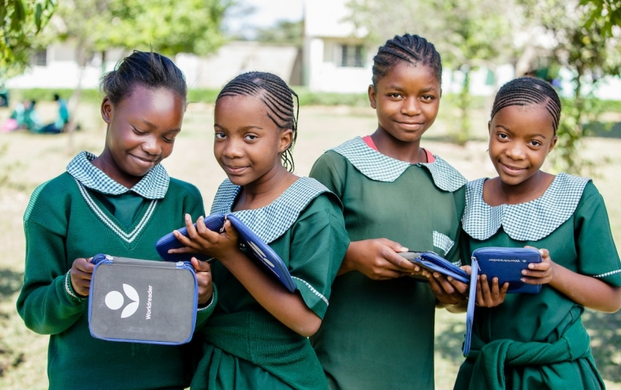
As part of GirlsRead!, e-readers were each loaded with approximately 100 books - primarily fiction written in English by African authors curated to be engaging to young people; many of the novels include strong female protagonists and non-traditional gender roles. The e-readers were charged using locally sourced solar panels installed on school roofs, and the girls were permitted to take them home during the project's duration to use for reading both on their own and with siblings and caregivers.
E-reader activities took place in the context of safe space groups, which are designed to build girls' assets and lessen their social isolation. The groups met nearly weekly over a period of 6 months, after school hours, and were led by two trained female mentors, a teacher at the school, and a community member. The sessions focused on an empowerment-based curriculum [PDF] that covered human rights, gender equality and norms, sexual harassment, prevention of HIV, pregnancy and contraception, communication skills, self-esteem, decision-making, and financial education.
In addition to engaging family members/caregivers through reading at home, four community engagement trainings were conducted with adults who influence girls' opportunities and attitudes towards education to attempt to create a supportive environment for gender equality, literacy development, and secondary school attendance and completion.
The study, with a sample of 1,299 adolescent girls at baseline, was conducted in Ndola and Chingola in Copperbelt province, and in Lusaka. Selected primary schools were randomly assigned to one of three arms: (i) e-readers provided within a safe space group platform plus community engagement activities; (ii) safe space groups plus community engagement activities; and (iii) control. There were 1,178 girls at endline (Arm i: 374, Arm ii: 425; Arm iii: 379). The endline survey was conducted between March and May 2018, approximately 6-8 months after the completion of the intervention.
The results of the evaluation indicate that girls in the e-reader arm scored significantly better on two of three basic literacy assessments than girls in the control arm; this was not the case for girls in the safe-spaces-only arm. Girls in the e-reader arm also scored significantly better on the non-verbal reasoning assessment than girls in the control arm.
Specifically, the scores on the basic literacy assessment increased for all arms but more so for the arm that included the e-reader and facilitated book group: 0.233 (56.3%) for the e-reader arm compared with 0.155 (44.8%) for the safe spaces only arm and 0.140 (34.9%) for the control arm. The research also showed that exposure to the e-reader improved non-verbal reasoning: Girls in the e-reader arm scored .363 points (2.3%) higher than girls in the control arm. Per the researchers, it is likely that exposure to books and facilitated discussion of books was sufficiently stimulating to improve girls' reasoning ability.
In terms of reading behaviour, the research showed that in the e-reader arm immediately post-intervention, 76.7% of girls reported reading outside of safe space meetings that was not schoolwork compared to 63.3% in the safe spaces arm and 65.0% in the control arm. (Differences between the e-reader arm and the safe spaces arm, and between the e-reader arm and the control, are significant at p < .001, whereas the difference between the safe spaces arm and the control arm is not significant.) The percentage of girls who spent an hour or more on average each week reading also was greater immediately post-intervention for the e-reader arm: 47.1% versus 37.1% in the safe spaces arm and 33.0% in the control arm.
Reflecting on the findings, the researchers note that, due to the rapid pace of technological change in sub-Saharan Africa, e-readers and mobile access to books "are potentially a more realistic and cost-effective long-term solution to the chronic shortage of reading materials than expanding access to paper books....As prices fall, e-readers or other digital devices can bridge the literacy and digital divides by inexpensively providing immediate access to thousands of informational resources....Further, compared to tablets or computers, e-readers are single-function devices, which can only be used for reading and not for playing games or searching the internet." Notably, despite the fact that girls kept their e-readers with them, a very small number of e-readers were lost, stolen, or broken by the end of the intervention.
"That said, gains documented in this study are a result of an intervention package, not simply the delivery of e-readers. Ongoing costs such as safe spaces mentors...were all necessary for the smooth functioning of the programme."
In conclusion: "This analysis of the effect of a relatively short-term 19 session pilot intervention among Zambian school girls shows that, in a setting where books are scarce, provision of e-readers with engaging content primarily written by African authors and lesson plans for mentors to read selected books with students has the capacity to improve English literacy and non-verbal reasoning....The implications of low levels of educational attainment and elevated levels of illiteracy for the health and well-being of young women and their offspring are profound."
Journal of Development Effectiveness 2021, Vol. 13, No. 3, 247-75. https://doi.org/10.1080/19439342.2021.1953566. Image credit: John Healey
- Log in to post comments