










































Extreme Dialogue
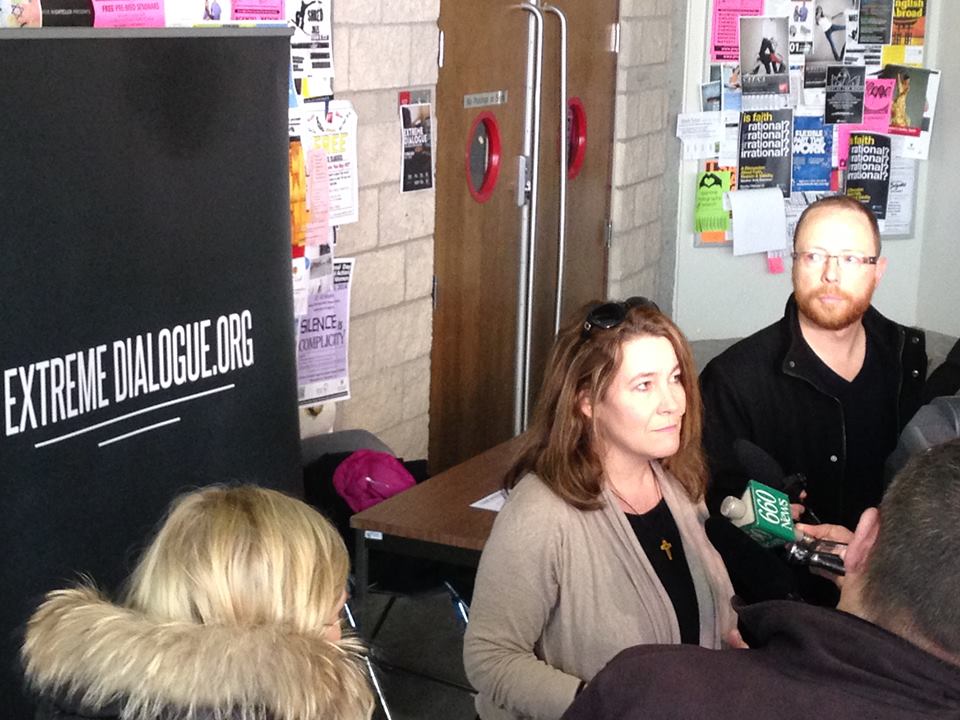
Extreme Dialogue aims to build resilience to radicalisation among young people through a series of open-access educational resources and short films that foster critical thinking and digital literacy skills. Extreme Dialogue encourages safe, constructive discussions around extremism and radicalisation in educational or community settings in the United Kingdom (UK), Canada, Germany, and Hungary. Its aim is to reduce the appeal of violent extremism and offer a positive alternative to extremist material and propaganda found online.
The Extreme Dialogue website features documentary films in which Canadians and Europeans affected by violent extremism share their stories. They feature: a former member of the extreme far-right in Canada; a mother from Calgary whose son was killed fighting for ISIS in Syria; a youth worker and former refugee from Somalia, a former member of the Ulster Volunteer Force (UVF) whose father was killed by the Irish Republican Army (IRA); a former member of the now banned UK Islamist group al-Muhajiroun; a Syrian refugee now living in Berlin, Germany; and a member of a Roma community in Hungary targeted by far-right demonstrations. The first-person experiences are meant to create a powerful viewing experience, helping the audience to relate and sympathise.
The website also provides free, open-access educational resources for young people aged 14-18 to build resilience against extremism through active discussion and enhanced critical thinking via classroom activities and group exercises. Consist of a Prezi presentation and a resource pack, the resources are also intended to increase the confidence of teachers and those working with young people in exploring what can be a difficult topic in a safe and constructive way. For further guidance about the teaching approach and how to deliver the resources, see the 37-page teacher's handbook [PDF].
Extreme Dialogue also provides training and delivery guidance around the use of the films and resources with young people in order to give teachers and youth practitioners the confidence needed to enable debates about sensitive issues.
Funded by Public Safety Canada via the Kanishka Project and co-funded by the Prevention of and Fight against Crime Programme of the European Union, Extreme Dialogue has brought together partners the Institute for Strategic Dialogue, filmmakers Duckrabbit, and the educational charity Tim Parry Johnathan Ball Foundation for Peace. Extreme Dialogue in Europe is supported by project partners West London Initiative in the UK, Cultures Interactive in Germany, and Political Capital in Hungary.
All films and resources are freely available online on the project website in English. Films and resources are also available in French, German, and Hungarian, and the films are accessible in British Sign Language (BSL) on request.
"Using Social Media to Communicate against Violent Extremism" [PDF] and Extreme Dialogue website, both accessed on December 9 2016, and email from Lucie Parker to The Communication Initiative on January 5 2017.
- Log in to post comments