










































Formative Research on Perceptions Regarding Vaccine for COVID 19: A Qualitative Study in India
"While vaccine acceptance is high among the community members, some apprehensions and hesitations too cropped up during the discussion, which should not be ignored for increasing the acceptance rate of COVID-19 vaccine."
In India, there is limited awareness of, and infrastructure and systems for, adult immunisation. In this context, India's Centre for Media Studies (CMS) conducted this qualitative, formative research study to inform risk communication and community engagement (RCCE) for COVID-19 vaccination, which was initially only available to adults. The data collection was undertaken just prior to the COVID-19 vaccination drive among healthcare workers, a priority population, which began in mid-January 2021. The intention was to use the findings (e.g., about perceived barriers and motivators for increasing confidence and trust in vaccines) to guide communication when vaccination for the general public was initiated.
The study was conducted in the last week of December 2020 in Andhra Pradesh, Bihar, Odisha, Madhya Pradesh, and Rajasthan. Participants were uniformly distributed across rural and urban locations, gender and age group, and socio-economic classification (SEC) categories. In all, 120 triads (groups of three physically distanced people), 50 in-depth interviews (IDIs) at the community level, and 25 key informant interviews (KIIs) with doctors and frontline health workers (FHWs) were conducted across the five study states.
Key findings:
- Popular name: In most of the triads and IDIs, participants across states, locations, gender, age, and SECs identified COVID-19 as "Corona".
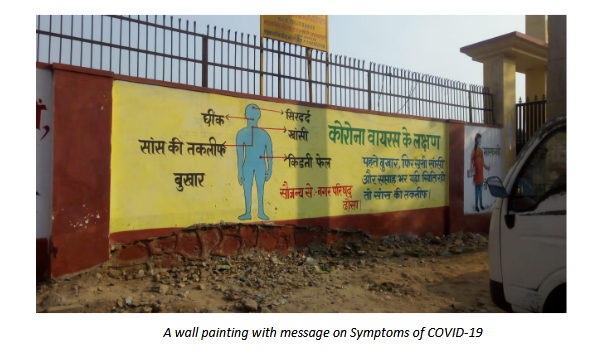
- Symptoms: Almost all participants were well informed about common symptoms.
- Precautions: There was high awareness about precautions against COVID-19, such as hand washing, wearing masks, and physical distancing.
- Reliable sources of information on COVID-19: In urban areas, television and newspaper, as well as views and opinions of prominent persons, were cited as reliable sources of information. In slums and low-income colonies, FLWs (e.g., auxiliary nurse midwives (ANMs) and Anganwadi workers) were also identified. In rural locations, the ANMs and accredited social health activists (ASHAs), who are from the local community and are in regular contact with the community members, were also considered reliable sources of information. Other preferred sources in rural areas were Panchayati Raj Institution (PRI) members and TV. Social media was mentioned as a preferred source by more people during discussions in urban areas, and by youth. Among sources of information preferred for vaccines, healthcare workers mentioned health department bulletins, technical guidelines, online videos, and trail reports, in addition to the common sources as also mentioned by general population participants.
- Perceived threat from COVID-19: Most of the participants during triads, particularly in rural locations of all states and youth in both urban and rural locations in most of the states, perceived COVID-19 to be a low threat, primarily due to the lesser number of COVID-19 infected cases reported in their community or neighbourhood. Other reasons included their faith in self-medication with herbs and the self-belief of strong immunity. ("The self-perceived notion of low or no threat from COVID-19 is a serious concern to be addressed emphatically.")
- Perception about the vaccine's effectiveness: Based on what they had read or heard about the vaccine, most of the community participants during triads and IDIs expressed high confidence in the vaccine's effectiveness, as it was developed under the close supervision of the government. A few participants, however, across all study states, had apprehensions due to the lack of information available in the public domain on side effects of the vaccine or because they felt that vaccine was made available in a very short period of time and has not been tested on all age groups.
- Eagerness to get vaccinated: Most of the participants during triads and IDIs, both men and women, in rural and urban locations across study states showed eagerness to get vaccinated. People with limited resources said they would give preference to vaccination over other needs in the family, even if they have to pay. These data suggest that vaccine acceptance will be high, as it is expected (and preferred also by the community) that vaccination will be done at a government facility monitored by government agencies. Reasons for trust in these facilities include: they are easily accessible; they have better-trained health providers, without bias; they will offer a genuine vaccine; and the vaccines are likely to be made available for free or at a nominal fee.
- Willingness to pay: The majority want the COVID-19 vaccine to be made available free of cost, or at a nominal fee, particularly to those who are economically poor, both in rural or urban locations. Family size, loss of livelihood due to the COVID-19 pandemic, and the lockdown were key reasons cited to make the vaccine available free of cost.
- Priority groups for vaccination: The community members agreed with the government's decision that healthcare workers should be vaccinated first because they are at a higher risk of getting infected. Others in priority groups were senior citizens, people with co-morbidities, and family members who go out for work (the main bread earners). Youth, children, and women were considered the least prioritised group for vaccination due to reasons like strong immunity (youth and children) and the fact that they don't go out frequently due to restrictions on their movement (women).
- Vaccine hesitancy (VH): Most participants did not disclose any self-hesitation for COVID-19 vaccination. However, from the community perspective, some opined that initial hesitation is to be expected by some. Key reasons for VH included: fear of side effects, price of the vaccine, accessibility of vaccination centre, rumours about vaccine efficacy, perceived self-immunity, and faith in naturpathy, among others. No distinct hesitation for the COVID-19 vaccine was observed by any of the participants' profile criteria like locations, gender age group, or SEC.
- Motivating factors and barriers for vaccination: Motivating factors to go for vaccination, across states, include: trust in source(s) of information on vaccination; low/no cost of the vaccine; ease of reaching vaccination centre; and provision of regular updates on adverse events following immunisation (AEFIs), side effects, and success rate of a vaccine. Barriers include rumours, incorrect/partial information, distance to vaccination centre (in rural areas), complacency, and self-perceived notion about no threat from COVID-19 (particularly among the rural population and youth). In addition, trust in natural remedies poses a challenge for the acceptance of vaccination. It was also feared that women may stay away from the vaccination drive either on their own or due to being prohibited by their family members.
Taking a cue from the motivating factors and barriers, as well as the vaccine eagerness, acceptance, and hesitancy and preferred sources of information, the two broad parameters for communication messages and strategy include:
- Motivational messages:
- Corona is life-threatening, and a vaccine is the only solution.
- In particular, elderly people and those with co-morbidities have lower immunity and so should take the vaccine.
- Comparison with the success of the polio vaccination campaign.
- Information about the success rate of vaccine; evidence of no/manageable side effects.
- Low/no price of the vaccine.
- Endorsement by a celebrity or renowned personalities and prominent political leaders.
- Factors influencing the communication strategy:
- Vaccine acceptance and trust: vaccination of prominent personalities; engagement of influencers for disseminating messages; vaccination at government-monitored facilities.
- VH: accessibility of vaccination centre (distance travelled to reach); cost of vaccination; concerns about efficacy and side-effects; and low perceived threat.
This formative study provides evidence for RCCE strategies to be developed for COVID-19 vaccination in India by the Ministry of Health and Family Welfare (MoHFW), the United Nations Children's Fund (UNICEF), the World Health Organization (WHO), and other partners. Suggestions:
- There are some trusted sources of information that will be critical in developing confidence and reducing hesitancy for vaccination. FHWs including ANMs, ASHAs, and Anganwadi workers, especially in rural areas and also in urban slum/low income areas, are critical sources of information that people believe and trust. In fact, they cross-validate information from other sources like television and newspapers, social media, and healthcare workers. Therefore, it is critical to ensure that correct and consistent information and capacity-strengthening efforts are made with such FHWs. Other local trusted sources, can be further strengthened by having important leaders, eminent scientists, health experts, and doctors addressing the issues or regularly participating in discussions held on different platforms. WhatsApp messages among friends and family are also considered as a reliable source for information on COVID-19 related regular updates. In this study, it was noticed that consistent information across various sources when reinforced is retained and remembered. Therefore, the use of multiple mediums and platforms with the same, correct, and consistent messages will be critical as the vaccination drive is initiated in the country.
- While there is an eagerness for the vaccine across the states, locations, class, and gender of participants covered in the study, there was some hesitancy visible both for self and for community members. The study brought out apprehension about vaccine effectiveness even by a few healthcare workers. Hence, it is important to raise their confidence levels by providing regular scientific communication messages. Doing so will, in turn, have a larger ripple effect on the community served by these healthcare workers in increasing the trust in the vaccine.
- COVID-appropriate behaviour (CAB), such as wearing masks, is diminishing day by day among community members, even though the vaccination drive has yet to start. Reiterating messages on CAB to be followed pre, during, and post vaccination should be a top priority in messaging across all mediums. Enforcement agencies need to continue being alert and strict to ensure CAB is being practiced in public spaces.
UNICEF IEC eWarehouse, October 29 2021. Image credit: CMS
- Log in to post comments