










































Girls Decide: Stand up for Choice on Sex and Pregnancy
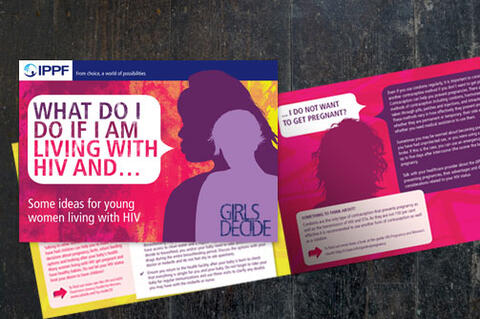
Implemented by the International Planned Parenthood Foundation (IPPF), Girls Decide is a communication initiative motivated by the belief that young women and girls should be empowered in order to make their own choices about their happiness, health, and development, including sex and pregnancy. Its purpose is to highlight the importance of girls' and young women's sexual and reproductive lives for both individual and global development and aims to ensure governments around the world to adopt policies that work for girls.
Girls Decide primarily uses the tools of printed materials and video to provide information and bolster girls' ability to protect their own sexual and reproductive health (SRH) rights. For example, IPPF produced a guide (in English, French, and Spanish) called "I Decide: Young Women's Journeys to Seek Abortion Care". It highlights the importance of empowering young people so they can accurately assess information that is available to them and access high quality services when needed. Various videos have also been produced as part of Girls Decide. For example, IPPF Member Association of the Republic of Macedonia, Health Education and Research Association (HERA) produced a short film entitled "Decision". This youth-led film unveils myths associated with the use of the birth control pill. It will be used in peer education programmes to offer high school students information on modern means of contraception. To access all Girls Decide resources, click here.
Another key strategy is the use of awards and recognition. The Girls Decide competition was designed to support IPPF's young volunteers to implement activities that promote positive approaches to girls' sexuality and aim to improve their confidence to make decisions with regard to issues around pregnancy. Selected proposals received small grants and technical support. For example, in Namibia, a youth group established 3 groups of 15 girls. Each group focused on a specific medium of information delivery: radio, school outreach, and community information services. The 3 groups developed their own materials and used them when conducting information sessions with other girls on SRH - giving specific attention to types of contraceptive methods, providing age-appropriate information, encouraging girls to choose to be sexually healthy, and giving girls information so that they can establish a healthy sexual identity.
Girls, Rights, Sexual and Reproductive Health, HIV/AIDS.
According to IPPF, "[r]ealizing girls' and young women's sexual and reproductive health and rights is a cornerstone of social and economic development and a human rights imperative. However, around the world, girls and young women are often denied their sexual and reproductive rights and the opportunity to make informed decisions about their sexuality." IPPF cites the following statistics:
- Adolescent girls aged 10-19 account for 23% of the global burden of disease due to pregnancy and childbirth.
- An estimated 2.5 million adolescents have unsafe abortions every year, and these account for 46% of deaths related to unsafe abortion worldwide.
- Newborn mortality constitutes 37% of childhood deaths under age 5, and, when maternal death occurs, child mortality is doubled.
IPPF website, December 30 2011.
- Log in to post comments