










































Global Citizenship Education: Preparing Learners for the Challenges of the Twenty-First Century
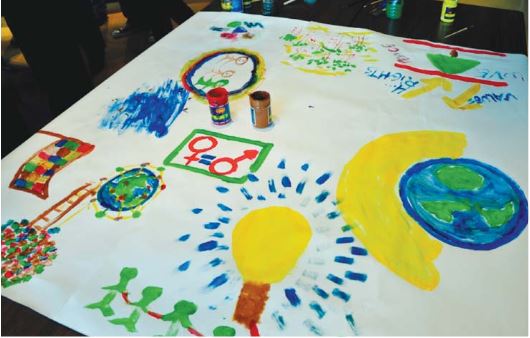
"For UNESCO, global citizenship education (GCE) develops the knowledge, skills, values and attitudes learners need to build a more just, peaceful, tolerant, inclusive, secure and sustainable world."
According to the United Nations Educational, Scientific and Cultural Organization (UNESCO): "Building on the conclusions of two international conferences dedicated to GCE, this publication aims to:
- Improve understanding of GCE as an educational approach and its implications for education content, pedagogies and approaches;
- Identify innovative approaches and good practice in GCE globally; and
- Share lessons learned and pathways to scaling up GCE."
This review found that, while GCE has been applied in different ways in different contexts, regions and communities, "it has a number of common elements, which include fostering in learners:
- an attitude supported by an understanding of multiple levels of identity, and the potential for a 'collective identity' which transcends individual cultural, religious, ethnic or other differences;
- a deep knowledge of global issues and universal values such as justice, equality, dignity and respect;
- cognitive skills to think critically, systemically and creatively, including adopting a multi-perspective approach that recognizes the different dimensions, perspectives and angles of issues;
- non-cognitive skills including social skills such as empathy and conflict resolution, communication skills and aptitudes for networking and interacting with people of different backgrounds, origins, cultures and perspectives; and
- behavioural capacities to act collaboratively and responsibly to find global solutions for global challenges, and to strive for the collective good."
GCE can be part of existing subjects (civic or citizenship education, social studies, environmental studies, geography, or culture) in formal school settings or can be its own curricular subject area. Less formal approaches can include: the use of information and communication technology (ICT) and social media, sport competitions, and the use of art and music, as well as "youth-led initiatives employing a wide variety of approaches." Enabling conditions for the promotion and implementation of GCE include: "the existence of an open environment for universal values, the implementation of transformative pedagogy and support for youth-led initiatives."
The way forward, as stated in the review, includes:
- mainstream GCE into relevant existing programmes and document its practice.
- provide continuous professional development for educators and transformative paedagogy.
- promote the "consistent and meaningful involvement of young people in the design, implementation, monitoring and evaluation of GCE. To do so, partnerships with civil society are needed and the utilization of ICTs, including social media, is critical."
- create an informal network, possibly a virtual network, to share experience and resources.
- advance consensus on indicators to measure GCE.
- engage with stakeholders across "multiple sectors, actors and levels."
UNESCO website, August 8 2014. Image caption/credit: Participatory activities in a session led by Injairu Kulundu at the Global Citizenship Education Forum, Bangkok, Thailand, December 2013. © UNESCO/S. Chaiyasok
- Log in to post comments