










































Great Idea
"Great Idea makes use of...ICT [information and communication technology] and media to amplify the effect of good quality lessons to be used inside and outside of schools."
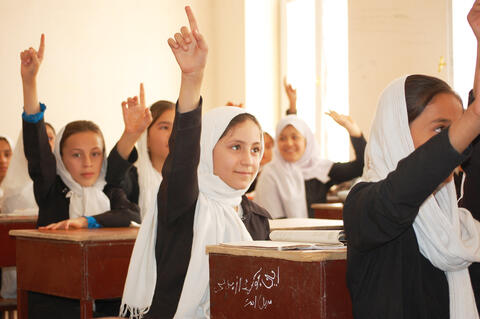
Great Idea is a mobile- and distance-learning project for secondary education in Afghanistan to increase the quality of and access to education for (girl) students. Great Idea taps into the potential of mobile technology to develop distance learning opportunities for both students and teachers at the secondary school level. Its purpose is to:
- support the Ministry of Education in the provision of quality secondary education to 21 secondary and high schools in the districts centres of Sayed Khel, ChariKar, Bagram, and Jabal Saraj through distance learning (DVD, radio, and the support of mobile communication);
- increase the enrolment of girls in the selected secondary schools and decrease the drop out of students during the course of the secondary education cycle; and
- raise awareness on the importance of education, especially for girls, and strengthen involvement of parents, pupils, teachers, religious leaders, and other community members in the 4 selected districts of Afghanistan.
Great Idea uses modern mobile technology to supplement subjects of Math, Physics, Biology, Chemistry, and English for grades 7-12 on a daily basis. (The incorporation of English as an additional course is designed to increase job opportunities for girls.) Lessons on the content, which is in line with the curriculum of the Afghan Ministry of Education, are pre-recorded in a TV studio in Kabul by master trainers to then be saved on micro SD cards and watched among those in and out of school. (The SD cards are distributed to schools, where the videos can be displayed by a mobile phone connected to a micro projector). The lessons are designed to help teachers in the classroom with good content knowledge and inspiring and interactive lesson methodologies. The same SD cards as provided for in school use can also be inserted into mobile phones (feature phones such as the Nokia C101). In this way, students can take home these SD cards for self-study. By using mobile phones, these videos have an even greater reach, as they can be spread amongst community members and out-of-school children. To date, the lessons have been recorded in Dari language. The languages of the video lessons will not be only in Dari language in the future but also in Pashto in order to extend the project to Pashto regions, such as Kandahar.
The project then supports teachers and students in understanding and teaching the curriculum - for instance, a mobile helpline allows for an interactive question and answer (Q&A) session with the master trainers after each broadcasted lesson. A competition is integrated into the lessons and facilitated through the mobile helpline. The competition encourages active participation and increases motivation. Students and teachers take part in separate competitions.
Great Idea has been developed with the input of project partners, teachers, students, and representatives. It has been tested and fine-tuned continuously with them. Teacher learning circles were established for participation, support, and promotion in the project. Four co-creation workshops were held over a period of 2 years in order to identify ways to improve the project and find a great solution together. More information about the co-creation method can be found on this page on the Great Idea website and/or in the white paper.
As part of Great Idea, efforts were made to raise awareness about the importance of quality education within the community. This is done by involving community members such as parents, teachers, and Mullahs in group sessions as well as through radio broadcasts.
Education, Girls
According to organisers, Afghanistan has suffered decades of war, civil unrest, deep poverty, and repressive governments. Although there has been progress since the fall of the Taliban (from a 4% enrolment in 1999 to 79% in 2010), education still faces significant obstacles in Afghanistan. Girls from rural areas and/or economically poor households are particularly disadvantaged. Their access to education is curtailed by factors ranging from early marriage to a shortage of female teachers. The chances of girls advancing to the secondary level of education are even slimmer: the net attendance rate of girls is more than two times lower than that of boys. Only one in five Afghan women aged 15-24 is literate. In a country where nearly half of the population is under the age of 15, the fate of education lies hand in hand with the fate of the entire country. The poor quality of both primary and secondary education in Afghanistan is caused by the lack of: thorough content-based knowledge; understanding and knowledge of effective teaching methods; safe, student-centred, conducive learning spaces; and low-quality teaching and learning materials.
The success of the project's first phase, between April 2011 and April 2013, reportedly led to a decrease in student drop-out rate, an increase in student test scores, and the promotion of teachers to higher grades. Interest has grown among the Ministry of Education, Provincial Education Department, community members, teachers, and students to continue and expand the project.
Butterfly Works, Coordination of Humanitarian Assistance (CHA), Oxfam Nobib, Saba Media Organization, Ministry of Education Afghanistan, Roshan, and 21 secondary schools in the Parwan province of Afghanistan.
Great Idea website, November 18 2016.
- Log in to post comments