










































From the Ground Up: Multi-Level Accountability Politics in Land Reform in the Philippines
Government Watch, or G-Watch (Isaac, Aceron); Rural Poor Institute for Land and Human Rights Services, or RIGHTS Network (Carranza); Accountability Research Center, or ARC (Aceron)
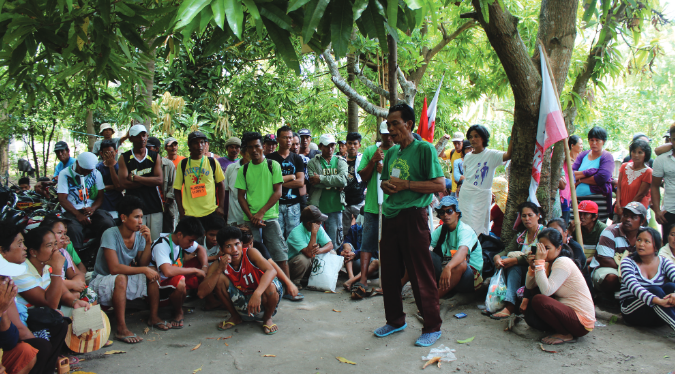
The case of the Peasant Movement of Bondoc Peninsula (Kilusang Magbubukid ng Bondoc Peninsula, or KMBP) sheds light on the contest over implementing land reform in the Philippines. This study narrates the struggle of KMBP through the lens of vertical integration - how campaigns target different levels of governance (village, municipality, national, etc.) to achieve meaningful change. Using vertical integration, the paper uses a new mapping tool to identify the wide variety of actions taken by KMBP and its partners, the level of governance they have targeted, and the level of intensity in which they were pursued. In addition to spotlighting the central role of peasant mobilisation in promoting redistributive policy implementation, this paper's broader takeaway emphasises the relevance of analysing accountability initiatives through mapping the varied repertoires of both pro- and anti-accountability forces.
Recognising that agrarian reform is critical for rural development and democratisation and necessary for alleviating poverty, in 1988, the Philippines enacted a land redistribution policy known as the Comprehensive Agrarian Reform Program (CARP). After almost three decades of implementation, an estimated 13% of the land targeted for redistribution remains in the hands of powerful landlords.
This paper focuses on redistribution action that has taken place in Bondoc Peninsula, a far-flung district located in the southernmost portion of Quezon Province. The Quezon Association for Rural Development and Democratization Services (QUARDDS) spearheads the campaign in Bondoc Peninsula and serves as the local non-governmental organisation (NGO) partner of the Katarungan/RIGHTS Network. Operating throughout the province of Quezon, QUARDDS provides legal and technical assistance to KMBP, a district-wide peasant federation that is also a member of Katarungan.
KMBP uses an approach involving radical peasant action to compel the state to implement its own agrarian reform programme. As the nascent peasant movement grew more assertive in the 1990s, hacienda owners responded with a series of actions to prevent land reform. This included various coercive measures, ranging from harassment and verbal threats to the forcible ejection of tenants and murder. Nonetheless, through the actions of KMBP, in addition to the transfer of private lands, 4,000 hectares of public lands are now under direct peasant control. This was due to a strategy that combined archival research and an ongoing boycott, which featured more than 800 peasant families joining in this form of direct action.
The paper maps the actors in Bondoc Peninsula's agrarian reform campaign and the actions they have undertaken across various levels to advance agrarian reform implementation. It does so by using a modified Scaling Accountability Mapping Matrix, which in its original formulation has two dimensions: Constituency-Building, which maps civil society actors; and Interfaces with the State, which identifies civil society actors' varied terms of engagement for monitoring or advocacy campaigns. In the modified version presented here, a third dimension is added: the Actions of Anti-Accountability Forces. This component emphasises that any initiative that seeks to attain reforms by making those with power and authority accountable is likely to face opposition by, for instance, landowners, their private goons, Maoist guerillas, and other allies, such as state or bureaucracy officials and even certain farmer-residents in the area.
Using this tool, a review of the strategy employed by both the KMBP and the anti-accountability forces shows the following major themes:
- Constituency-building: As shown in Table 7 on page 28, grassroots organising and awareness-building involved components such as coalition-building, mass collective action, public education (e.g., through networking with the media (especially radio and newspapers) and with international civil society organisations, or CSOs), independing CSO monitoring of policy implementation, horizontal exchange of experiences, participatory processes (e.g., discussions) to develop CSO policy alternatives, and strategic use of information and communication technology, or ICT (e.g., online presence through the Katarungan/RIGHTS Network website).
- Interfacing with the state: As shown in Table 8 on page 30, components included policy advocacy with executive and legislative bodies, legal actions, participation in "invited spaces" and "claimed spaces", public protest, and engagement with public accountability agencies.
- Action from anti-accountability forces: As shown in Table 9 on page 32, these actions can be categorised into two broad types: 1) proactive efforts to influence decision-making processes and policy implementation (e.g., engaging in elections, influencing appointments, making sure the person in charge has smooth working relationships with them, etc.); and 2) reactive actions against efforts to hold the forces of impunity to account (e.g., harassment, legal cases, counter-propaganda/misinformation campaigns (involving mass actions, fora, public meetings, use of ICT, media campaigns, and linkages with fellow anti-accountability actors) etc.).
In reflecting on these strategies and the actions that have been outlined throughout the paper, it can be observed that, to achieve scale, farmers in Bondoc Peninsula have created peasant formations at the village, municipal, and district levels, which are integrated into Katarungan at the national level. Each of these formations hold regular meetings and assemblies to elect their leaders, define their strategies, and discuss organisational concerns in the most democratic manner possible. Vertical integration is further facilitated by allied agrarian reform NGOs that provide technical and legal assistance. QUARDDS is playing this role at the provincial level, and the RIGHTS Network is playing it at the national level. The RIGHTS Network, for its part, provides legal, political, and technical support to KMBP farmers. It also helps to push their cases at the national level by facilitating dialogues with pertinent government agencies, engaging the media, and developing alliances with institutions such as churches and political parties. It has brought the spate of agrarian-related killings and harassments in Bondoc Peninsula to the attention of the international community by linking with solidarity groups such as the Philippinenbüro and the International Peace Observers Network (IPON). KMBP's participation in a national federation, on the other hand, enables Bondoc farmers to interact with rural citizens from other regions and provinces. This has allowed them to share their experiences and forge common strategies.
During the farmers of Bondoc Peninsula's two-decade campaign for agrarian reform, 10,000 hectares of land have been taken from some of the biggest landlords in the area and placed under the control of 3,800 tillers. In conclusion: "When Citizen-led and citizen-focused, a long and winding campaign becomes rooted in and anchored to the purpose of the action: to win a pro-people reform, sustained through solidarity, passion and vision for the future that promises better lives for the poor and marginalized who are bound to benefit from the success of the reform."
ARC website, January 17 2018 and August 25 2021. Image caption/credit: A community meeting in Hacienda Matias, where farmers discussed their issues and concerns about the implementation of agrarian reform. © Katarungan/RIGHTS Network
- Log in to post comments