










































Grounding Innovation in Pacific Media and Communication for Development Projects
RMIT University (Noske-Turner, Tacchi); Loughborough University (Tacchi)
"The communicative ecologies approach grounds our analysis of innovation, sustainability, and strategy in local contexts, enabling us to explore how the spread of digital technologies is being integrated into Pacific media and communication practices."
This research paper examines the Pacific Media Assistance Scheme (PACMAS) Innovation Fund (IF), which has opened up the media and communication for development field to new players in the Pacific Islands by funding small-scale, highly localised, low-cost initiatives. Authors Jessica Noske-Turner and Jo Tacchi examine the ways in which innovation was framed in the initiative and grapple with the question of what happens in terms of strategy when donors have less control over the focus of funded projects. Through an analysis of some projects undertaken as part of the PACMAS IF, they investigate what innovation means in this context, paying particular attention to how the spread of digital technologies is integrated into media and communication for development practices.
There is tension that the authors explore prior to detailing the research they undertook. The IF model allows for adaptive, locally driven, and complexity-based approaches. As such, it implicitly rejects cookie-cutter solutions that are universally asserted over the particularities of local places and realities. Monitoring and evaluation (M&E) often focus on how closely central strategic planning is delivered through implementation. Some argue that a more suitable focus for evaluation would be an initiative's ability to be adapted to local contexts and systems. In this article, Noske-Turner and Tacchi argue that initiatives like the IF require different criteria to evaluate value and outcomes.
The 14-country baseline study consisted of a desk review of existing literature and documentation, field visits by a team of research assistants to each of the countries, 212 interviews, and a verification process involving 28 participants from across the Pacific. Researchers for the Australian Research Council (ARC)-funded research project, Mobilising Media for Sustainable Outcomes in the Pacific Region, engaged with media and communication initiatives across the Pacific to develop an approach to the design and evaluation of media and communication for development (C4D). Organisers conducted a workshop with media and C4D practitioners from across the Pacific in Goroka, Papua New Guinea (PNG), a field visit and a second workshop in Vanuatu, interviews with media and C4D practitioners, and ongoing action research.
Donor agendas and funding approaches have a significant influence over the practice of media and communication for development in the Pacific, as outlined in the next section of the paper. The impetus for the introduction of an IF into PACMAS was in part a response to broader shifts at the policy and donor levels to incorporate more C4D approaches. While PACMAS continued to be located within governance frameworks, there was a recognition that using media to advance better governance required a broader focus on how people communicate, including such examples as FemLINKPACIFIC in Fiji and Wan Smolbag in Vanuatu. The maximum amount granted was AU$30,000, or, up to AU$50,000 if the project had a regional focus. Due to the smaller grant sizes, there has been a greater tolerance for risk compared to most funding schemes. There were 23 applications in the first round, growing steadily with each subsequent round to 60 applications in the fourth and final round. The groups funded through the IF included established organisations such as the Secretariat of Pacific Community and the World Association of Community Radio Broadcasters, medium-sized non-governmental organisations (NGOs), small and emerging NGOs, media outlets, training and education institutions, and small production organisations. As a funding model the IF pushes back against the dominance of donor agendas, funding community-led initiatives.
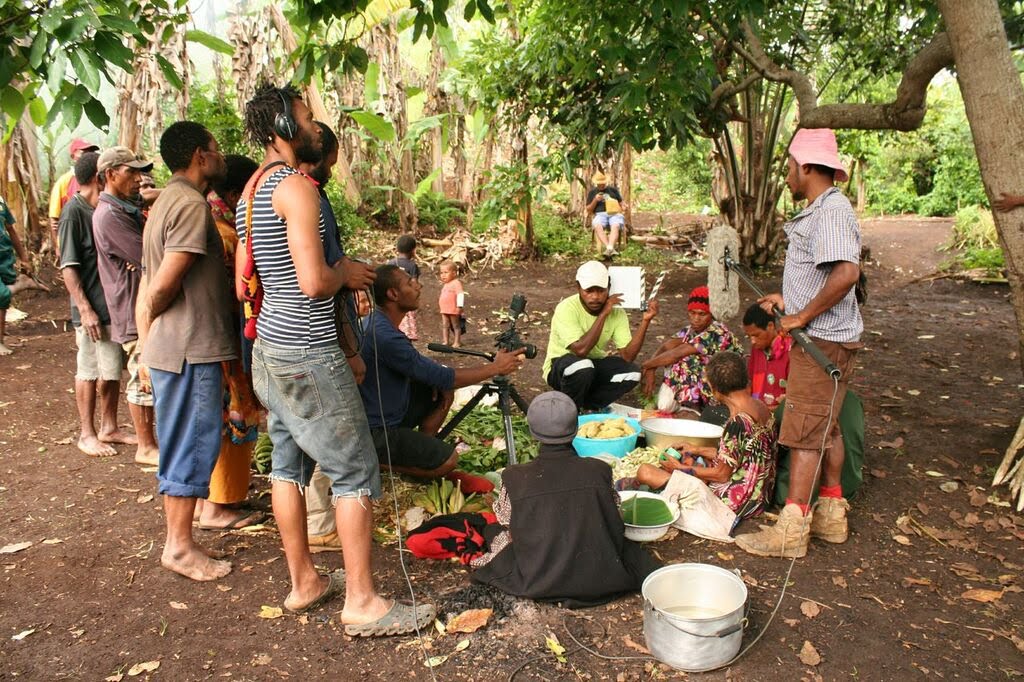
Noske-Turner and Tacchi suggest that the use of digital platforms and technologies is an interesting entry point to think about grounded innovation. The original intention for the PACMAS IF, according to the programme design document, related strongly to new media and technology. Stakeholders stressed their desire to innovate through: the creation of new media content (including social and citizen media); the trialing of new forms of communication that serve community groups; investigation of the potential of new media technologies; and engagement in training opportunities. One IF project that stood out as a tech-focused innovative project was M-Link, from Women in Business Development. M-Link created a mobile database for farmers, including access to crop and organic compliance information and a way to track the progress of participating farmers. While this and other projects most clearly include digital technology, a closer look at the spectrum of projects indicates a complex blending of analog and digital adapted to suit local communicative ecologies. The "communicative ecologies" concept highlights wider contexts of communication flows, channels, and practices, including formal and informal, technical and social, beyond Western-centric expectations of communication. The accessibility and functionality of mobile phones and other devices vary within and across countries and depend, to a large extent, on local infrastructures. This means recognising that communication may equally take place in haus piksas (village cinemas) in PNG or the airport runway in Tuvalu, where people gather of an evening, as well as mass media platforms such as film, radio, and newspapers. The paper provides several examples that highlight how digital and analog technologies are integrated in projects in the Pacific. "Taking a grounded view of innovation considers digital technologies as they are appropriated, adapted, and assembled to create something new. Ignoring this context risks imposing external conceptualizations and values about what constitutes the new or cutting edge, and can devalue such locally and relatively contextualized views."
Noske-Turner and Tacchi argue that, "far from a series of ad hoc, rehashed, nonstrategic projects, there is a strong continuity between many of the IF projects and larger, long-term, endogenous media and communication for development practices in the Pacific. What is clear from surveying media and communication for development practices in the Pacific is that there exists a particularly strong storytelling element. This takes many forms, from community-based drama, film, television, and video production, to music performance and production." Several examples are provided. Furthermore, along with a strong focus on and tradition of content production (both media and community-based), there is an emphasis on dialogue-based communication, either in association with content production or as the primary focus of media and communication for development initiatives. For example, the dialogue aspect is critical to Wan Smolbag's approach as a whole. As these and other examples illustrate, "there are some distinctive endogenous approaches emerging that emphasize storytelling and dialogue. Understanding and incorporating these endogenous approaches are likely to lead to more effective and sustainable outcomes, and the community-driven nature of the IF demonstrates how a more open funding model can encourage this in practice."
In conclusion, Noske-Turner and Tacchi suggest that narrow definitions of "strategic development" constrain the capacity of media and communication for development practitioners to effectively respond to local challenges and interests in ways sensitive to changing communicative ecologies. They argue that "projects funded through an IF model have the potential to be innovative in a grounded sense and sustainable if we rethink our notions of sustainability....Many of the projects work in ways that adapt to or build on existing communicative ecologies, integrating new and digital technologies and contributing to achieving locally defined goals and spaces for dialogue. These kinds of outcomes require different measures, with an eye to issues of continuity, groundedness, and local demand. It is helpful to begin by grounding notions of innovation when thinking about how new technologies are being used in media and communication for development in the Pacific."
Information Technologies & International Development, Vol 12, Issue 4, Winter 2016: Digital Media, Technologies and Social Change in the Pacific Islands, pages 59-69. Image caption/credit: Kole's Village, Bena: JIm Sari, Jenno Kanagio, Dilen Doiki, Paul Bebes, Nicky Tura. Photographer: Laba Kenny
- Log in to post comments