










































Happy Dampatti (Happy Couple)
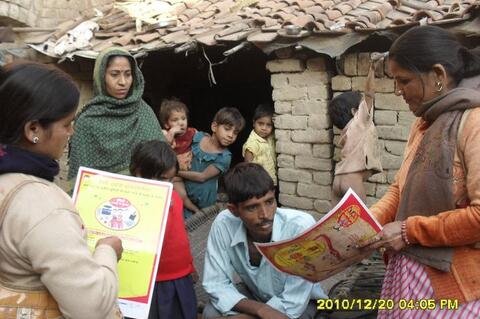
"Talking openly about family planning is not usual behavior for people residing in slums of Agra, India..."
Happy Dampatti (Happy Couple) is a social marketing and behaviour change communication (BCC) campaign using a variety of communication strategies in an effort to mobilise the community, engage the intended audience directly with family planning services, and seek and reward local role models. From December 20-26 2010 under the Urban Health Initiative (UHI), the Johns Hopkins Center for Communication Programs (CCP) piloted the Happy Dampatti (Happy Couple) contest in a 50,000 population slum cluster in Agra, a city on the banks of the river Yamuna in the northern state of Uttar Pradesh, India. The Happy Dampatti contest - now since expanded beyond its pilot run - identifies couples who have effectively integrated family planning in their lives and encourages them to share their family planning stories with their peers and on camera.
Going door-to-door, UHI peer educators clad in Happy Dampatti branded t-shirts reached more than 1,000 eligible couples in the intervention slums and encouraged them to participate in the contest. They communicated the fact that the 5 secrets of a "Happy Dampatti" include: spousal communication about the family's dreams, consistent use of contraceptives, immediate postpartum family planning, immediate post-abortion family planning, and male responsibility in planning for the future. Their promotion effort was aided by announcements from branded rickshaws and rickshaw microphone announcements, stilt walkers, wall paintings, posters and banners, radio promo spots, text messages (SMSs) sent to over 2000 mobile phone users with the contest signature jingle set as the ringtone on the cell phones of all staff.
Also included in the effort are "enrollment camps". The programme seeks to engage the community and draw people out of their homes for counselling on family planning and referrals to service, so couples had to visit the colourful Happy Dampatti enrollment camps to officially enroll in the contest. At these camps, trained staff counselled couples on family planning, assisting with choosing a method and promoting inter-spousal dialogue. Couples were referred to family planning services at local facilities. Staff also sold socially-marketed contraceptives. Over 3 days, more than 150 couples were counselled, over 100 packets of condoms were sold and more than 100 referrals were made for intrauterine devices (IUDs).
Happy Dampattis were selected through a range of activities, including games, a contraceptive quiz, personal family planning stories, and role plays. For example, existing successful contraceptive users recorded their stories about accepting family planning and overcoming barriers on video. These videos were judged by an independent jury who selected 12 finalists. At the Happy Dampatti main event on December 26, 5 overall winners were chosen through games and competitions, which were attended by over 3,000 people, as well as by senior government officials, public and private health care providers and the media. The event was telecast on two local television networks. The No. 1 Happy Dampatti was announced, but all of the couples were celebrated through local media (billboards, in the press, and on radio and television) channels as exemplary models for the use of family planning.
After the above-described pilot run of the contest, UHI scaled up the project in the city of Aligarh. Three Happy Dampatti contests were held in Aligarh slums during June 2011, with 4 more contests scheduled in other Aligarh locations starting in September 2011.
Click here to listen to the campaign song and to access other materials, including videos.
Family Planning.
JHUCCP estimates that over 210,000 people were reached through the contests directly and an additional million people were reached through related mass media.
The UHI, a Bill and Melinda Gates Foundation-funded 5-year endeavour, works to promote family planning in India and 3 other countries by increasing uptake of birth control and delaying and spacing methods and by promoting modern methods of contraception through the use of role models, mobile health applications, and entertainment education.
JHUCCP website, October 24 2011.
- Log in to post comments