










































The Health Shop: Applying Integrated Marketing Communication to Generate Demand for Malaria Testing in the Private and Public Sectors
"The impact of this campaign demonstrated that IMC can be successfully applied to health products, services and behaviours when promoted within a private sector development approach. Demand-side interventions should be a primary component of an intervention to introduce mRDTs [malaria rapid diagnostic tests] in the private sector in order to ensure appropriate uptake."
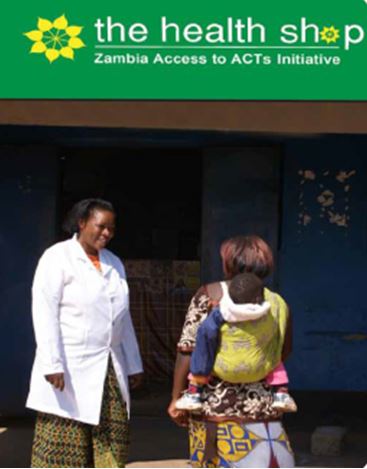
This 4-page brief discusses a pilot project to generate demand and uptake of artemisinin based combination therapies and malaria rapid diagnostic tests in Zambia using an Integrated Marketing Communication (IMC) approach. The project applied the principles of '4Ps' used in the private sector: product, price, placement, and promotion. This included branding drugstores and informal outlets offering artemisinin based combination therapies and malaria rapid diagnostic tests (mRDT) as 'The Health Shop.'
A 'dipstick study' was conducted at the outset of the intervention which identified barriers to testing before treatment, including "very little knowledge and awareness about the importance of testing for malaria before taking medicines, lack of mRDTs in the market, misunderstanding that mRDTs could also test for HIV and belief in traditional medicine's efficacy to some extent." It was found that consumers needed to better understand the purpose and administration of mRDTs, and needed more information on its effectiveness, safety, and cost. Consumers also expressed readiness to take the test at drugstores and informal outlets where they were already buying other medicines. The communication project’s behavioural goals were to "position malaria testing as the first action to take when feeling feverish, preferably in an accredited 'health shop'" and to ensure that service providers tested for malaria first before offering ACT.
As part of the intervention, the health shops in drugstores and informal outlets, were branded with signage, logo, and cheerful colours. The rapid testing was marketed as saving people time and money, so that "you can pay attention to more important things in your life such as family, work, business or education." The Health Shop was promoted through public relations, a highly visible launch, a radio and community-based drama, public service announcements, posters, brochures, t-shirts, etc. An independent evaluation was conducted in March and April 2011 using household survey data, client exit interviews, and mystery shopping.
Key findings are outlined as follows:
- "Integrated Marketing Communication can be successfully applied to health products, services and behaviours when promoted within a private sector development approach.
- Demand-side interventions should be a primary component of an intervention to introduce malaria rapid diagnostic tests in the private and public sectors for greater impact.
- Demand-side interventions can have impact not only on uptake of new services but also on changing care-seeking behaviours.
- Monitoring effectiveness of a communication intervention should be built into the intervention's monitoring and evaluation plans from the onset, allowing for progress tracking and identifying key outcomes."
Overall the project was found to increase access and testing for malaria as well as encourage health-seeking behaviours within the first 10 months. "Between baseline and endline, knowledge on ACTs and mRDTs increased in intervention districts over control districts. Awareness of ‘test before treat’ message increased from 43 percent to over 96 percent in the intervention districts. 'The health shop' branding impacted on the behaviour relating to malaria testing and treatment among users: footfall in 'The health shop' increased from 37 to 48 percent aided by the recognition of shops by visual triggers such as a poster, sign or sticker." In addition, it was found that consumers quickly moved from awareness (largely through radio spots and discussions) to accessing services at The health shops. As well, service providers benefited from increased clientele and profits due to the promotional campaign, which also identified which shops had been chosen as health shops.
Malaria Consortium website on July 3 2015.
- Log in to post comments