











































Increasing Influenza Vaccine Uptake in Children: A Randomised Controlled Trial
The Chinese University of Hong Kong (Yeung, Chan, Tam, Nelson); The University of Hong Kong (Tarrant)
Studies show that most Hong Kong parents are not aware of the Government's recommendation that young children should receive influenza vaccination, emphasising the importance of making this information concise and easily accessible to parents. In light of the low uptake rate of this safe and effective vaccine, the disease burden in Hong Kong children, and the lack of previous local studies, the researchers conducted a randomised controlled trial (RCT) to determine whether a communication-centred intervention package could increase influenza vaccine uptake in Hong Kong children aged from 6 to 24 months.
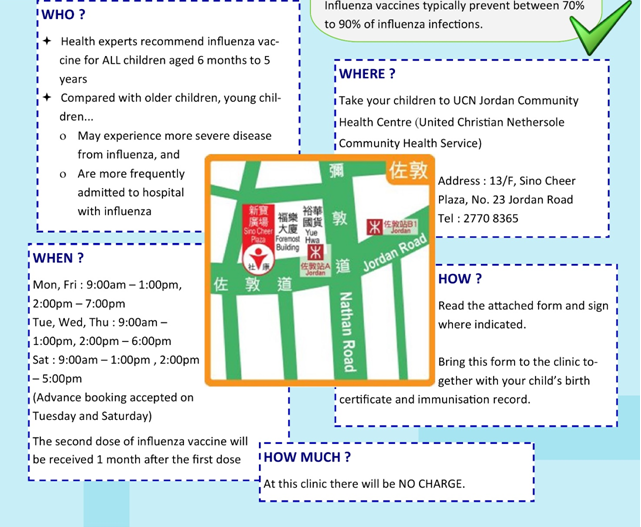
A total of 833 eligible mother-infant pairs were enrolled from 2 samples: families of children who had participated in a previous knowledge, attitudes, and practices (KAP) study (hereafter, group 1), and mother-infant pairs recruited from postnatal wards (hereafter, group 2). Control groups received publicly available leaflets about the Vaccination Subsidy Scheme (VSS), which encourages children aged from 6 months to below 12 years to receive seasonal influenza vaccination (influenza vaccine is not included in the Hong Kong Government's universal Childhood Immunisation Programme, or CIP). Intervention groups additionally received: (i) a concise information sheet about the risks of influenza to children and the benefits of influenza vaccination; (ii) semi-completed forms required for the VSS, with highlighted guidelines of where to sign the form and a reminder to take the child's birth certificate to the clinic; (iii) the contact number and address of a specific community health centre registered under the VSS that is in reasonable proximity to their home and that provides influenza vaccine without any additional cost above the subsidy and without the need for a prior appointment; and (iv) text message reminders for vaccination at one week and 1-2 months after the information package was provided. Enrolled mothers were contacted when children were approximately 1 and 2 years old to determine influenza vaccination status of the families and their plan to vaccinate their children. Also, at enrolment and at the end of the study, maternal attitudes towards influenza and its vaccine were assessed by a questionnaire based on the Health Belief Model.
By taking missing influenza vaccination status as unvaccinated to provide a conservative result, 38% (157/416) of intervention-children and 13% (54/417) of control-children received influenza vaccines by approximately 2 years of age. The intervention package effectively increased influenza uptake in 2-year-old children by an absolute difference of 25% (p-value <0.001). By the age of 1 year, 27% (114/416) of intervention-children and 5% (22/417) of control-children were vaccinated, and this provided an absolute increase of 22% in influenza vaccine uptake by the intervention package. Maternal influenza vaccine uptake in intervention group was higher during this 2-year period in those who had never been previously vaccinated. Mothers' self-efficacy regarding the use of influenza vaccine in her child - i.e., belief and confidence in her own ability to make a good decision - was also improved with the intervention.
With regard to mothers' attitudes, the phenomenon of decreased perceived benefits of influenza vaccine and increased perceived barriers of vaccination (developing immunity by getting the disease was better than getting a vaccine to prevent that disease, and too many vaccines can overwhelm a child's immune system) in the control-mothers at 24 months as compared to birth or 6 months was not observed in the intervention group. Intervention-mothers agreed, at the end of the study, that they had more access to the information they needed to make good decisions about vaccinating their children than at the beginning of the study. In both groups, recommendation from healthcare professionals, family, and friends remained an important factor when deciding whether to vaccinate their children but became comparatively less important at 24 months than at birth or 6 months of age.
The researchers reflect: "Although further study may be required, it is potentially a feasible intervention to increase influenza vaccine uptake in children in the community. Manpower required for implementation would not be large. Hong Kong's network of Maternal and Child Health Centres (MCHCs) would be a potential venue for delivery of such an intervention. MCHC nurses could provide similar concise information at the 6-month visit for routine vaccination and it would take around 5 min to explain the information and answer caregivers' queries. It is also technically possible to automate text message reminders but it would be slightly different from the intervention in this study as interactive response was provided in this study if the mothers had any query about influenza vaccination during the study period. Implementing the intervention in Hong Kong could provide a potentially large impact on influenza disease burden. This intervention package could result in a reduction in incidence of influenza hospitalisation in this age group ranging from 13% (62% vaccine effectiveness...with a 21% intervention impact) to 24% (68% vaccine effectiveness...with a 36% intervention impact)."
Vaccine (2018), https://doi.org/10.1016/j.vaccine.2018.07.066.
- Log in to post comments