










































Influenza and Pertussis Vaccination during Pregnancy - Attitudes, Practices and Barriers in Gynaecological Practices in Germany
Robert Koch Institute (Böhm, Röbl-Mathieu, Wichmann, Hellenbrand); German Professional Association of Gynaecologists (Scheele, Wojcinski)
In Germany, antenatal influenza vaccination has been recommended since 2010, but uptake remains low. Several countries recently introduced antenatal pertussis vaccination, which is currently under consideration in Germany. In this context, the Robert Koch Institute (RKI) and German Professional Association of Gynaecologists (BVF) conducted a survey among gynaecologists in private practice on attitudes, practices, and barriers regarding influenza and pertussis vaccination during pregnancy.
Gynaecologists were invited to complete a pre-tested, 24-item questionnaire published in the German Professional Association of Gynaecologists' journal in September 2017 within 2 months. There were 867 responses.
Selected findings related to influenza vaccination during pregnancy:
- Current practice: Almost all respondents were aware of the influenza vaccination recommendation for pregnant women (99.2%) and most stated recommending (95.4%) and performing (91.4%) it. Although the majority reported informing their pregnant patients about this recommendation (98.5%), 8.6% of them informed on patient request only. Compared to gynaecologists who actively informed patients, the latter were significantly less likely to state recommending (65.3% vs. 99.1%, p<0.001) and performing vaccination (62.2% vs. 95.1%, p<0.001) or to provide information material on influenza vaccination during pregnancy in their practice (18.9% vs. 65.0%, p<0.001). Among gynaecologists who offered their pregnant patients influenza vaccination, 44.2% stated that at least 50% of women accepted vaccination. This proportion was higher among gynaecologists who actively informed pregnant women (47.0% vs. 3.9%, p<0.001).
- Barriers: Overall, time and effort required to inform pregnant women was most often perceived as a barrier (26.4% at least partly agreed). Some gynaecologists indicated that pregnant women often held misconceptions about vaccination during pregnancy, which frequently led to vaccination refusal, despite time-consuming consultation. Physicians who perceived difficulties in integrating vaccination into routine practice processes as a barrier were least likely to report actually performing vaccination.
Selected findings related to pertussis vaccination in gynaecological practices:
- Current practice: Although the majority (86.7%) stated recommending pertussis vaccination to close infant contacts, only 53.7% stated performing this in their practice. Of participating gynaecologists, 698 (82.1%) stated informing their patients about the possibility of pertussis vaccination during pregnancy. Of these, 18.6% informed upon patient request only.
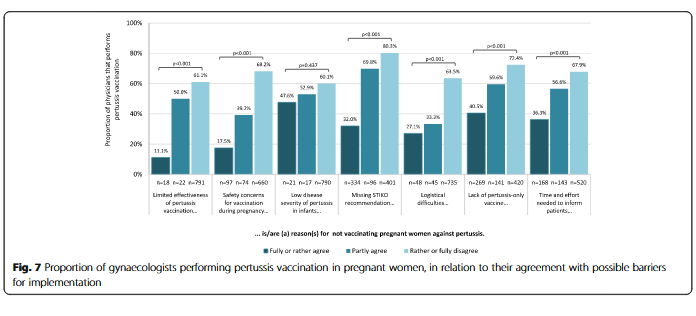
- Barriers: Pertussis vaccination was least likely if lacking official recommendation (32.0%), logistical difficulties (27.1%), safety concerns (17.5%) and limited vaccine effectiveness (11.1%) were perceived as barriers. Of participants not yet vaccinating pregnant women against pertussis, 86.5% reported they would follow an official recommendation.
- Measures for attaining high pertussis vaccination coverage in pregnant women: Including vaccination recommendations in the maternity record (95.2%) and informing the public (88.7%) and healthcare professionals (86.6%) were considered the most suitable measures. In additional comments, participants proposed better information and continuing education of healthcare professionals, including general practitioners, midwives, and practice support staff. Many comments addressed how best to inform pregnant patients; use of a range of media to convey positive messages, including non-scientific media such as TV, campaigns, the internet, social media/apps, and interventions in educational settings, was suggested.
To deepen analysis of the findings, the researchers look at the Complacency, Convenience, and Confidence ("3Cs") model by the SAGE working group, which describes vaccine hesitancy as a complex interplay of many factors. While the model was developed primarily to explain vaccine hesitancy among target groups for vaccination, the 3Cs can also be applied to vaccinators. For example, the researchers note that physicians who obtained influenza vaccination themselves were more likely to actively inform about and vaccinate their pregnant patients against both influenza and pertussis in their survey, as also observed by others. In their survey, concerns of limited effectiveness and safety were more common among gynaecologists who reported not obtaining annual influenza vaccination. In addition, those who obtained annual influenza vaccination were more likely to provide information material on vaccination in their practice. Thus, physicians' own vaccination practices seem to reflect their confidence in vaccination.
Because gynaecologists' confidence in vaccination is crucial for implementing vaccination in pregnancy, the researchers suggest that doubts on vaccine effectiveness and safety should be allayed among gynaecologists and pregnant women via various communication channels, and solutions for logistical barriers sought. The findings suggest several approaches to improve implementation of vaccination recommendations by gynaecologists and to support them in their important role as vaccination advocates. For example:
- Include vaccination recommendations in the maternity record held by pregnant women.
- Increase public knowledge and awareness, particularly about pertussis vaccination, through public campaigns, information material for pregnant patients in practices, and/or social media or apps. (Such approaches may reduce concerns and hesitancy in pregnant women and could help facilitate consultation on vaccination by physicians.)
- Increase knowledge and therefore confidence in these vaccinations among gynaecologists through enhanced focus on and inclusion of vaccination in continuing medical education activities and/or through information material developed specifically for physicians. (Though the researchers are unaware of evidence showing that provider education improves vaccination uptake, they clarify that such material should address the benefits and limited risks of recommended vaccinations, as well as harms due to vaccine-preventable diseases. This information could be provided, for example, by professional associations such as the BVF.)
- Educate midwives. ("Although midwives are not involved in delivering vaccination in Germany, they play a significant role in antenatal and postnatal care and thus, their support of vaccination recommendations is important for a successful implementation.")
In conclusion: "findings provide information on how implementation of current vaccination recommendations by gynaecologists could be improved and high pertussis vaccination uptake among pregnant women could be achieved, should...[it be] recommend[ed] in the future."
BMC Health Services Research, Volume 19, Number 616 (2019). https://doi.org/10.1186/s12913-019-4437-y
- Log in to post comments