










































Intentions to Use a Novel Zika Vaccine: The Effects of Misbeliefs about the MMR Vaccine and Perceptions about Zika
University of Pennsylvania
"In the absence of a realistic understanding of the risks of Zika and the benefits and risks of a Zika vaccine, people may import into the decision process their beliefs or misbeliefs about other vaccines."
In August 2016, the National Institutes of Health (NIH) in the United States (US) announced the launch of a Phase 1 clinical trial of a DNA-based Zika vaccine, and the second phase of the trial of that vaccine was announced on March 31 2017. This study by researchers at the Annenberg Public Policy Center (APPC) and the Annenberg School for Communication (ASC) at the University of Pennsylvania examined factors that may affect the eventual acceptance or rejection of such a vaccine. The paper provides context, shares findings, and discusses implications of those findings for public health officials and health communicators.
Many types of vaccinations have been the subject of misinformation about alleged risks, with resulting misbeliefs having a deleterious affect on vaccination rates. For example, although the bogus association between the measles, mumps, and rubella (MMR) vaccine and autism was debunked, and the original paper by Wakefield and colleagues was retracted, a 2014 Harris Poll of 1,756 US adults still found that 33% of parents of children under the age of 18 reported believing that vaccinations can cause autism. MMR misbeliefs correlate with reduced intentions to vaccinate children, as the Theory of Reasoned Action (TRA) can help explain. In this theory, the strongest predictor of volitional behaviour is behavioural intentions resulting from beliefs, attitudes, and norms (and, in later models, perceived control).
Looking through this lens, one would expect intentions to vaccinate against Zika to be strongly correlated with beliefs about Zika and its vaccine and to a lesser degree with beliefs about other vaccines and diseases, and other health behaviours. However, as Zika vaccines are being developed and tested, the scientific understanding of the nature of the virus remains incomplete and the public's knowledge of what science does know lagging. It was only in 2015 that the disease was found to correlate with microcephaly and, in adults, with Guillain-Barré syndrome (GBS). In such a context, individuals may form beliefs based on those already held about familiar diseases and treatments.
The study used to test the researchers' hypotheses includes survey responses from 3,337 individuals between August 25 2016 and September 26 2016, which was part of a larger, 34-week random-digit-dialing sample of US adults on attitudes, behaviour, and understanding related to the Zika virus (ZIKV). Key findings of the survey include:
- The more likely someone is to believe in the false association between the use of the MMR vaccine and autism, the less likely that person is to say they would get a Zika vaccine.
- People who believe in the ability of science to solve problems were more likely to intend to use a Zika vaccine.
- Looking for information about Zika online was associated with increased intentions to vaccinate, as was knowing that Zika can be acquired from mosquitoes.
- People who accurately believe that Zika causes the birth defect microcephaly, and the more cases of microcephaly they believe were diagnosed in the US, were more likely to intend to vaccinate - as were those who mistakenly believe that infected people always show symptoms and that Zika is likely to cause death.
- People who were engaged in behaviours to protect against Zika were less likely to intend to get the vaccination, which "may be the result of their confidence that their actions pre-empt the need to be vaccinated."
- General positive opinions about the US Centers for Disease Control and Prevention (CDC) and NIH increased intentions, as well as confidence in the government's response.
One of the researchers, Yotam Ophir, says of the results: "We found that the misbelief about the MMR vaccine's association with autism was more influential on the decision of whether to get vaccinated for Zika than even perceptions of Zika itself, which is worrisome, especially in light of the persistence of that misinformation." The study results suggest that accurately communicating about the risks of Zika can help lessen the detrimental effects of the misbelief. "Even if we can't change what people think about the MMR vaccine, if we can give them an accurate picture of how vulnerable they are to a disease such as Zika, they can make a more informed decision about it," Ophir said. Once the Zika vaccine exists, health communication challenges will include vaccine hesitancy and anti-vaccine communication.
In exploring the study's limitations, the researchers note that factors not measured here that may also diminish intentions to vaccinate include the newness of the vaccine and fears associated with vaccinating pregnant women. "Future studies should more comprehensively test the range of attitudinal barriers to vaccination and the specific ways in which they may affect intentions."
They conclude: "Building on prior research and theories about health decision making, this study emphasizes the importance of risk perceptions, including severity and susceptibility. To scholarship supporting the importance of a match among attitudes, beliefs and intentions, this study adds evidence of the need for health communicators to address a spill-over effect from misbeliefs about one vaccine on intention to use another."
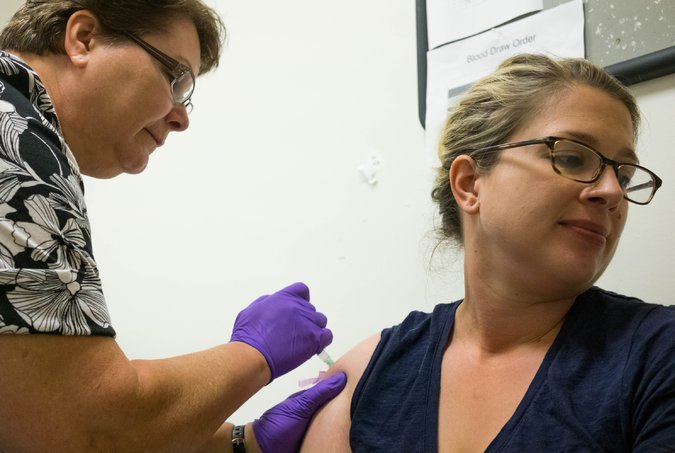
Journal of Public Health, pp. 1-7. https://doi.org/10.1093/pubmed/fdy042 - sourced from Annenberg School for Communication website, accessed on March 15 2018. Image caption/credit: "Linda Wadsworth, a nurse, injected Jen Wenzel, a volunteer, with a DNA vaccine for Zika being developed by the National Institutes of Health." Noah Scialom for The New York Times
- Log in to post comments