











































Internal Migration: A Manual for Community Radio Stations
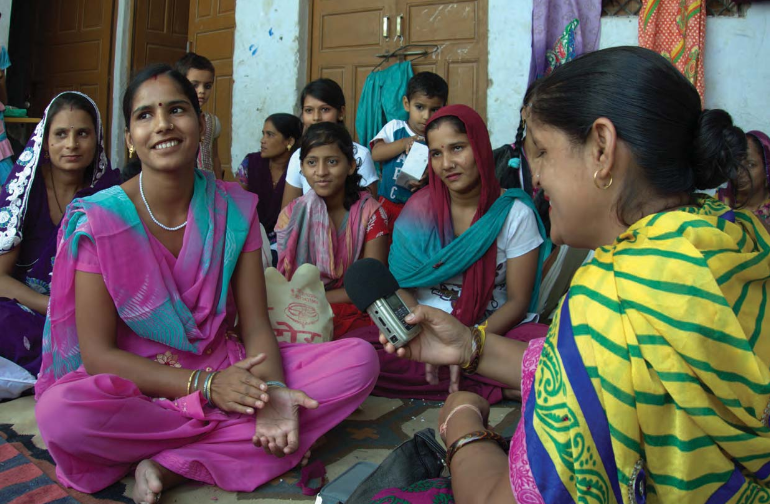
"Given the Internal Migration in India Initiative (IMII)'s objective to increase understanding of the issue of internal migration, advocate for policy reform for inclusion of internal migrants in society, and inform migrants about their rights and responsibilities, community radio stations represent a vital opportunity to build community understanding of and a supportive environment for internal migrant populations."
Noting that community radio (CR) is rapidly becoming the medium of choice for creating community conversations around key developmental issues and that CR helps build on these conversations to mobilise community members and promote social inclusion, this training manual supports community radio personnel in their capacity and potential to produce and broadcast migrant-sensitive programmes. In India today, many, if not most, CR stations lie in parts of the country where migration is a significant issue - in source areas as well as destination areas. Potentially, this means a possible audience of over 25 million people today, growing to 60 million over the foreseeable future, whom CR could involve in discussions around migration, migrant rights, and migration's links to issues around the right to education, children's rights, social protection, and human development at large.
Developed by United Nations Educational, Scientific and Cultural Organization (UNESCO) and Ideosync under the umbrella of the IMII (launched by UNESCO and the United Nations Children's Fund (UNICEF) in 2011), this manual lays out the basic concepts associated with internal migration, highlights the main challenges faced by internal migrants across the country, stresses their rights and entitlements, and showcases existing audio programming that is friendly to migrants. It covers topics such as: Understanding Internal Migration, The Vulnerability of Migrants, Migrants and Voice, Researching Migrant Issues, Designing Community Radio Content on Migration, Content and the Challenge of Migrant Mobility, Ethical Concerns While Addressing Migrant Populations, Working with Migrant Populations: Learnings, and Resources.
"Often, out-migration is seen as desertion by people who stay behind in the villages, and there is a general negative public opinion about internal migration in India. This manual lays out a different perspective on the issue of internal migration, which contextualizes and explains the causes and consequences of migration in a non-judgmental way, through a rights-based approach." In that way, the manual guides CR practitioners through a process of thinking about the kind of radio programmes, campaigns, and other broadcasts that can be developed to address the myriad issues around migration, particularly reflecting ethical approaches to addressing migrants and their issues. It also examines methods and practices to actively include migrant communities within the CR station's listenership, programming, and outreach.
Publishers
137
New Media Development Publications July - December 2015, sent from CAMECO to The Communication Initiative on February 18 2016; and UNESCO website, June 6 2016. Image credit: ©Gurgaon Ki Awaaz
- Log in to post comments