










































Keeping Governments Accountable: The COVID-19 Assessment Scorecard (COVID-SCORE)
Barcelona Institute for Global Health (ISGlobal), University of Barcelona (Lazarus, Plasència); University of Global Health Equity (Binagwaho); City University of New York Graduate School of Public Health & Health Policy (El-Mohandes, Ratzan); UCLA Fielding School of Public Health and Geffen School of Medicine (Fielding); London School of Hygiene and Tropical Medicine (Larson); Vilnius, Lithuania (Andriukaitis)
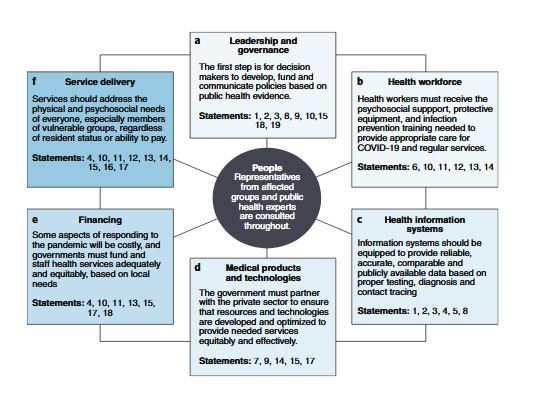
"Representatives from affected groups and public health experts are consulted throughout."
Written during the period of the COVID-19 pandemic in which many actors in the response are holding out for a vaccine to be developed, this paper underscores the need for governments to improve their outbreak preparedness and response by incorporating a health-systems approach. This, according to the authors, is necessary due to concerns, for example, that vaccine hesitancy may preclude large-scale uptake and the development of herd immunity. Thus, the paper presents recommendations for government action based on the World Health Organization (WHO)'s health systems framework (see above) and other national and international public health guidance.
Six key recommendations for action include:
- Improve public health communication and health literacy - Some considerations:
- "Clear and consistent communication to the public via reliable, comprehensive and up-to-date data is crucial...Evidence-based communication can help foster transparency and trust, enabling the population and government officials to make informed decisions." This means "explaining the basis for the latest public-health recommendations - particularly in the context of a novel virus, for which new evidence continues to emerge and guidelines continue to evolve..."
- When drawing up a communication strategy, governments should take into account varying educational, cultural, and language backgrounds so all population groups are engaged. This process needs to involve consultation with public health experts, opinion leaders, and community representatives at all levels.
- "A strategy for increasing vaccine literacy will be crucial for improving uptake..."
- "[I]t is also important to regularly survey public knowledge, perceptions and behaviors and to conduct qualitative research at a national and, if practicable, international level..."
- Facilitate robust surveillance and reporting - For example, public health bodies are advised to "maintain real-time national, subnational and local epidemiological databases with harmonized data on every known case of infection."
- Develop pandemic preparedness - For example, "[e]very country and international health organization should have a pandemic preparedness team of public-health and medical experts and provide pandemic-response training."
- Strengthen health systems - Some considerations:
- Faciliation of coordination and collaboration between primary care services and social services can help ensure, in particular, that clients who are most vulnerable and those with complex needs can get help for stress-related conditions associated with the pandemic.
- Health and social workers can be tasked with promoting vaccine literacy to help prepare clients for an eventual vaccine and provide actual vaccinations if one becomes available.
- Engaging sectors outside health can be a promising strategy, such as collaborating with the technology sector to support the use of telehealth technologies.
- Ensure health and social equity - For example, "Gender and other dimensions of vulnerability should be considered in all pandemic control measures..., and other issues raised by nongovernmental organizations and by the public in surveys."
- Ensure that confinement and de-confinement strategies are comprehensive - For example, international cooperation and consultation on the exchange of knowledge and experience in this regard should be initiated quickly.
The authors offer a brief critique of the pandemic response, such as their assessment that: "Scientific and technical experts have been exchanging information and collaborating on COVID-19 research across borders, but their cooperation has been anything but systematic."
Along those lines, they argue that, for the above 6 recommended actions to be successful, trust needs to be restored in the systems that support public health. "That begins with a credible chain of accountability." To facilitate this, they have developed the COVID-19 Assessment Scorecard (COVID-SCORE), a list of 19 statements (see Figure 2 in the paper) to enable people to conduct an assessment of their city, state/regional, or national government's response to COVID-19 and its preparedness for public health emergencies. An example: "Public health experts, government officials, and academic researchers agree on COVID-19 nomenclature and clearly explain the reasons for public health measures."
In conclusion: "This pandemic should be a wake-up call for countries to address the most critical shortcomings in their pandemic readiness and health-system resilience in order to prevent and mitigate the effects of future catastrophes."
Nature Medicine 26, 1005-08 (2020). https://doi.org/10.1038/s41591-020-0950-0. Image caption: A pandemic health systems framework. Adapted from the Nobody Left Outside (NLO) Service Design Checklist, which is based on the WHO Health Systems Framework (2007). Statement numbers correspond to the COVID-19 Assessment Scorecard (Fig. 2).
- Log in to post comments