










































Language Barriers in Polio Vaccine Campaigns in Somalia: Focus on Maay Speakers in Banadir
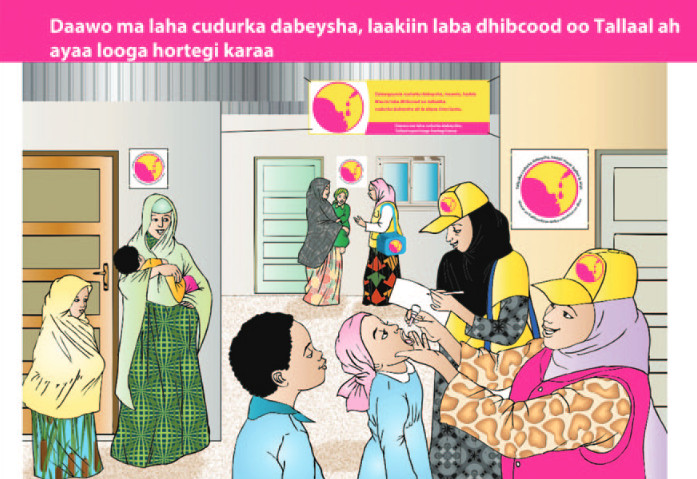
"There is nothing that I have understood from the audio that I just listened to, it is only in Mahaatiri, and I don't understand Mahaatiri. I also don't know what polio is."
The issue of minority inclusion in both humanitarian and development programmes is significant in Somalia but often neglected. In Somalia, repeated cycles of conflict, famine, and floods have led families from the Southern regions, who predominantly speak Maay, to flee to internally displaced person (IDP) camps around the capital city of Mogadishu. Health and other humanitarian services are usually provided in the Mahaatiri language within these IDP camps, and the same applies to campaigns to encourage polio vaccination. In this collaborative report, Minority Rights Group International (MRG), CLEAR Global, Humanity & Inclusion for Sustainable Advocacy (HISA), Jubba Valley Development Centre (JVDC), and Marginalised Communities Advocacy Network (MCAN) explore the comprehension of polio vaccination information shared by health workers in Mahaatiri among monolingual Maay speakers. The research reported here was conducted as part of the MRG project Improving polio coverage through minority IDP inclusion in Somalia (2022-2023), which is funded by a grant from the Bill & Melinda Gates Foundation.
Some historical context: Maay speakers have long faced language discrimination within the majority Mahaatiri-speaking society. Many see the Mahaatiri language as being used to reinforce social inequalities between speakers of Mahaatiri and of other languages. During the colonial era and as part of the state broadcasting body, Radio Mogadishu used to air its news broadcasts in Maay alongside Mahaatiri. At around the time of independence (July 1 1960), Radio Mogadishu stopped its Maay broadcasts and continued only in Mahaatiri. As noted in the report, "Maay speakers already feel discriminated against, and historical feelings of neglect and exclusion may influence current reactions to public health information." Debates have continued as to whether Maay and Mahaatiri are similar enough to be considered two dialects of one language or are sufficiently different to be considered two distinct languages. MRG research shows that many Maay speakers in fact face great difficulties understanding Mahaatiri, especially people from rural areas and people with low levels of literacy or formal education.
The report is based on interviews conducted with 24 mostly illiterate Maay speakers in 3 IDP camp locations using a range of tools including qualitative approaches such as comprehension testing. The researchers asked Maay speakers for their understanding of several audio-recorded explanations (in Mahaatiri and in Maay) and posters that were used during polio vaccination campaigns by the United Nations Children's Fund (UNICEF) and the Ministry of Health (MoH) and partners. The team also tested the understanding of key terminology in Mahaatiri with Maay speakers.
The results show that those who speak only or primarily Maay do not fully understand most of the health messages on polio and polio vaccination presented within vaccination campaigns that use Mahaatiri. Visual aids and images accompanied by Mahaatri text, which are used by health workers to explain polio to Maay speakers, are also not well understood. These findings show that for those who speak only Maay, the language of communication is a barrier, meaning that some do not sign up for vaccination outreach programmes, and that this contributes to the frustration of considerable efforts to reach 100% vaccination rates to eradicate polio in the area.
Recordings or audio fragments in Maay were much better understood than text and pictures and the recordings in Mahaatiri. "When the voice spoke in my own language, I understood it very well", said one participant. However, not all Maay words were equally well understood, as there are different dialects in the Maay language. "I misunderstood one-third of it", said one elderly man who spoke a different dialect than the one used in the recording. Furthermore, medical terminology is not well understood by research participants, even if it is translated into Maay. Many Maay speakers rely on alternative healing and traditional medicine, in part because conventional medical care is often not available.
Knowledge of polio vaccination and levels of trust in polio eradication campaigns within the IDP camps are low, these research findings show, not least because of a lack of representation of ethnicity within current visual aids and given the absence of culturally and linguistically sensitive translation of polio eradication campaigns to Maay-speaking populations.
Many Maay speakers identified "polio" in Maay as "dabeel" or "dabeel jinni". In local knowledge, a dabeel can spread on the wind or be caught from sitting under a tree. Where health workers used the term "dabeel" to describe polio, it helped Maay speakers understand, while health workers gained trust and credibility. "We learnt that dabeel can also be prevented with vaccination. This is a new concept, as we have always associated dabeel with the traditional smoke treatment", one woman mentioned. She reported getting her children vaccinated after hearing the explanation from health workers. Translating and contextualising terminology related to alternative understandings of health, diseases, and treatment may help people understand the content better.
In addition to requesting information about polio vaccines in their own language, people want health information to be delivered in a way that is understandable and culturally and linguistically sensitive. Health communication material, including posters and radio spots, should be developed so that diverse groups of people can understand them. The researchers recommend using simple terms and words that people without formal education understand and including images of people who look like the Maay-speaking community.
The report concludes that unless health campaigns aimed at eradicating polio in Somalia address linguistic, ethnic, and cultural specificity, and unless issues of marginalisation of minority groups are prioritised within polio campaigns at the level of recruitment of and training for workers and appropriate design of literature and visual aids, goals to reach 100% rate of vaccination among local populations in Banadir District will remain challenging.
MRG website, November 15 2023. Image credit: MRG
- Log in to post comments