










































Nepal: Reconstruction through radio
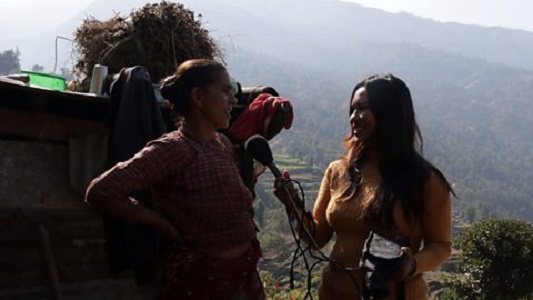
Originally posted on the BBC Media Action blog by Pratibha Tuladhar on January 11 2017 - Timorous rays of winter sun fall on the potato fields of Nuwakot, a district in central Nepal still recovering from the impact of the 2015 earthquakes. The residents of Belkot village are outside, digging and weeding their patches of land.
I’m with Bhawana Gurung, one of the presenters for BBC Media Action’s radio programme, Milijuli Nepali (Together Nepal), to speak to our audience and find inspiring stories about people rebuilding their lives despite their ongoing difficulties. The daily radio show – which airs on the BBC Nepali Service and over 50 local radio stations in 14 earthquake effected districts – gives people practical information about things like water purification and safe construction practices, as well as health advice and innovative business ideas.
As we step into the front yard of a straw-roofed house – one of many in the village – we’re welcomed with a Namaste by Sita Poudel, a farmer and housewife. When Bhawana introduces herself as presenter of Milijuli Nepali, Sita excitedly invites her neighbours to meet her. The women in the village are fans of the show, and say Bhawana’s motivational conversations about reconstruction have inspired them to get through their more difficult days.
“I remember the episode where you interviewed a group of female builders. Skills you learn are always your own!” says Sita, smiling. “I love that your programme motivates women to learn new skills.”
Sita lives in what remains of her house after the 2015 earthquakes. The first floor was destroyed and the ground floor, with its partially cracked walls, is now the place where the family cooks and sleeps. Others in the village were forced into similar arrangements; while many continue to live in makeshift tin huts that were built after their houses collapsed.
As the reconstruction slowly gets underway, Sita’s neighbours say they are grateful for information about safe and sustainable construction that they heard on Milijuli Nepali.
Nearby in the village of Raatmate, we speak to Kanchi Rai, a member of the Danuwar community who have their own language and are often marginalised in Nepali society.
Kanchi tells us that, as a Danuwar, she faces cultural and language barriers in her quest for information about post-earthquake reconstruction. She said she would like Milijuli Nepali to explain how she can access Nepal’s government reconstruction fund.
We’re now planning to include this information in future episodes. Nepal’s government has committed to provide 300,000 NPR (about 2,260 GPB), to people who are rebuilding their houses damaged by the earthquakes. Broadcasting simple, clear information about what government help is available and how to access it can be life-changing, and helps makes the government more accountable for its promises.
As we wrapped-up our Nuwakot visit, Bhawana tells us that going to the villages to seek feedback from listeners helps her appreciate the impact of the programme – as well as research new ways to help her audience. “As a presenter, I feel inspired when I hear that people have done things differently because of our show. That’s when I feel like my work has paid off,” she says with a wide smile.
Click here to access this BBC Media Action blog and related links on their work in Nepal.
Image credit: BBC Media Action
Contact:
BBC Media Action
BBC Media Centre, MC3A, 201 Wood Lane
London
W12 7TQ
United Kingdom (UK)
Phone: 44 (0) 20 8008 0001
Fax: 44 (0) 20 8008 5970
Media.action@bbc.co.uk
- Log in to post comments