











































Our Girls, Our Future
Originally posted on the BBC Media Action blog by Catherine Juma, November 22 2016 - Girls in South Sudan are less likely than boys to start school and more likely to drop out. Our radio producer visited her former school to find out if educational aspiration for girls is improving.
“Where’s my mango tree?” I wondered, as I entered the gates of my former school, welcomed by a gaggle of smiling school girls dressed in smart red and white uniforms
As a young girl, I’d planted a mango tree in a shady area of Juba Girl’s Secondary School. The tree was a symbol of a future ripe with possibilities, where if you nurture something – feed it, water and protect it - then delicious fruits will eventually appear.
On returning I was overwhelmed with happiness. The long, narrow classrooms of the school hold many special memories, not least, as the place where I first learned the art of writing – small steps which would help me launch my career as a journalist.
I’m currently using my journalism skills to produce ‘Our School’, a radio show in which we highlight inspirational stories to convince girls – and their parents – that education matters. Girls are still less likely to start school than their male counterparts in South Sudan, and those who do are more likely to drop out early.
A good girl stays in school
Many parents in South Sudan believe that a ‘good girl’ should stay at home. Poverty and insecurity as well as traditional ideas about the place of girls in society all play their part. I believe the opposite - that for South Sudan to forge a better future - a ‘good girl’ should stay in school.
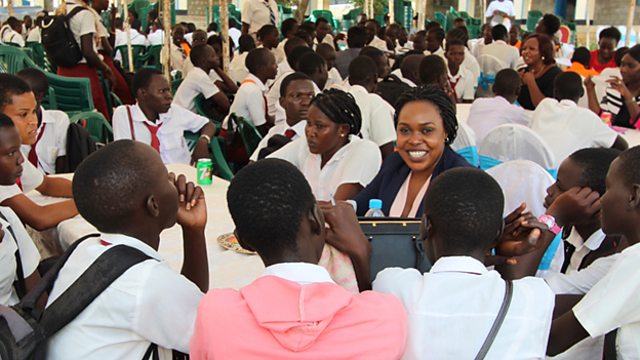
Passing through the grassy courtyard I once played in as a child, I joined a stage filled with scores of successful women: lawyers, doctors, bankers, engineers, journalists and businesswomen. A sea of eager young faces looked up at us. The careers fair ‘Our Girls, Our Future’, organised by Girls Education South Sudan, was an opportunity to provide young girls with role models – and a chance to quiz us on our achievements.
One girl asked me about some of the challenges I faced at school. I told her there were many! The dangerous distraction of boys (to be avoided at all costs!), lack of reliable transport to get me to class in time, low expectations and the constant disruption of war. Unsurprisingly, many of these challenges still hinder girls’ education and limit their aspirations today.
There is hope. The number of girls completing their final year at Juba Girls Secondary School has rocketed since I was there over a decade ago. I’m confident that radio shows like ‘Our School’ and initiatives like the careers fair will help improve this figure even more.
Investing in success
After the panel discussion, we broke up into groups for mentoring sessions. “What advice would I have wanted to hear as a 16 year old?” I asked myself.
“To succeed, a girl needs to know why she's in school, I repeat, she needs to know this. School isn’t just about learning new things now, it’s an investment in the future of your family, your community and your country,” I told my group. After the mentoring session, I picked up my recorder and put on my headphones to capture all the inspiring conversations around me, to be broadcast to girls across South Sudan through our national radio partner, Radio Miraya.
“Ah Catherine, I want to be like you”, said a girl, tugging on my t-shirt as I gathered my things to leave. Along with the warm glow of nostalgia from visiting my former school, it felt so good to be one of the women acting as a role model for these girls.
I never did find the mango tree I planted all those years ago. Instead, I found hundreds of little girls, striving to be the best they can be. Just like little trees – the more sustenance they can get (through positive role models and education) – the more fruit they’ll bear and the stronger they’ll grow.
This article was written as part of the BBC’s 100 Women season. Join the conversation on Twitter, Facebook and Instagram using the hashtag #100women.
Click here to access this BBC Media Action blog and related links on their work in South Sudan.
Image credit: BBC Media Action
Contact:
BBC Media Action
BBC Media Centre, MC3A, 201 Wood Lane
London
W12 7TQ
United Kingdom (UK)
Phone: 44 (0) 20 8008 0001
Fax: 44 (0) 20 8008 5970
Media.action@bbc.co.uk
- Log in to post comments