










































Pinch, Leave an Inch and Roll: Applying the Communication-for-Behavioural-Impact (COMBI) Approach to the Promotion of Proper Male Condom Usage in Jamaica
University of the West Indies
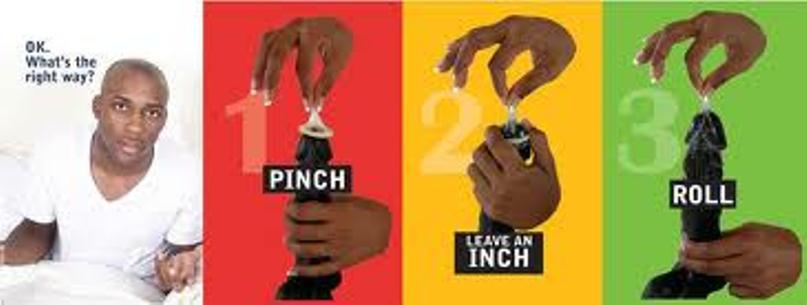
This article from the journal Caribbean Quarterly (Special Issue on Communication in Action) reviews a condom distribution project in Jamaica through the Communication for Behavioural Impact (COMBI) lens. This framework is used to understand the process of creating the "Pinch, Leave an Inch and Roll" campaign, one of Jamaica's National HIV/STI (sexually transmitted infection) Programme's campaigns.
The article first gives background for the Ministry of Health-coordinated programme's four main components: prevention; treatment, care, and support; enabling environment and human rights; and monitoring and evaluation. Within the prevention component, the National HIV/STI Programme team used behaviour change interventions to promote safer sex on a broad scale and among most at-risk populations using strategies that include: community outreach; special events with free condom use demonstrations and distribution, as well as HIV testing; and national media campaigns. Both television show and party event sponsorship were used to add visibility to the messages. In addition, the Priorities for Local AID Control Efforts (PLACE) strategy identified locations (bars, clubs, sex work locations, bus stops, malls, etc.) and trained influential people in those locations on HIV risk reduction and condom use and supplied condoms. These short- and long-term interventions were measured for evaluation by: number of persons reached; number of condoms distributed; number of HIV tests conducted; number of peer educators trained; number of condom access points established; and number of social service referrals, among others. Three occasions for yearly major events include: Safer Sex Week, celebrated during Valentine's Day week; Regional HIV Testing Day, a collaboration with ScotiaBank Jamaica and the Caribbean Broadcast Media Partnership on HIV and AIDS; and International World AIDS Day.
The article describes reasons that various age groups may not use condoms, including complexity of use as observed in the condom demonstrations, which became the basis for developing the "Pinch, Leave an Inch and Roll" campaign. It then describes COMBI as a form of strategic communications planning and mobilisation, including 5 major areas used in commercial marketing efforts:
- Public relations/advocacy/administrative mobilisation;
- Community mobilisation;
- Sustained appropriate advertising;
- Personal selling/interpersonal communication/counselling; and
- Point-of-service promotion.
The article outlines using the ten steps of the COMBI framework for the campaign:
- The overall goal: reduce vulnerability to HIV transmission, primarily among male adolescents, as well as the adult population.
- Behavioural result/objectives: encourage correct and consistent condom use promoted through "three simple steps".
- Situational market analysis: Through such measures as having attenders at a party event demonstrate condom use on a penile model, the HIV prevention team could observe behaviours and mistakes in order to focus the messaging campaign.
- Overall strategy: Existing communication strategies involving outreach workers and peer educators at events and locations were chosen for point-of-service promotion. Advertising material was added, including a 45-second video, a mini-brochure, and poster. The edutainment strategy of the message creation was carried through by adding drama to messaging.
- COMBI plan of action: Message creation was done by brainstorming, outlining creative concepts, and enlisting help from a communications consultant.
- Management and implementation: The four units of staff for the Ministry of Health HIV/STI Programme collaborated with the HIV prevention team to develop versions of the campaign materials and analyse them for acceptable or offensive content.
- Monitoring implementation: The public feedback resulting from the campaign, including newspaper editorials and columns (see samples here under ‘reactions to campaign’), , expanded public debate and stimulated the production of a reggae song using the campaign tagline. A recall campaign done one year later using focus groups and a quantitative survey indicated that 97% of respondents recalled campaigns about safer sex practices without being prompted. 12% recalled the slogan without a prompt; 85% could complete it with a prompt.
- Impact assessment: Short-term impact was assessed by the recall study, but long term impact of a single campaign needs to be assessed through a Knowledge, Attitudes, Behaviour, and Practice survey. These are conducted every 4 years by the Ministry of Health, and data was not available at the time of publication of this article.
- Scheduling: Campaign scheduling was considered critical, as there were other HIV/STI campaigns running concurrently, some of which were complementary, such as a parent-child campaign entitled "Time to Talk" and a women-focused campaign called "Smart Women". In order to prevent “message fatigue", the campaign used "advertising flights" - timed groupings of messaging. (COMBI recommends 6 messaging efforts per day, 5 days per week, for 3 weeks.) The campaign used TV and cinemas and distributed branded materials through committees, special events, non-governmental organisations, sector ministries, other agencies, and tertiary-level schools.
- Budget: The article lists funding sources.
The lessons learnt include: using existing structures; persevering for the long term, including responding to market research trends; ensuring strong programme leadership and basing activities on epidemiological data, not moral views on risky behaviour; establishing good working relationships with planners and the creative team; and spending funds wisely through strong financial management.
For more information on obtaining the published journal article, please contact the editor of the Caribbean Quarterly or Livingston White. (See contact information below.)
Emails from Livingston White and Chinyere Roberts to The Communication Initiative on October 4, November 21, and December 5 and 7 2012, respectively, and the article: White, L., Byfield, L., Sutherland, S., & Reid, R. (2012). “Pinch, Leave an Inch and Roll": Applying the Communication-for-Behavioural-Impact (COMBI) Approach to the Promotion of Proper Male Condom Usage in Jamaica. Caribbean Quarterly (Special Issue on Communication in Action) Vol. 58, nos. 2-3 [June-Sept 2012], pp: 43-66.
Comments

perpetuation of myths
The idea that it's necessary to leave space at the end of the condom has been incessantly repeated since the start of the AIDS epidemic - but without evidence! In fact, this part of the manoeuvre is unnecessary see:
Spencer B, Gerofi J. Can we tell them how to do it? In: Mindel A. Condoms. London: BMJ Books; 2000. p. 207-219.
- Log in to post comments