










































The Place of Sport in the UN Study on Violence against Children

Centre for Youth Sport and Athlete Welfare, Brunel University, UK (Brackenridge), Department of Social and Cultural Studies, Norwegian School of Sport Sciences, Norway (Fasting, Sand), Research and Graduate Studies, University of Winnipeg, Canada (Kirby), Hong Kong Sports Institute, Hong Kong (Leahy), University of Laval, Ste. Foy, Quebec, Canada (Parent)
The abstract of this UNICEF Innocenti Research Centre (IRC) Discussion Paper states that the purpose of the analysis is to identify sport-related material in the documents and gaps in research knowledge about the role of sport in both preventing and facilitating violence against children. The paper complements the UNICEF IRC study titled 'Protecting Children from Violence in Sport: A Review with a Focus on Industrialized Countries' (July 2010), developed by the same research team.
The methodology employed included a secondary analysis of more than 100 country surveys that were returned as part of the consultation for the United Nations Study on Violence against Children, as well as numerous other documents. The authors present the following rationale for the focus of the analysis: Sport plays a significant role in many programmes and is used by many agencies as a tool for health and social development and post-conflict reconstruction. It is also recognised as having popular international support and is frequently adopted as a mechanism for international advocacy and fundraising. However, sport has often been overlooked as a potential vehicle for the promulgation of child protection and as a site of violence to children.
The major themes that emerged from the content analysis are grouped as follows: children's right to rest and leisure and to engage in play and recreational activity; children's experiences of sexual abuse; sport and exercise used as punishment; and prevention of violence in sport.
Findings detailed the following themes:
- In India, child labour often restricts the right to rest and leisure and to engage in play and recreational activity, particularly for girls. Similarly, among Ethiopian child domestic workers, recreation and play are, for the most part, non-existent. Few reports of abuse during sport were found, but a limited number of cases of teacher-to-student abuse were mentioned in some countries, including this statement by a teacher: "the harassment of women by men is so common that there's no need to make mountains out of mole-hills."
- In some countries sport and exercise are used as indirect forms of punishment, or as a sanction for breaking the rules.
- Prevention of violence in sport was among the most frequent of the responses found. These included the action of "having parents, players, coaches and officials sign a code of ethics or good behaviour pledge", and reducing homophobic violence in sport. A 2003 UNICEF publication is cited, which states that child protection professionals can and do train other professionals who work with children. This includes the training of professionals who work in sports clubs to recognise, react to, report, and refer child abuse cases.
The authors also outline several minor themes that emerged from the research. These encompass: a "troublingly high acceptance of violence in the culture of sport; spectator violence, particularly hooliganism in soccer; excessive training of talented child athletes at the expense of their overall physical and mental development; child labour in sport; and trafficking of young athletes."
While recognising the limitations of this documentary analysis of UN sources, the authors also point to the fact that a parallel analysis of the issue, which went beyond the UN study, also yielded little evidence of violence against children in sport. The analysis also had other limitations that should be taken into account when interpreting the findings: only English-language sources were consulted, and the interpretations and norms for child safety and child violence differ widely across cultures and societies.
The analysis concludes that:
- "There is a lack of coordination between governments and sport NGOs on the subject of violence against children in sport....
- There appears to be no evidence of a functional link between the agencies responsible for sport for development and those responsible for prevention of violence to children. The UN Committee on the Rights of the Child could act as a form of international 'watchdog' for children in sport in this regard....
- There is a marked absence of empirical data about the forms, prevalence, and incidence of violence against children in sport and about the best mechanisms for preventing or resolving such problems....The efficacy of sport as a tool of violence prevention has not yet been assessed....
- Countries approach the matter of violence against children in many different ways (including child labour; prevention of sexual/economic exploitation; health promotion; cultural or educational development) so there is no common agreement on what constitutes adequate violence prevention. International standards for safeguarding children and for violence prevention in sport would be a useful measure, especially if monitored through a designated authority within each country. Children and youth ...need to be consulted and involved when developing international standards and other mechanisms for addressing violence in sport.
- The issue of sport and violence against children needs to be addressed at policy levels within governments and by national and international sports agencies."
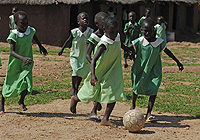
UNICEF website, August 19 2010; and email from Patrizia Faustini to The Communication Initiative on October 25 2010. Image credit: © UNICEF/NYHQ2007-0878/Cranston
- Log in to post comments