










































The Postmodern Medical Paradigm: A Case Study of Anti-MMR Vaccine Arguments
University of Kansas
"MMR vaccine skepticism is not an objectively calculated belief driven by rational arguments alone; it is influenced by a variety of factors that are subject to irrational risk perception and cognitive biases."
Argumentation scholars have demonstrated that some portions of the public are not persuaded by even the soundest scientific evidence. Offered in the context of the controversy in which Andrew Wakefield falsely trumpeted a connection between the measles, mumps, and rubella (MMR) vaccine and autism, the essay analyses the arguments of the antivaccination movement, arguing that many analysts have misdiagnosed the root causes of vaccine skepticism. The authors suggest that anti-vaccine beliefs transcend ideology; rather, the emergence of antivaccine advocates points to the power of a conspiracy theory supported by anecdotes.
Opening the essay is an explanation of the Wakefield controversy. In brief, in 1998, Dr. Wakefield published an essay in The Lancet, a respected British medical journal, claiming a connection between the MMR vaccine and autism. Six years later, The Lancet retracted the article, and Britain's medical council subsequently stripped Wakefield of his medical license. However, in many ways, the damage was done. A small but influential group of antivaccinators continue to prolifically spread Wakefield's disproven and scientifically inaccurate message linking vaccines to autism.
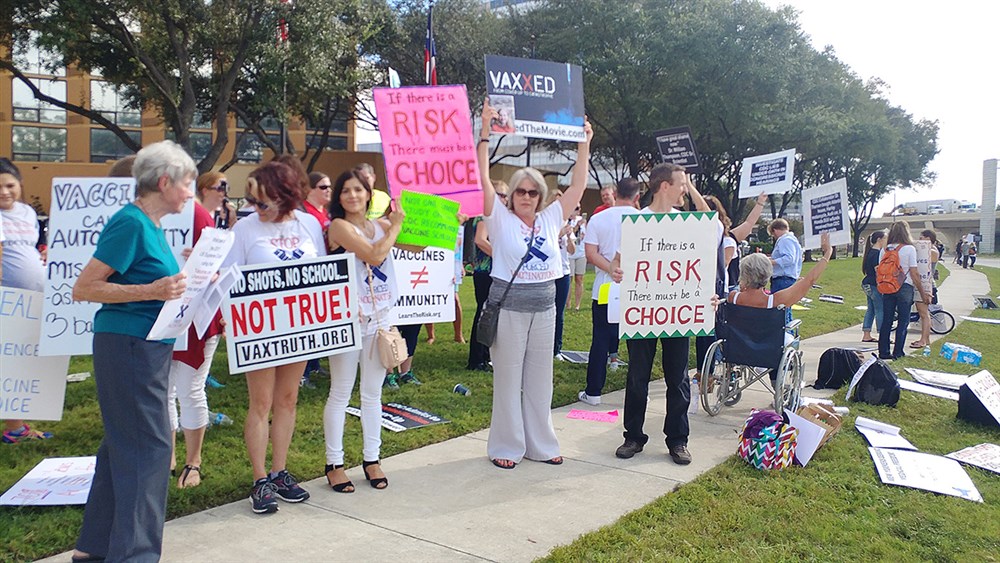
Brett Bricker and Jacob Justice then explore public opinion concerning vaccine science and declining vaccination rates. Outbreaks of the measles are already occurring, with major spikes in measles throughout the United States (US) in 2014 and 2015 (and 2019). These outbreaks are directly related to lack of vaccination. While some have blamed political conservatives for antivaccine science propaganda that can fuel vaccine refusal, according to Bricker and Justice, anti-MMR sentiment cuts across lines of culture, race, political ideology, affluence, and educational attainment. So, accusing one group or another as being to blame for vaccine resistance is not only a poor reflection of reality, but it runs the risk of polarising people further and generating resentment.
Instead, Bricker and Justice argue that "something fundamentally different from other disputes about science-related public policy is influencing vaccination opinion formation: the postmodern medical paradigm, which elevates subjective experience and raises skepticism towards objective bases for knowledge." The postmodern medical paradigm has three characteristics:
- hostility toward singular truths - vaccine skeptics reject robust scientific evidence proving the MMR vaccine is safe and effective as merely one version of reality;
- aversion to scientific objectivity - skeptics favour online communities and social networks over traditional physicians for information concerning vaccine decisions; and
- decreased trust in expertise - everyone is an expert in Web 2.0 health care, characterised by patient-to-patient collaboration , whereby personal experience is viewed as an equally valid form of medical understanding.
For Bricker and Justice, the appeal of antivaccination discourse is linked to two aspects of the postmodern medical paradigm:
- "[A]ntivaccination advocates counter appeals to scientific consensus by relying upon anecdotes and highly emotional personal stories. These anecdotes typically involve the firsthand testimony of parents of autistic children who are convinced of the vaccination-autism link and use their own experiences to caution the audience against vaccination. Although educated and scientifically literate audiences may rightfully be skeptical of such anecdotal appeals, lay audiences often find them persuasive because of the sincerity of the featured parents and their seemingly common-sense arguments."
- "[A]ntivaccination arguments utilize conspiracy theory rhetoric to discount provaccination counterarguments, alleging a concerted effort by the media, government agencies, and pharmaceutical industry to conceal the truth about the vaccination-autism link. This argumentative technique casts doubt on the scientific consensus, by implying that the vaccination-autism link could be definitively proven were it not for widespread collusion to stifle the flow of information....The conspiratorial nature of this discourse helps explain why antivaccination sentiment transcends partisan boundaries, uniting ideologically diverse groups under a single banner: these narratives may resonate with liberal/progressive individuals because of their skepticism towards the motives of corporations, while they may also manipulate conservative fears of invasive government run amok."
Next, Bricker and Justice illustrate the centrality of these argumentative strategies in two texts that are central to the antivaccination movement: Callous Disregard: Autism and Vaccines - The Truth Behind a Tragedy by Andrew Wakefield and the documentary film adapted from the book Vaxxed: From Cover-Up to Catastrophe. "Both works rely heavily on anecdote and conspiracy theory to diminish scientific authority and constitute their audiences into a community....In addition, both anecdote and conspiracy theory serve important psychological functions for the audience. The numerous emotional stories shared by parents of autistic children may serve a reassuring function, reminding viewers who have autistic family members that they are not alone. The conspiracy theory also encourages identification by positing a shared enemy around which antivaccination individuals can rally against."
They conclude by analysing argumentative strategies that may help counter the trend towards skepticism of the MMR vaccine and the rise of the postmodern medical paradigm. Considering that parents are emotional beings making difficult decisions - not merely rational consumers of scientific information - simply repeating the facts denying the link between vaccines and autism is insufficient. Bricker and Justice suggest that pro-vaccine advocates combine scientific argument with effective storytelling, such as by:
- Providing anecdotes of paediatricians and family doctors who vaccinate their own children;
- Portraying the experiences of children who lived through, or died from, measles, mumps, or rubella, including testimony from diverse groups of affected parents and children in the present day; and/or
- Encouraging parents who are already confident about their choice to vaccinate to speak out about their decision, such as by joining and becoming active in online communities that share positive stories about immunisation.
In conclusion: "MMR vaccine advocates must trumpet the message of MMR safety by coopting the persuasive strategies of skeptics; namely, using the power of narrative and anecdote alongside their robust scientific argument denying the link between the MMR vaccine and autism."
Western Journal of Communication, DOI:10.1080/10570314.2018.1510136. Image credit: Maggie Fox / NBC News
- Log in to post comments