










































Reducing Substance Use and HIV Health Disparities among Hispanic Youth in the U.S.A.: The Familias Unidas Program of Research
Department of Epidemiology and Public Health, Miller School of Medicine, University of Miami
"The objective of this article is to describe a program of research involving Familias Unidas, a Hispanic-specific, parent-centered intervention, aimed at reducing substance use and HIV health disparities among Hispanic youth."
This United States-based study focuses on the theoretical foundation of the intervention Familias Unidas, the empirical research supporting the theoretical model, the intervention model itself, the findings of the programme of research, and the translation of this intervention into community practice. According to the study, both "substance use and HIV contribute largely to the health disparities that exist between Hispanics and other segments of the population." [Footnotes are removed throughout by the editor.]
Familias Unidas is a Hispanic-specific, parent-centred intervention, focused on reducing health disparities in substance use and HIV risk behaviours among Hispanic youth. Familias Unidas intervention is based on ecodevelopmental theory, a social ecological model to explain the multiple effects and interrelatedness of substance use and HIV risk behaviours. The model names systems that influence behaviour including:
- macrosystems (e.g. cultural values);
- exosystems (e.g. parents’ support systems);
- mesosystems (e.g. parental monitoring of peers); and
- microsystems (contexts in which the adolescent participates directly, such as the family).
The second element of ecodevelopmental theory is a developmental perspective that emphasises the changing nature of youth across time as a function not only of the adolescent’s current social context but also of changing conditions in the social context throughout the child’s life. The third element of ecodevelopmental theory is social interactions. "We hypothesize that risk and protection are expressed in the patterns of relationships and direct transactions between individuals...", suggesting that the amount of support parents get - sometimes a scarcity for immigrant parents - is "directly predictive of the harshness or supportiveness in their parenting which in turn may affect the likelihood of adolescent drug use and unsafe sexual behavior."
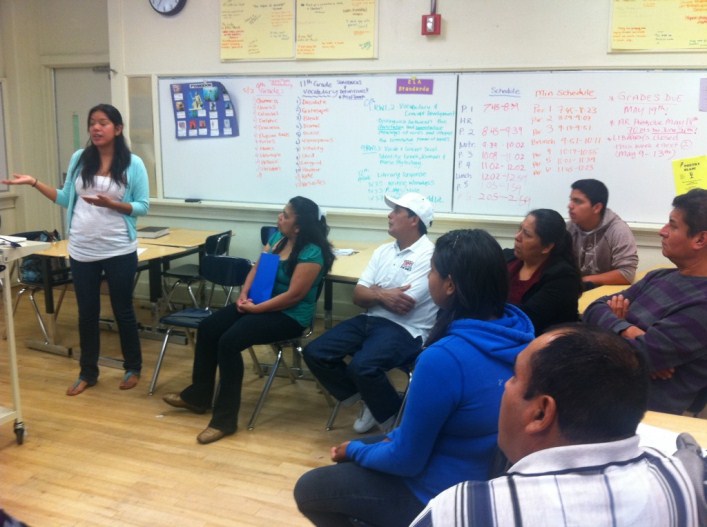
The Familias Unidas intervention was developed through a community-based participatory research model. In preparation for Familias Unidas, community representatives identified sexual risk behaviour and substance use as particular causes for concern amongst local parents. The intervention is delivered through multi-parent groups that place parents in the change agent role and through family visits. "Parent groups are the main activity of the intervention, which bring parents together for the purposes of establishing parental investment, increasing parental support, and providing a context for parent participation in a conjoint skills learning process. The most important process used to achieve these goals is ‘participatory learning’, based on the problem posing approach pioneered by Paolo Freire for use with marginalized populations. In participatory learning, parents learn through dialogue rather than instruction. Group activities such as role plays and other forms of behavioral rehearsal aid in skill acquisition. Throughout the group sessions, parents build perceived responsibility and control (i.e., self-efficacy).”
In addition, facilitators visit the families of participants. Family visits provide the facilitator with:
- an opportunity to restructure family, peer, and school risk processes.
- an opening to maintain family motivation, practice, and implementation of the skills that the parent learned within the group sessions.
- an opportunity to guide parents to transfer the competencies learned in the group sessions to their adolescent, foster more nurturing and supportive relationships, and increase parent-child communication.
- a chance to involve other family members and address issues and barriers to the communication process.
Efficacy study 1, conducted in 2003, evaluated the efficacy of Familias Unidas, relative to a prevention-as-usual control condition, in improving family functioning and in reducing behaviour problems - an antecedent for substance use, unsafe sexual behaviour, and related health outcomes such as HIV. Participants were assessed at baseline, randomised, and reassessed at 3, 6, 9, and 12 months post baseline. The study used an intent-to-treat design (also used in studies 2 and 3), such that participants continued to be assessed at each time point, whether or not they had completed the intervention. "Familias Unidas was found to significantly increase family functioning compared to the prevention as usual control condition (F(4, 577) =2.68, p < .04) and to reduce adolescent behavior problems (F(3, 424) =4.25, p < .006)."
Efficacy study 2, conducted in 2007, evaluated the efficacy of Familias Unidas in preventing adolescent alcohol, cigarette, and illicit drug use as well as unsafe sexual behaviour, relative to an HIV preventive intervention and a cardiovascular preventive intervention. Participants were assessed at baseline, randomised, and reassessed at 6, 12, 24, and 36 months post baseline. "This second efficacy study evaluated the efficacy of Familias Unidas plus Parent Adolescent Training about HIV [PATH], a parent-based HIV preventive intervention relative to (a) PATH plus English for Speakers of Other Languages (ESOL) and (b) ESOL plus HEART, a cardiovascular health promotion intervention. The ESOL + PATH condition focused specifically on increasing parent-adolescent communication about sex and HIV risks....In addition to demonstrating an effect on current cigarette use, drug use, and unprotected sexual behavior at last sexual intercourse, Familias Unidas + PATH was also efficacious in preventing cigarette use initiation (10.8% in Familias Unidas + PATH, 24.3% in ESOL + PATH and 27.1% in ESOL + HEART, χ2 (2) = 6.79, p < .04; w = .18) and in preventing the incidence of sexually transmitted diseases (0% in Familias Unidas + PATH, 1.2% in ESOL + PATH and 5.9% in ESOL + HEART, Fisher’s Exact p-value = .05)."
Efficacy study 3, conducted in 2011, evaluated the efficacy of the intervention in preventing adolescent substance use as well as unsafe sexual behaviour relative to a prevention-as-usual control condition and focused on Hispanic youth with clinical levels of behaviour problems. "At baseline, the majority (74.2%) of the participating adolescents self-reported having at least one major psychiatric disorder....The most common self-reported disorder was Attention deficit hyperactivity disorder (33.0%), followed by Panic disorder (29.2%) and Obsessive-Compulsive disorder (29.2%)." Participants were assessed at baseline, randomised, and reassessed at 6, 18, and 30 months post baseline. "Familias Unidas was found to improve family functioning compared to the control condition (F(1, 211) =17.5, p<.001). The results also showed that Familias Unidas was efficacious, relative to the prevention as usual in reducing substance use (b=0.53, z =2.42, p < .02; d =0.25) as well as in reducing the frequency of unprotected sexual behavior (b=−0.32, z =−2.3, p < .03; d =0.25). The analyses showed that family functioning mediated the effects of condition on substance use. Finally, the results of this third efficacy study showed that Familias Unidas was efficacious in preventing the incidence of adolescent externalizing problem behaviors."
The study concludes that: "Moving interventions such as Familias Unidas from development and feasibility studies, to efficacy, to community based practice and broad dissemination is important if we are to reduce health disparities and make a substantial impact on the health of the Hispanic population."
Psychosocial Intervention website, April 2011; 20(1): 63-73, accessed on May 6 2013. Image credit: Familias Unidas
- Log in to post comments