











































Rising Waters: Working Together on Cape Town's Flooding
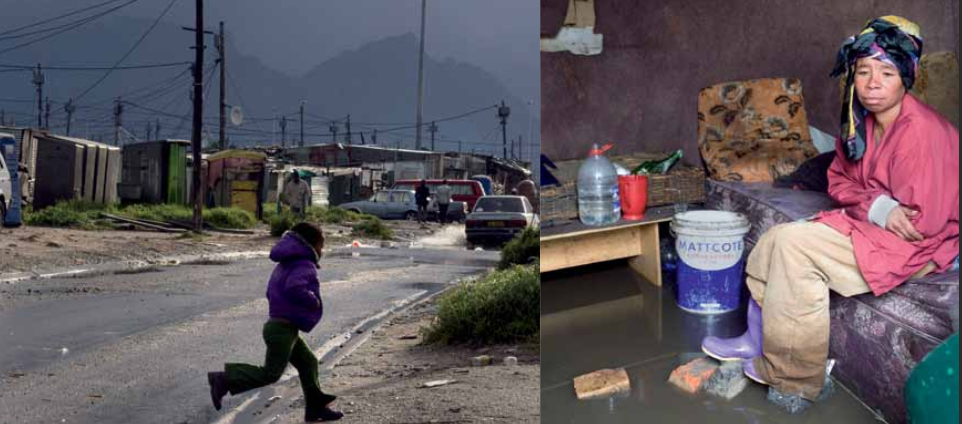
"Addressing life's challenges in Cape Town's flooded shacklands calls for communities and the municipality to work together, new research from the African Centre for Cities has found."
Implemented in the Cape Flats, a low-lying coastal zone outside Cape Town, South Africa, the FliCCR Flooding in Cape Town under Climate Risk (FliCCR) project was a 3-year research effort to explore how such shacklands can best implement effective decision-making processes within the context of climate change adaptation and high levels of informality. Past city efforts to upgrade the infrastructure, such as public toilets and improved sanitation and stormwater drains, have failed because communities were not consulted or involved in the efforts. Thus, the University of Cape Town's (UCT) African Centre for Cities (ACC) and partner departments studied how communities and the municipality can work together to implement effective solutions to the impacts of climate change. This project report shares the results of the research, which was funded by the International Development Research Centre (IDRC) and the United Kingdom Department for International Development (DFID) as part of the Climate Change Adaptation in Africa programme.
The researchers explain that, while the state used to force people of colour to settle in the Cape Flats under the apartheid regime, the area now attracts migrants from the economically poorer countryside. Tens of thousands live in cramped conditions, in low-cost formally registered houses, or in rickety squatter camps. When the winter rains come to this natural wetland, the high water table seeps up, pooling in and around houses, where it will stagnate for days. Even in the formally housed areas, where the wetland has been tarred over and cemented in, stormwater drains back up; debris and household waste then flood the streets and nearby homes and businesses. One resident, Bomkazi Sokhaya, says he lives with sewage-tainted water seeping into his home. The municipality's portable toilets are not emptied regularly, leaving many residents to use buckets as toilets, which they empty into the standing water near Sokhaya's home.
"Our work shows that there needs to be better collaboration between different sectors. That includes the different local government departments, civil society organizations - which may help with food and blanket distribution during a flood event - and volunteer leaders from within the communities themselves," explains Gina Ziervogel, senior lecturer in UCT's Environmental and Geographical Science Department. The work by her colleague Laura Drivdal, from UCT's Centre of Criminology, highlights the difficulties of community-level governance. Communities are often represented by committees, whose members are drawn from voluntary activists. Their role is to address issues such as safety and neighbourhood development and to negotiate with external actors such as local government, ward councillors, and civil society organisations. The expectations of these volunteer committee members can be unrealistically high, she says. Their community expects them to sway local authorities' decision-making processes. Meanwhile, local authorities expect them to rally the community together at workshops and meetings. In many cases, these community leaders don't wield nearly as much influence as they are expected to.
The researchers have developed a series of recommendations to guide the city's work with communities. They recommend for example, that it ensure transparency and report back to communities to avoid suspicions that could lead to conflict. They indicate that there should be:
- more human interaction, collaboration, and communication between affected parties;
- exploration of non-structural measures, such as planting shrubs or grass in flood-prone areas; and
- behaviour change amongst residents, along with information sharing such as warning new residents which areas are known to flood badly, and encouraging settlement on higher ground. Early warning systems, possibly even by SMS (text messaging), can send out alerts about localised flooding, urging people to move to higher ground, or indicate where the nearest shelter is.
"Many different civil society and non-governmental organisations (NGO) assist communities....The Jungle Theatre Company has run programmes on behalf of the Disaster Risk Management Centre, to educate communities about flood and fire awareness....These organisations need to be included in decision-making, problem solving and governance-related discussions." These steps are suggested to help build trust and cooperation as the city endeavours to work with communities:
- "Understand the political conditions in each settlement, through speaking with different residents and leaders.
- Assess and manage the expectations on leaders, transparency, people's roles and communication channels regularly.
- Manage residents' expectations by not making broad promises.
- Ensure constant transparency and report backs, avoiding suspicion and gossip which heighten internal tensions.
- Be aware of possible internal conflicts, political agendas and the possibility of self-enriching intentions. Negotiate internal tension, perhaps using professional negotiators.
- Work towards a culture of mutual respect and never underestimate the residents' competence, their knowledge about politics or technical issues, and their capability to learn."
In short, the idea is that "government" is based on hierarchy, where state and society are separate from one another. Local authorities may create "invited" spaces in which the community or civil society is allowed to participate. On the other hand, "governance" blurs the line between public and private, fostering networks between different parties so they can work towards common goals. "Collaborative governance" uses grassroots activism. Though this approach can involve conflicts that come with ideological clashes when different players come together, it tends to be less paternalistic and more inclusive. Hence, "flood risk governance" is an approach suggested to result in a more holistic understanding of the causes, impacts, and possible responses to flooding, which can build a platform for developing collaborative activities that will help reduce flood risk in a proactive way.
The municipality has indicated it is willing to foster collaboration across its departments and to work with communities and civil society organisations. It is looking for solutions to flood risk and carrying on education campaigns. It is also trying to buy privately-owned land so it can develop new housing areas. And it is prioritising at-risk areas for appropriate flood risk reduction measures. The City of Cape Town is also working to develop a rigorous coastal policy and management framework to better respond to the pressures of urban development and economic growth.
Email from Kelly Haggart to The Communication Initiative on November 2 2015; "New Ways to Deal with Cape Town's Flooded Communities", by Leonie Joubert. Image credit: Rodger Bosch ©, with additional contributions from Bruce Sutherland, City of Cape Town ©
- Log in to post comments