










































Routine Immunization Microplanning Challenges and Opportunities in Low- and Middle-Income Countries: A Mixed-Method Landscape Analysis
PATH (Salisbury, Hong, Ebeling, Shearer, Grapa); JSI Research and Training Institute (Hossain, Oskouipour)
"Being committed to carry out a plan that people themselves developed wound up being really important." - Global technical partner
Microplanning is an intervention used to systematically define the activities, resources, timing, and location of immunisation services, particularly to reach underserved or under-immunised populations. Initially introduced to immunisation programmes as a component of polio eradication activities, microplanning was incorporated into global guidance for routine immunisation with the introduction of the Reaching Every District (RED) approach in 2002. In this paper, the MOMENTUM Routine Immunization Transformation and Equity (M-RITE) project reviews the existing evidence on implementation and institutionalisation of microplanning, identifies strategies to improve microplanning, and documents evidence on new approaches to microplanning, including digitally enhanced and integrated microplanning.
M-RITE (described at Related Summaries, below) employed a three-stage mixed-method approach, using the Consolidated Framework for Implementation Research (CFIR) throughout the research process to guide the analysis. First, from June to July 2023, they conducted a literature review that yielded 39 articles on microplanning for routine immunisation. Second, from June to August 2023, they administered an online survey to gather insights from 63 individuals in 24 countries regarding the factors that constrained and enabled microplanning in low-resource settings. Third, they conducted 14 interviews with individuals from seven countries to better understand the barriers and enablers.
The project review found that the level of implementation and institutionalisation of microplanning for routine immunization was highly variable from setting to setting (between and within countries) and, in many, still highly dependent on partner resources. Although there was a paucity of published literature describing the drivers and effectiveness of microplanning and how to sustain it over time, the review did identify factors at both the development and implementation stages that influence implementation and whether the process is sustained over time. These include, for example:
- The level of community engagement: The engagement of community members and other non-traditional stakeholders was broadly acknowledged as being critical to the development of high-quality microplans. Key informants reported that the participation of community stakeholders resulted in microplans that were more reflective of local needs and priorities, particularly in the location and timing of immunisation sessions. In addition, the participation of local stakeholders encouraged greater local buy-in into microplanning implementation. However, engaging communities in the microplanning process requires additional resources, such as reimbursement for transportation costs, which immunisation programmes may not have.
- Healthcare worker (HCW) ownership: Cultivating ownership was found to be an important factor for motivating health workers to develop and implement microplanning. For example, JSI supported microplanning implementation in 25 districts in Uganda from 2014 to 2019 and found that HCWs experienced a higher degree of ownership over the microplans when they were engaged in the process of developing the plans.
- Access to high-quality and timely data: Microplanning requires accurate, timely data on priority populations and catchment areas. However, accessing high-quality denominator data was a commonly cited challenge. Local enumeration activities can provide up-to-date, high-quality data, but this process can be time- and resource-intensive. Digital tools, especially geospatial technologies, are another potential strategy to map populations for more accurate estimates. However, some key informants cautioned that digital tools, without community insights, cannot accurately capture migration patterns, community movement, or perspectives on the timing and location of outreach services.
- The complexity of microplanning tools: The literature and key informants indicated that challenges stem from the length and number of tools and templates, the detailed information required to populate them, and the Excel-based format of some templates.
- The extent to which supervisors follow up on the plans: Factors that key informants indicated enhance health worker ownership and motivation for implementing microplans were supportive supervision and mentorship, coupled with monitoring and accountability mechanisms from higher levels of the health system. One best practice cited by key informants for monitoring microplanning was creating a WhatsApp group to send reminders to immunisation focal persons at the subnational level. The WhatsApp groups provided a venue for higher-level authorities to encourage microplan development and use.
The project found a growing emphasis on digitally enhanced microplanning, especially the use of digital tools and applications to map catchment areas, identify high-risk populations, and estimate populations. Although there is some evidence to support the effectiveness of this approach in arriving at more accurate estimates, M-RITE stresses that they must not be viewed as a replacement for community engagement, as communities may not accept figures if they are not engaged in the process of developing those estimates. Furthermore, HCWs must be sufficiently capacitated to use the digital tools. Finally, while digitally enhanced microplanning can address some of the challenges identified through this review, it cannot address all and may in fact exacerbate some without careful evaluation of the costs and benefits.
Notably, many implementation constraints identified in the review, such as a lack of HCW ownership, accountability, and operational resources, are not specific to microplanning and instead more broadly reflect barriers to implementation of routine immunisation programming. As such, the sub-optimal implementation of microplans should not necessarily be interpreted as shortcomings of microplanning alone but rather as a reflection of broader weaknesses in routine immunisation systems.
In conclusion: "This review indicates that microplanning is most successful when HCWs are engaged in the development process, thereby increasing their ownership over the process and the likelihood of the plans being implemented. Likewise, community participation was found to contribute to the enhanced recognition of the barriers missed communities face in accessing immunization services, and to better inform the development of remedial strategies. While these findings highlight the benefits of a 'bottom-up' approach to microplanning, key informants cautioned that it is resource-intensive, and there remains a need for robust research and documentation on the costs and benefits of this approach."
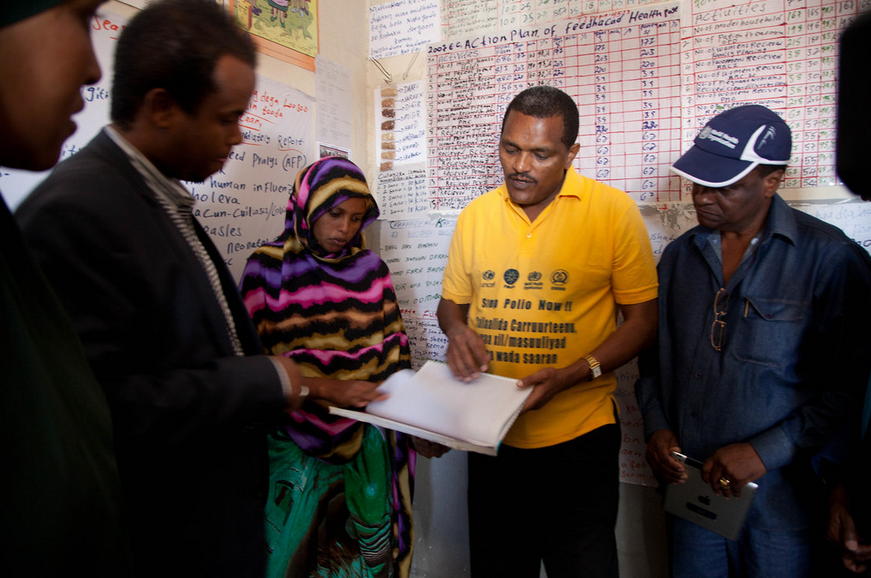
Vaccines 2024, 12, 1370. https://doi.org/10.3390/vaccines12121370. Image caption/credit: H.E. Dr. Kebede Worku talking to the local Women Health Development Army leader and others at Feedho Health Post, Fafan Zone, Somali Region. ©UNICEF Ethiopia/2015/Getachew via Flickr (CC BY-NC-ND 2.0)
- Log in to post comments