










































Samvedana Plus
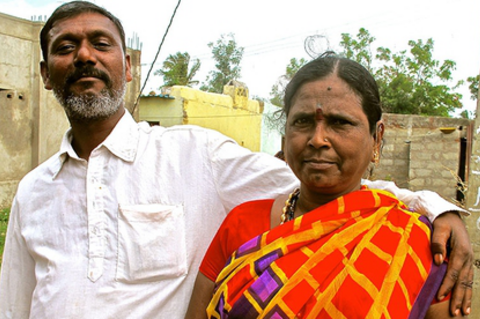
"HIV prevention interventions need to be specially calibrated to address...distinct structural sources of vulnerability and risk in intimate relationships."
Samvedana Plus is an intervention and evaluation study (2014-2017) to investigate the relationship between social norms around intimate violence and HIV risk in the context of sex workers' intimate partnerships and to assess the efficacy of the intervention in modifying these norms. The project is working with 800 female sex workers (FSWs) in 47 villages in 2 talukas of Bagalkot district, North Karnataka, India, to challenge disempowering gender norms, reduce intimate partner violence (IPV), and increase condom use in these intimate relationships. The project also works with FSWs' intimate partners (IPs), a community based organisation (CBO) of sex workers, and the wider society to achieve these objectives. Karnataka Health Promotion Trust (KHPT) is implementing Samvedana Plus in partnership with Chaitanya AIDS Tadegattwa Mahila Sangha (CATMS), a CBO of over 4,600 sex workers
KHPT asserts that effective interventions to address IPV use overlapping strategies to: shift norms about the acceptability of physical violence as a form of discipline; challenge gender roles that give men authority over women; and work with men and women to encourage new relationship models and flexible gender roles that promote equality. The objectives of working with FSWs are to: build their self-worth and collective efficacy; develop their skills to change norms of violence and negotiate safer sex; inform them about protective laws; empower them to identify solutions and support mechanisms; and enable them to act against violent and risky relationships.
Community engagement is central to this project. For one, the Samvedana Plus team recruits female outreach workers (ORWs) and trains them in gender, IPV, sexually transmitted infections (STIs)/HIV prevention, counselling, facilitating group sessions, and working with CBOs). Each female ORW manages 4 to 5 clusters, with 2 to 3 villages in each cluster, comprising 50 FSWs. A total of 8 ORWs (4 of whom are FSWs) reach 360 FSWs currently. ORWs meet the FSWs in their homes in the village. In each 20- to 40-minute discussion, the ORW covers information on programme activities, gender, and violence in general, and identifies if the sex worker needs counselling. The programme considers the distribution of female condoms as a key activity during outreach, as these provide an HIV prevention method that is FSWs control themselves. ORWs also lead individual counselling, provide links to services and commodities, facilitate group sessions, develop customised safety plans with each FSW, host special events meant to build solidarity among the FSWs and provide a platform for them to share their experiences of resisting violence with their peers, and help the District Programme Coordinator select certain sex workers (between 30 and 35 years of age) to be trained to become social change agents who will continue to advocate for prevention of violence against women after the end of the intervention.
The project also has 4 male outreach workers who work with the IPs to: conduct workshops with men to reflect on violence, norms, and alcohol use; to provide counselling to address issues of behaviour change; and to distribute and demonstrate condoms and to counsel men to use them in intimate relationships.
The intervention works at 3 levels:
- Individual level - for example, Samvedana Plus provides individual and couple counselling and holds workshops for the FSWs and IPs of FSWs. (Sex workers enumerated through the baseline survey were asked to identify their IPs and consent for them to be contacted by the project.) Female and male ORWs are recruited and trained in gender, preventing IPV and HIV/STIs, and working with CBOs. The aims of the outreach, similar to that described above, are: to make FSWs aware of intimate violence, their rights, and the law; to build skills to challenge norms and intimate violence; to negotiate condom use; to make IPs more sensitive and responsible in their relationships; and to encourage IPs to treat the sex workers with respect as equals.
- Community level - for example, Samvedana Plus engages with local community leaders, residents, family members, and self-help groups (SHGs) to design sustainable ways to prevent IPV, raise awareness about domestic violence, create networks of support and action within the community, and advocate for women's rights. Community dialogue, street plays, folk shows, and stakeholder meetings aim to increase awareness of relevant rights and laws. In 2015, street plays were held in 20 villages. The Samvedana Plus team develops scripts to focus on issues such as gender discrimination and stereotypes, female foeticide, eve teasing, child marriage, and domestic violence. ORWs along with FSWs from the CATMS gather support for the event by meeting with the village leaders, SHG members, and school management members. Together, they choose a venue and spread information about the play in the community. At the end of the play, the audience is invited to ask questions, and the ORWs and CBO members respond.
- CBO level - for example, Samvedana Plus seeks to strengthen the CBOs of FSWs in order to: recognise this form of violence (IPV) against members; stand together against IPV; and strengthen its own systems to stop this violence. A grassroots initiative of the CATMS, the Crisis Management Team (CMT) is set up to resolve disputes, establish women's rights and build a network of institutions providing legal counsel to rural FSWs. An external resource person facilitated a 3-day training of 6 members of the CBO Board and 18 CMT members. Using the manual developed by an external expert in discussion with the programme team, organisers arranged role play and games to prompt participants' critical thinking on how gender norms perpetuate violence. CATMS advocates with the government to give increased attention to IPV against FSWs while implementing the Domestic Violence Act. The CBO also carries out advocacy to change the attitude of the staff at government service centres, such as counselling centres, helplines, shelter homes, and short stay homes.
The evaluation employs a cluster randomised control trial design, including: quantitative baseline, midline, and endline assessments amongst FSWs, and baseline and endline assessments with their IPs; qualitative, longitudinal case studies with FSWs and their IPs; in-depth interviews with facilitators of the programme; and implementation monitoring. Click here [PDF] for the cluster randomised controlled trial study protocol. Click here to access all publications and resources emerging from Samvedana Plus, such as this implementation design document [PDF].
Violence against Women, HIV/AIDS
According to KHPT, inconsistent condom use within intimate relationships results from a combination of factors including: partner violence, alcohol, gender norms, notions of intimacy, trust and romance, sex workers' intention to have children, fear of losing their partner, and an inaccurate understanding of HIV risks. Research shows that sex workers who experience less violence use condoms more frequently than those who experience more violence. Violence can cause condom breakage and physical injuries, and prevents women from negotiating condom use. As most partners of sex workers have multiple, concurrent sexual partners, inconsistent condom use puts all at increased risk of STI and HIV.
The Samvedana Plus baseline survey of FSWs found that close to 51% experienced some form of violence from their partners. Approximately 66% believed violence in their intimate relationships to be justified if it was for the sake of the children or to keep the family together. Here, social norms around the acceptability of violence carried more weight than the individual's own perceptions. Among the challenges KHPT cites: Many community feel that sex workers "deserve" violence because they are considered immoral. Sex workers accept traditional gender norms and tolerate violence, as they see no recourse. Programmes to prevent violence against women tend to ignore sex workers, thus further marginalising them.
Organisers say that retaining ORWs, especially those from non-sex-worker community, has been a challenge. For instance, the programme selected young, unmarried women who are not from the sex worker community because the project expected skills in documentation and counselling. However, these ORSs sometimes struggle to sustain the rapport with the sex workers or work with the CBO, and some leave to get married or find new jobs. The constant need to build the capacities of ORWs has also been a challenge.
The programme, led by KHPT in partnership with CATMS, runs with support from the University of Manitoba, What Works to Prevent Violence against Women and Girls? Global programme, which is managed by the South African Medical Research Council and funded by UKaid (the United Kingdom (UK) government. The evaluation is funded by KHPT and the London School of Hygiene and Tropical Medicine (LSHTM) under the STRIVE consortium funded by UKaid the UK government. The views expressed do not necessarily reflect the UK government's official policies.
STRIVE website, Samvedana Plus Implementation Briefs, and What Works website - all accessed on June 2 2017; and email from Parinita Bhattacharjee to The Communication Initiative on June 3 2017. Image credit: Priya Pillai
- Log in to post comments