










































Scaling Steep Slopes - The Public Policies Helping to Transform Medellin
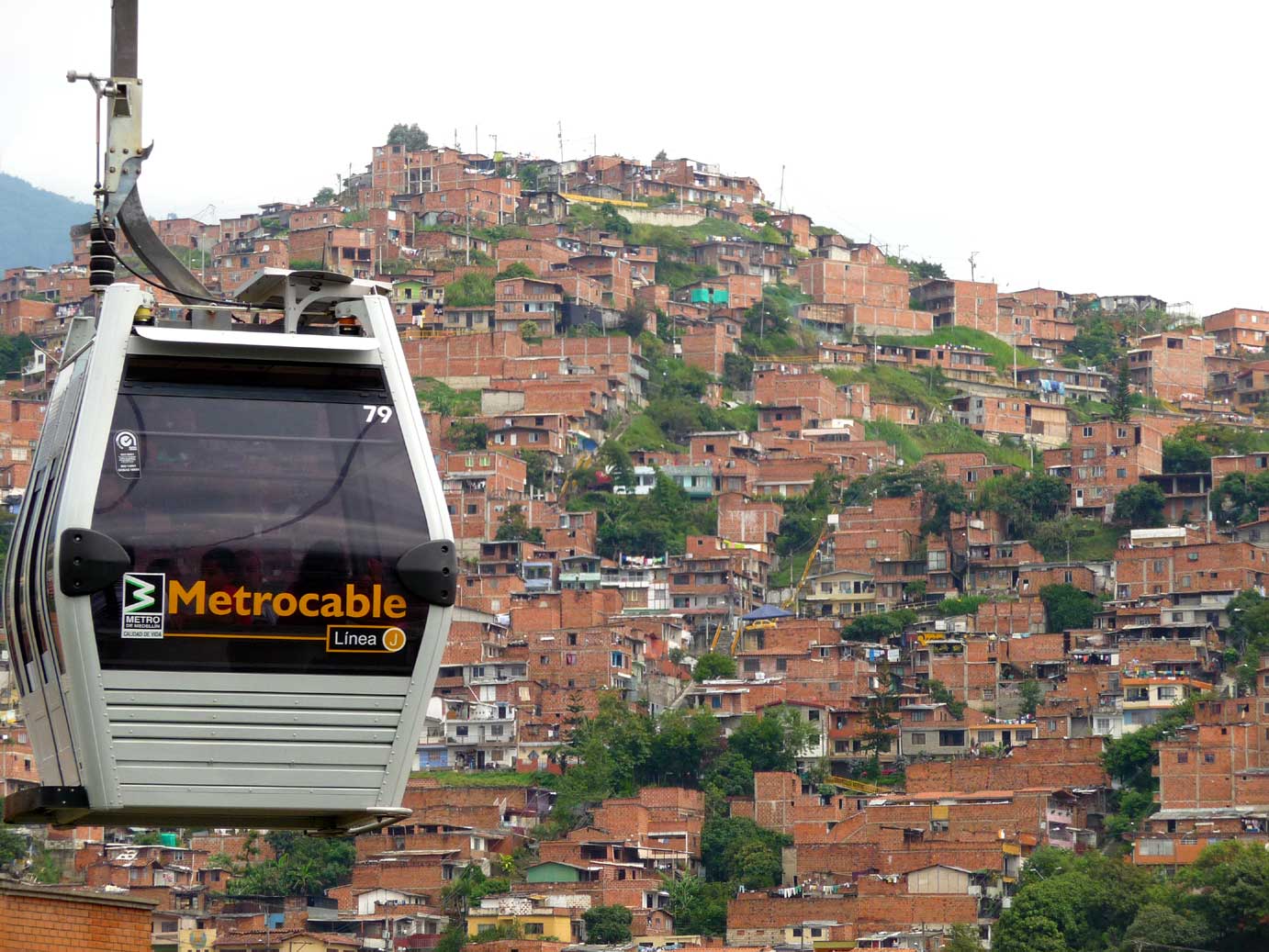
Can there be any argument with a policy that drives strategies and programmes that reduces homicides from 184 to 26 per 100,000 adults over a 5 year period [2003 to 2007]; significantly raises a city's Human Development Index score [74.35 in 2001 to 80.4 in 2006]; sees the Quality of Life Index zoom upwards [68.09 in 2001 to 83.77 in 2006]; and makes considerable economic gains for that city? Not to mention puts more smiles than frowns on people's faces and more pride than shame in their hearts? Such is the case of Medellin, a city of 2.5 million people in Colombia, and how it happened, and continues to happen, may have significant policy lessons across many aspects of international development.
Mention Medellin and most people - including me before a recent visit - immediately conjure images of drug cartels and unmitigated violence. Life was cheap. Hit men were abundant. Crime was endemic. Poverty was rife. Though a wealthy city the great majority of that wealth, including the tax pesos contributed by all, were in the hands of a very few. There were numerous "no-go" dangerous areas for public officials who were anyway severely mistrusted, often for good reason. The cartels ran the poor barrios where 90% of the population of Medellin live. Factions fought. Schooling was poor quality. Housing was primarily "informal". Medellin had these and other issues that are too commonly experienced across far too many cities. But that is a view of Medellin that is five years out of date, as indicated above.
The prime driving force for transforming Medellin into a comparatively safe, economically advancing and educated city is a set of public policies built around open public spaces, transparent public processes, the culture of citizenship, high quality for all and striking symbolism including [you need to stick with me here] cable cars, library parks, bridges, budget control and a botanical garden! There is still much to be done but huge amounts have been achieved.
The response of most cities to rising violence [and Medellin had the highest homicide rates in the world] is to close things down and to contain - to increase security, make that security increasingly visible and forceful and ensure that the places that the elite gather, live and work are comparatively safe. For many years, Medellin took that approach. It did not work. So, they took a 180 degree turn and opened everything up!
In the poorest and most violent communities, library parks were built. Five library parks operate at present, and many more are planned. These are as they sound - a combination of places of learning [library] and play [park]. They are places for the community to gather, to talk, to organise, to make and perform music, poetry and dance, to access other ideas [thousands of books and hundreds of computer terminals with broadband access], to network and to discover. The buildings and services are high quality. They are designed to be open - with numerous fully open access points [no entry gates or guards] and large numbers of open spaces as gathering and discussion venues. Security is minimal and never armed. The Library Parks have become both hugely popular and appropriated by communities. Closed doors have been replaced by open spaces - physically and psychologically.
Moravia is a very poor barrio in Medellin that was renowned for the worst violence. A significant venue for that violence was a local creek across which two communities used to shoot at each other. So, the city bought the houses either side of the creek at above market value, demolished those houses and on one side of the creek built a library park and on the other an open green park. The library park was the last building designed by Colombia's most famous architect - extremely high quality. But what was striking was the symbolism. They built three pedestrian bridges over the creek - actually and symbolically linking the two communities. And rather than forget the people who lived there, the names of those families whose houses were purchased are engraved into the glass side of the building. That symbolism resonated with significant meaning well-beyond the 100 meters either side of the creek. The library park is incredibly well used. The shooting did not go to another location. It dramatically reduced.
Medellin is in a very steep valley. As with so many cities, the economically poorest communities live on the outside in informal settlements. In Medellin, that means living on the side of mountain cliffs over a thousand feet high. It is a precarious existence. So the city built some cable cars - not just any old cable cars, but gondola style ones that would be the pride of any French ski resort. The effect was enormous and, according to the locals, immediate. It opened the community. For those that had a job, the previous 2-hours-each-way bus ride over snaky, narrow roads was replaced by a 20 minute journey in comfort. Family-, friend- and community-time increased from both quantity and quality perspectives. Many people's houses were now open to all to see from the gondolas. We are all vain and proud and when people can see your house you take extra steps to make that house attractive and safe. This has a knock-on effect.
With more people spending more time in their communities, businesses began to flourish. In one barrio there were 10 businesses before the cable car and now there are hundreds - mostly locally-commenced, -owned and -managed. Services came: there was no bank before - now there are banks; health facilities arrived. More bridges were built. The cracks down the mountainside divided communities. Suspicion and inter-community violence were rampant. So, pedestrian bridges were built across the "cracks" to link these communities. The spaces below the cable cars were made into walkways. People use these as connection points. This space, openness and connectivity is transforming these areas. Some of the most well-used libraries are at the entrance to the cable cars - people spend their time reading whilst travelling.
In the end, it often comes down to money. In Development, we always seem to be so reluctant to hand over the purse strings to people in their communities. Not Medellin. Seven per cent of the city's core budget - 70 million dollars - is now directly controlled by representative committees in some of the poorest communities in Medellin. Part of the agreement with the city by these communities is that they will go through a two-step process: first, consultation within the communities on priorities; and, then, allocation and monitoring of resources related to the agreed priorities. But the decisions are all their own. So, a community in a poor barrio can be responsible for millions of dollars of local expenditure. For those of us in development action, the stock-in-trade of governance and democracy progress is accountability, participation and transparency. Medellin has that in bucket-fulls. The people involved in deciding how these fund will be spent live in the communities in which they are spending. Everyone in those communities knows how much there is to spend and what the priorities are. These local decision makers see their friends, family and fellow community members all the time. Dialogue, transparency and accountability are high. Good decisions are made.
The media are a vitally important part of this process: not as strategic accomplices but just through doing their journalism and media roles according to their highest standards and ethics. There is no media in any country that can be isolated from and unaffected by the overall social and political mood [witness the USA media post 9/11 and pre Iraq involvement]. Medellin is no different. A closed, fearful, threatening city with power firmly in the hands of elites has to affect media reporting and insight no matter how high the media-related laws rank on some international freedom of the press scale. So, the first immediate effect of these policy changes on media in Medellin was to 'free up' the press as a more open social atmosphere emerged.
There were other specific and immediate effects. Everything outlined above - and much more for which there is no space at this time - is news! It is worthy of reporting. The kinds of social changes taking place produce numerous local stories and, perhaps more importantly, significant and real themes and issues for debate and dialogue - great stuff for all media. That media engagement really helps the overall change process - and it helps strengthen the media. It also provides an atmosphere in which the media can be creative: Just one example.
There are a large number of TV channels in Medellin and a mix of ownership patterns - from completely private sector to the Mayor's office. TeleMedellin is owned by the people of Medellin through the office of the Mayor. TeleMedellin executives have complete editorial independence. They are about to launch a new way of doing the news. The nightly news programmes will be hosted by local families from their homes. Sitting somewhere in their home the normal news reader will read the normal news in the normal way. But after each of the lead items they will turn to family members for their comment, reaction and insight. This opens up the news, makes it real and connects the news item to people's lives. But the integrity of the news as news is maintained. And it will certainly make a refreshing change from so called "expert opinion"!
There is often a park somewhere in most cities. That park is often a social space that has been lost to the broader community. Medellin has a botanical garden very near Moravia. Few people ventured there - certainly never at night. City officials decided that creating a vibrant, open, safe, beautiful botanical garden would not only be important in its own right, but would send a very powerful signal and message to the rest of the city. So, they got the park itself into great shape with the best examples of local vegetation. Then they replaced the solid wall around the park with a transparent fence, opening the park up so that people passing could see what was there and of course making it much safer for those in the park. A design competition was held for the public space created at the center of the park. It was won by a group of local architectural students competing against some of the biggest architectural firms in Latin America. Festivals - music, literature, drama, poetry - were organised and hosted in that public space. Then they created the best restaurant in Medellin [believe me - it is good!] which brought the elites into the park and gave them a vested interest in its future. The vibrancy and symbolism of this open approach were huge.
Two important parts of the Medellin strategy they label "nearness" and "delivery". At all levels of the city government, public officials were encouraged and supported to spend significant amounts of their work time in economically poorer communities engaging and listening - to get "near" to the people experiencing the most difficult issues - to spend as little time as possible sitting behind desks. And all public officials were expected to "deliver" on promises - they are accountable for and are judged on things happening. Underpinning both the "nearness" and "delivery" strategies is an attempt to "build trust". In our development rush to implement programes and projects, perhaps, as a policy imperative, we too often overlook the vital importance of "trust'. Let's face it, if people do not know the people saying that they will help them, if they are not "near" to them, if they do not see the results of that help, then there is hardly a solid basis of the trust required for development action on often very sensitive issues. Medellin is trying to address this vital element for all positive progress.
Leaving Medellin airport we were delayed by fog [a hazard of living in a high mountain valley!]. One of my CI Latin America colleagues introduced me to a fellow stranded passenger, an acquaintance of hers who turned out to be a leading business women in Medellin. She had little idea why we had been in Medellin. Before she could ask, I asked for her impressions and assessment of the change process in Medellin. She was unreservedly enthusiastic but from a very different perspective. Of course she cares about the development of people - as do those of us who come at this from a development perspective. But her primary interest is making money as a business women, and, for her, the economic climate in Medellin had improved markedly.
It's kind of hard to get economic development progress when communities are fearful, violence is high, people have difficulty getting to work and everyone's home situations are so precarious. Contrary to what we are often told about business people she did not even mind paying the taxes related to these developments because she had trust that the city would deliver - and, as they have delivered, she has a better environment to do business. She applauded and supported the public policy driving these changes. But this public policy aproach around public spaces, dialogue, debate, etc. is not something we see in many international agency macro-economic policies.
Perhaps what is most striking about the Medellin process from a development perspective is how it has gone counter to the current of the predominant streams of development thinking and strategy. It is a city-based process when much development focus and action is negotiated with and for the country/nation. There was no detailed micro-plan of action. The Medellin process is more akin to dropping a few well-placed stones in a lake in order to change the dynamics than it is to mapping out a detailed plan for how and where we want those ripples to flow. Medellin did not seek to follow global policies. Instead, it sought out the places from which it felt it could learn relative to the situation and issues in Medellin. Those places included three cities/regions whose positive development progress provided both ideas and inspiration - Bogota, Catalonia and Curutiba. But in the end they are doing it the Medellin way. There is a collection of organisations driving this process. The Mayor's office is vitally important for the overall policies. But there is a network of community groups, ComFama [the health care cooperative], the Mayor's office, EPM [more below], businesses and local NGOs - the shared, collective, leadership and ownership is real strength. It is an integrated approach - there are no issue silos here - at the core of all of this work is the creation of public space; openness, debate and dialogue; a culture of citizenship, community budget control and the importance of symbolism. For example, they did not set out to address violence specifically. They did set out to create more safe, open spaces expecting that those would have a significant effect across a range of related issues, including the levels of violence. You can feel the passion - and that passion is infectious. There is even a local civic group called Passion for Medellin. Finally, there is a specific emphasis on the often overlooked policy element of culture. The city of Medellin spends four times more money each year through its Culture budget than does the Federal Ministry of Culture for the whole of Colombia.
What is happening in Medellin is a grand public policy process in the rich tradition of the New Deal in the USA to overcome the Depression, the Marshall Plan for resurrecting Germany post World War II, the creation of the National Health Service in the UK in the late 1940s to improve health standards and other big public policy processes. The shape, style, scale, strategy and principles of the Medellin initiative are, of course, very different from those and other examples. But the public policy-driven process is not different. This is public policy in the driving seat, not market forces.
If I was to read your mind at this time, and if I was a betting person, I would lay a small wager that you have one question in your mind - "how did they pay for all of this?" The answer to this question deserves its own article because part of that response also runs counter to predominant economic development thinking and action. There were two main processes that created the funds to support all of the above and more. First, through greater transparency and accountability related to the city budget, the extent of the city's ability to make the significant investments highlighted above became very apparent. There was more city money than anyone thought. Second, and this is the counter-thought element, Medellin has pursued a policy of public ownership of public services [water, electricity, sewerage and now digital telecommunications] and has demanded that those services be efficient and profitable. EPM - Empresas Públicas de Medellin - the Medellin public utility company, is amongst the most efficient and profitable companies [all companies] in Latin America. And it is owned by the residents of the city through the office of the Mayor. There is no privatisation here. Consequently, there is no expatriation of profits beyond the valley walls. Instead, a substantial share of the profits, over 100 million dollars per annum, are immediately returned as investments in the city.
It would be a huge mistake to think that everything is fixed in Medellin or that these policies alone were 100% responsible for the change that is occurring. There are emerging challenges and other factors have contributed. For example, there there have been recent violent episodes involving de-mobilised guerilla and para-military personnel. It is still far too early to say what impact these overall public policy efforts will have long term on the wealth "gap" that is the curse of so many cities and countries including Medellin and Colombia. The death of the globally infamous cartel leader Pablo Escobar helped the situation as has the overall performance of the Colombian economy with record growth the past 4 years.
But quite clearly, based on the data and the local critique, huge progress has been made and these public policies have been vital to that progress. The mountains that ring the valley in which Medellin exists are indeed very high as are the social and economic challenges that the people living within that mountain wall face. But through a commitment to open public spaces, transparent public processes, the culture of citizenship, high quality for all and striking symbolism, big, positive changes are happening and the physical and social obstacles seem greatly diminished. It is well worth your in-depth policy analysis.
Warren Feek
Executive Director
The Communication Initiative
August 15, 2008
Comments
And Bogota too...
Hi Warren,
Thanks for creating this new public space for policy makers. Reading this prompted me to recall my last trip to Colombia, and as you briefly mention in your piece on Medellin, Bogota has gone through a very similar process. They also built libraries on the same principles - excellent design, open public spaces, built near the barrios - and combined with improved transit to reduce travel time for the poorest and ensure them better access to work and equal access to high quality learning and social spaces. Bogota also constructed a beautiful winding public park/pedestrian roadway which would be closed to traffic on certain days and filled with bicycles and people promenading. While I believe policies in Bogota have shifted a bit as new mayors have come into power there was a lot of emphasis on creating opportunities for people to reclaim their city spaces. A night where only women went out in the streets and men stayed home in solidarity. There were also mimes stationed at points in traffic flow known for frustrated/angry drivers doing stupid things - the mimes would caricature the actions and this had a marked impact on traffic safety. This is an example of transparency taken an extra step - the individual sees their own behavior mirrored back to them and others reflect on that persons behavior and likely their own as well.
I wonder how many other examples there are of this approach to public policy....
Thanks for writing this up.

in my dreams... Medellin transformation
In my dreams, in all of our dreams, this is what we would wish for - the revival of old fashioned community, and at the heart of this is culture; cultural activities that bind people together. I would dream of this in South Africa, but sometimes it seems that the very culture that should bind us together is what separates us. Who can agree on what the Springbok team should be called? Should we ever perform Shakespeare? Should ngoma dancing be done by women? Is virgin-testing abusive to young women? What should we call that street - after whom and why? Is Afrikaner nationalism worse than Zulu nationalism? Did Xhosas get a better deal under Mbeki's leadership? Why do whites care so much about their dogs and cats? And so it goes on and on...
Mistrust, disrespect, tribalism, prejudice, and blatant ignorance. That's our only united cultural currency.
US foreign assistance---3rd largest recipient
Hello Warren,
Being Colombian and having visited Bogota recently, I am very proud and impressed with the progress this wonderful country has made and certainly welcome such positive press about the many wonderful initiatives Colombians have taken.
As you may know, Colombia is the 3rd largest recipient of American foreign aid after Israel and Egypt. I would like to know how this is part of the figures of money available to Medellin. I think it's important to mention this and understand the role of these funds---and if and how they contributed to this success.
I visted Medellin 4 years ago, and it was beautiful---first time for my mother from Bogota, and there was much to be loved about this place. I admire their progress, just want full information.
Thank you.
Maria Claudia Escobar
Maybe there can be an argument...
I found the article about Medellin heartening, uplifting and inspiring. But while I read and rejoiced, a little nagging voice kept asking how this jives with Uribe's repressive government and the current drive to pass a Free Trade Agreement during a lame duck session. What's good for business and tourism isn't always good for people. Uribe has the worst record in Latin America for unionist killings. To bring down those numbers, family members of unionists have now been targeted instead. It looks good on paper but the reality is even more harsh.
Likewise, "economic gains" aren't always gains in self-sufficiency. In other countries like Peru, when the economic gains were broken down, they were shown to create more disparity between relatively well-off urban dwellers at the expense of indigenous highland residents. The rural poor create the "new wealth" through farming and mining, which is exported for money, which is used by the city-resident landowners to buy services and imported goods. The cycle is one that first suctions up the real wealth - food and goods - from the poor, sells them to the highest global bidder, and trickles the money back down. But it never reaches those who created it in the first place.
In Colombia also, indigenous communities are being brutally evicted from lands they hold title to, which is given to "rehabilitate" ex-paramilitaries on palm oil plantations. This increases economic growth and gives those who've committed violent atrocities some "green" retraining growing biofuels. After they've done one last job...
If Medellin is able to do all this without interference from the government, the cynic in me says that it serves their interest. While the rest of Latin America is "the most exciting place in the world," as Chomsky begins his recent article, I wonder if Medellin is Disneyland South - a show piece built on exploitation, cranking out "a small world after all" a little too shrilly.
Tereza at retrometro.com
Medellin, Colombia
I am exalted to read of this transformation. I was a Peace Corps Volunteer in Colombia from 8/72 to 12/74 in conservation and worked out of Medellin. Though much of my first year was in the selva of the Northern Choco', my second year I lived and served in Medellin. The "land of eternal spring", it was a wonderful time to be there. So my heart is gladdened to read of what the "orchid capital of the world" is again becoming. PM
Re. Scaling Steep slopes
I was really impress with the article on Scaling Steep Slopes because it makes me to know that there is hope for other impoverished nations. If only the people of those nations could be selfless and opened to other development strategies. This has uplifted my day knowing that third world countries CAN be known for positive thinking and non-voilence.
Thanks CI
This is an amazing post
This is an amazing post Warren - thanks
Ideas for Botswana
Thanks for your amazing article on Medellin! Truly inspiring!
We're starting to plan and develop a small training and cultural centre in a rural area 10 miles south of Gaborone. Your article gave us lots of ideas.
Now if we only had a few mountains to stick cable cars on!
Thanks again for making such a difference through articles like this and your wonderful work on CI !!!
Ross
No matter how bad things get...
What is happening in Colombia is inspiring. The leadership of citizens and local politicians in Medellin and other cities such as Bogota shows how local organization combined with a strong understanding of communication and an unwillingness to accept the status quo or continue to repeat failed approaches can have a huge impact in very difficult (some might have said hopeless) situations. There is much to be learned from these experiences.

A Response to Warren on Medellin
Thank you for this reflection, which I find so inspiring. It resonates on so many levels, and vividly demonstrates the shortcomings of imposing a framework on what strategies *should* be pursued to "fix" a particular problem (e.g., violence). The meanings of (safe) space and place for recouping the identity of a community - its pride - cannot be overstated. I think this is an excellent example of an innovative approach to an ostensibly intractable challenge...one that could not be carbon copied and applied elsewhere, necessarily - but that is just the point!
Feek's Public Spaces in Medellin
Klaus Heimann
this is interesting,different,even counter-intuitive.Is its success due to unique features of the host environment,or can it work equally in very different social settings?Israel seems unlikely.
Hello Warren, Thanks for
Hello Warren,
Thanks for this very interesting article. I'm studying Public Policy and I'm doing some researches about Medellin transformation and more specifically about how it has been done, what were the key players actors, what was the policy agenda...
Do you know where I can find such information?
Thanks for your help.
- Log in to post comments