










































Spaces for Engagement: Using Knowledge to Improve Public Decisions
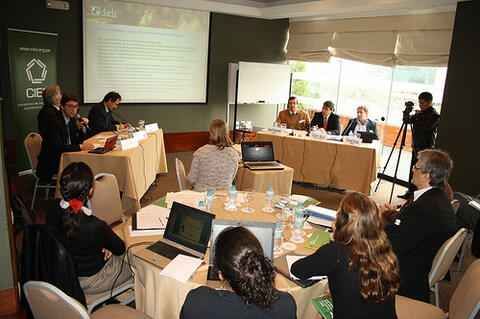
"Spaces for Engagement: Using knowledge to improve public decisions" is a partnership between Global Development Network (GDNet) and Centro de Implementación de Políticas Públicas para la Equidad y el Crecimiento (CIPPEC) that is designed to improve the bridging of science, research and policymaking in Latin America, mainly by strengthening the capacity of policy research institutes (PRIs) to influence public policies. Through promoting a range of activities (from online training to research production), the project seeks to deepen and expand a community of practice composed of researchers from PRIs and civil society organisations (CSOs) as well as policymakers who are strongly committed to improving the use of evidence in policymaking. The programme also promotes South-South collaboration by sharing knowledge and lessons learned with similar institutions in Africa and Asia.
The project is divided into these areas of focus:
Knowledge production
- Sound Expectations: From Impact Evaluations to Policy Change [PDF] - This paper outlines an analytical conceptual framework to be used in the production of a case study series. The cases are expected to identify factors that help or hinder rigourous impact evaluations (IEs) from influencing policy and improving policy effectiveness. Created to be adaptable to the reality of developing countries, it aims to enable researchers to produce case studies which identify factors that affect and explain IEs' policy influence potential.
- Weaving Global Networks: Handbook for Policy Influence - Designed for global and regional networks, civil society organisations, policymakers, and donors that support networks, this handbook endeavours to improve knowledge about how these networks of potential policy influences operate.
- Learners, Practitioners and Teachers: Handbook on Monitoring, Evaluating and Managing Knowledge for Policy Influence [PDF] - With the publication of this handbook, GDNet and CIPPEC aim to support organisations that can monitor and evaluate their interventions and to develop systematic strategies for knowledge management. It includes stories of previous experiences in these fields in the region of Latin America, reflections on the most common challenges and opportunities, and concrete working tools. These contributions aim to pave the way for the influence of public policy research in the region. Click here to download the Spanish version [PDF].
- Series: How to build a policy influence plan? - Organisers say that, in public policy contexts, people may have doubts about the utility to plan how they want to influence decision makers. With the support of GDNet, CIPPEC developed this series of how-to guides, which include an approximation of the basic concepts and some tools to develop a plan for policy influence. Please click on each URL to access them in PDF format.
- What is an influence plan. Why should we plan [PDF]
- The policy making process. Analyze the context for effective influence planning [PDF]
- Where are we and how far can we go. Identify strengths, weaknesses, opportunities and challenges [PDF]
- What we desire. Define influence objectives [PDF]
- Who should we work with. Define actors and alliances [PDF]
- How to generate the desired impact. Define the proposal [PDF]
- How to carry out the proposal. Define strategies and actions [PDF]
- How to communicate. Define the strategy and key messages [PDF]
- Who, how much and when. Define resources and timeline [PDF]
- What have we learned? An approximation to monitoring and evaluation of policy influence [PDF]
- Series: How can we monitor and evaluate policy influence? - According to organisers, many organisations recognise that, sooner or later, they need to deepen the way they measure their impact in terms of policy influence. There are multiple challenges of doing so - from the scarcity of specific resources and internal knowledge for this type of exercise to the difficulty of measuring the degree of influence on the generation of a public policy. In addition, few concrete experiences (positive or negative) have been shared in this field. However, there are also many reasons to start a process of monitoring and evaluation (M&E). This series invites organisations to explore the opportunities and challenges of this practice, addressing specific tools to develop a system of M&E. Below are the contents in PDF format.
- Why should we monitor and evaluate policy influence [PDF]
- Step One: where are we and where do we want to go [PDF]
- Establishing the basis for the M&E strategy [PDF]
- Defining how to measure short, medium and long term results [PDF]
- Data collection methods [PDF]
- Using knowledge to improve policy influence [PDF]
- Series: How to communicate research for policy influence - Toolkit N° 1: Policy briefs [PDF] introduces the definition and features of policy briefs, one of the tools most widely used by policy research institutes to influence public policies. It includes:
- A series of research papers which aim to shed light on how think tanks conduct research for policy, such as monitoring and evaluation of policy impact, production of new communications tools, influence of funding models on policy impact strategies, and strategic alliances with media.
- Comparative studies that are designed to contribute to the reflection and debate in Latin America on the roles and challenges facing PRIs when they seek to bring the knowledge they generate into the public policy realm.
- Case studies on linking research and public policy and on monitoring, evaluation, and knowledge management of public policy influence.
- Bibliographical reviews that are meant to identify, summarise, and analyse available information at GDNet on a specific topic to support a policy influence process conducted by a PRI.
Knowledge sharing and capacity building
- Regional conferences - "Use of Knowledge for a Better Public Policy Influence" (Lima, Peru, August 2011), "Training on Monitoring, Evaluating and Managing Knowledge on Policy Influence" (Buenos Aires, Argentina, July 2010), "Bridging Research and Public Policy in Latin America" (Buenos Aires, Argentina, June 2009), and "Linking Research Communication to Policy Impact through Knowledge Management" (Buenos Aires, Argentina, February 2008).
- Online courses - In 2010, GDNet and CIPPEC created an online training space, through which they have delivered online courses on how to draft a policy influence plan, how to monitor and evaluate policy influencing, how to communicate research, and how to improve childcare policies. Through a combination of theoretical modules and practical exercises, courses aim to help CSOs, policy research institutes, universities, and policymakers detect their strengths and opportunities for policy influence. Debates and exchange of experiences among trainees are also promoted. Technical advice is provided by facilitators through detailed feedback on exercises. As of October 2012, CIPPEC and GDNet have developed 12 online courses on critical issues for policy influence - 8 for Latin America and 4 for Asia and Africa - with the participation of more than 175 trainees belonging to more than 40 countries around the world.
- Peer assistance - CIPPEC and GDNet support cross learning between policy research institutes in Latin America, Africa, and Asia in critical issues for policy influence. The objective is to contribute to strengthen think tanks' policy influence through access to lessons learned by their peers and colleagues. To date, CIPPEC and GDNet have supported 6 peer assistance experiences involving policy research institutes from Argentina, Colombia, Ecuador, Nicaragua, Peru, Uruguay, Venezuela, and Zimbabwe.
- Executive Directors of Latin America (DEAL) - DEAL is a community of practice that brings together executive directors from policy research institutes in the Latin America region interested in improving the impact of policy research. DEAL is a space that allows the search for answers, the sharing knowledge, the exchange of best practices and lessons learned, the discussion of challenges and dilemmas, and the receipt of materials and skills.
- Online communities on the use of evidence in climate change and childhood policies - CIPPEC and GDNet coordinate 2 online communities addressing the use of evidence in childhood and in climate change policies, with more than 60 participants from 14 countries and 80 participants from 17 countries, respectively.
- VIPPAL and newsletter (only available in Spanish) - CIPPEC and GDNet launched an online platform, VIPPAL - Bridging research and policy in Latin America, which is a virtual space for all those interested in strengthening the links between research and public policy in Latin America. VIPPAL also has a monthly newsletter addressing Latin American researchers, CSOs, think tanks, policymakers, journalists, and members of international organisations interested in bridging research and policy in Latin America.
- Other workshops and presentations - Encouraging south-south collaboration, CIPPEC and GDNet also share lessons learned and deliver trainings in different countries. Among other collaborations, they have delivered trainings on research communication and policy briefs in Peru, Kenya, Tanzania, and Uganda and share lessons learned in conferences in Nigeria and Canada.
Content in English is available at GDNet's site. Content in Spanish is available at the VIPPAL site.
Science
GDNet and CIPPEC
Connect South website, September 27 2012; and emails from Leandro Echt to The Communication Initiative on October 9, October 12, and November 2 2012.
- Log in to post comments