










































Technique-based Inoculation against Real-world Misinformation
University of Cambridge
"[I]nvestigating whether active inoculation interventions can...be effective at preventing unwanted persuasion attempts found in real-world misinformation gives insight into how...to pre-emptively counter such misinformation."
During the COVID-19 pandemic, misinformation and conspiracy theories that have proliferated online have been linked to diminished willingness to follow health guidance measures and reduced intentions to get vaccinated. Concerned by such trends, researchers have turned to psychological and behavioural science. For instance, inoculation theory is a framework for reducing susceptibility to both individual examples of misinformation (issue-based inoculation) and to the techniques and strategies that are commonly used to mislead or misinform people (technique-based inoculation). This study's two separate experiments ask whether the latter type - technique-based inoculation - can (i) reduce susceptibility to real-world misinformation that went viral on social media and (ii) confer cross-protection against misinformation that inoculated individuals were not trained to recognise.
As the researchers explain, inoculation theory posits that pre-emptively exposing individuals to a weakened form of a misleading argument and teaching individuals how to refute those arguments triggers the production of "mental antibodies". This process has been shown to confer psychological resistance against future manipulation attempts, much like a medical vaccine induces resistance against a particular pathogen.
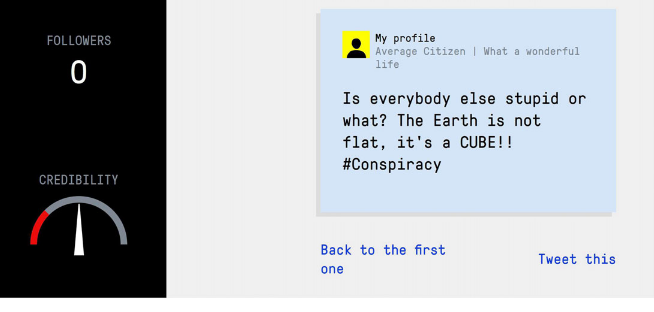
One example of a technique-based inoculation intervention is Bad News, a free 15-minute online game in which players learn about six common misinformation techniques, a categorisation known as DEPICT: Discrediting opponents, Emotional language use, increasing intergroup Polarisation, Impersonating people through fake accounts, spreading Conspiracy theories, and evoking outrage through Trolling. In the game, players take on the role of a fake news creator and are tasked with building a fake news empire by (i) gaining as many followers as they can and (ii) maximising their credibility. During the game, players are forewarned about the threat of misinformation and exposed to weakened doses of the strategies used in its production, consistent with the mechanisms of inoculation theory.
For the present study, the researchers implemented two voluntary pre-post survey experiments within the Bad News game environment between March 15 and September 7 2020, involving 2,188 participants in total.
- Experiment 1 (n=1,216) uses social media posts that make use of one of the DEPICT techniques to test if the Bad News game reduces susceptibility to real-world misinformation. In total, participants were shown nine social media posts before and after playing Bad News (two control items, one item for each of the six techniques, and one item about COVID-19). For the misinformation items, the researchers find a significant reduction in perceived reliability post-gameplay, which translates to 64.4% of the post-gameplay reliability scores being lower than the mean of pre-gameplay reliability scores. They also found that participants rate all six misinformation posts that made use of one of the manipulation techniques learned in Bad News as significantly less reliable after playing. In addition, truth discernment increased significantly after gameplay, indicating that Bad News players improve in their ability to discern real information from misinformation. The effect of inoculation was most pronounced for those who were most susceptible to misinformation prior to gameplay.
- Experiment 2 (n=968) uses a different set of false and true headlines that do not explicitly make use of a DEPICT technique to test whether cross-protection against untreated misinformation is achieved. Specifically, participants were shown a series of real and false news headlines (including headline source) as they may appear on someone's social media feed. Notably, experiment 2 asks about the accuracy rather than the reliability of a set of headlines. Overall, this experiment showed that playing the Bad News game significantly decreases the perceived accuracy of false headlines, with no effect on real headlines, leading to improved truth discernment. The researchers suggest that these "results show a reduced (but still significant) inoculation effect even for misinformation that Bad News players were not inoculated against, indicating partial cross-protection..."
Although not a consistent finding, the observed decrease in the perceived reliability of real news warrants further discussion, as this is not an explicit goal of the inoculation intervention. The researchers argue that this finding is not a major concern.
The researchers suggest that future research further explores the potential cognitive and affective mechanisms by which active inoculation interventions can confer resistance to misinformation, particularly insofar they (i) make people aware of their own vulnerability and (ii) elicit greater motivation to protect oneself from manipulation.
In conclusion, the experiments performed as part of this study "corroborate previous findings that playing Bad News improves people's ability to spot misinformation....This is especially important in light of the game's relatively easy scalability (being free-to-play in a browser on a phone, computer or tablet) and availability in approximately 20 languages. The game may be implemented as part of media literacy curricula in schools, or played as a standalone game in-browser. In addition, the game may be deployed in conjunction with other anti-misinformation tools such as videos..., 'prebunking' infographics..., accuracy-based interventions...or media literacy interventions...to improve resilience against online misinformation at scale."
Royal Society Open Science 9: 211719. https://doi.org/10.1098/rsos.211719. Image credit: Bad News
- Log in to post comments