










































Use of the Arts in Social Mobilisation for Typhoid Conjugate Vaccine in Pakistan
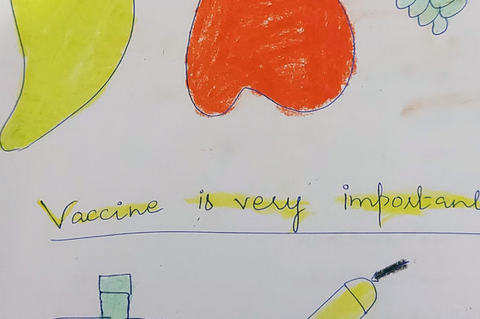
"[W]hen we use creative arts, we access different pathways to accept and understand the values of a health program or intervention. For this reason, social mobilization strategies should engage with the public using approachable, arts-based mediums. These mediums help provide evidence-based information and positive narratives about a vaccination program." - Habib Afsar, Center for Arts-based Methodologies and Well-being (CFAW)
In Pakistan, social mobilisation has played a significant role in motivating individuals and communities to take part in the typhoid conjugate vaccine (TCV) campaign, which seeks to reach nearly 30 million children. During the two TCV campaigns in Punjab Province, Pakistan, in February and June 2021, Center for Arts-based Methodologies and Well-being (CFAW), an initiative housed at PHC Global, conducted a series of arts-based community mobilisation sessions. The project aimed to engage with specific populations, particularly those considered vulnerable or harder to reach - giving them alternative ways to raise their voices and hopefully providing them with a sense of empowerment and ownership to make their own choices about TCV for their children.
This initiative integrated art, creativity, and health communication to empower local community members and foster a process of critical reflection. The project team believed that if communities understood the context of typhoid (causes, risk factors, personal impact, prevention, and health services), they would decide to get their children vaccinated with TCV. This approach, built on trust and honesty, is in contrast to a rigid, often clinical, structure that can exacerbate fears and concerns. Such approaches can cause people to feel "forced" to take a vaccine.
The central idea of using resource-oriented, arts-based methodologies in a health context is to enable people to recognise and exert their personal agency. An arts-based approach not only broadens the perspective of what is understood as "knowledge", but it also creates opportunities for participants to determine their own values. As such, arts-based methodology can contribute to the development of locally and contextually appropriate interventions to elicit social change. Furthermore, art-making can accommodate people who learn in different ways and those with varying levels of literacy. It can also reduce hierarchical divisions and tensions.
Over a 2-week period, 12 community workshops were held in all cities with 236 beneficiaries and influencers participating in total. Participants consisted of school-going children, teachers, community influencers (health workers, imams (religious leaders), union council representatives), and parents. Although the sessions were 90 minutes in length, more often than not, they continued far longer than the allotted time. The project team rooted each session based on the assumptions that:
- People care for their health and the health of their families and communities.
- By creating agency, communities are more likely to act with responsibility and make informed decisions.
- By establishing a dialogue in a "safe environment", people speak of their fears and expectations, which may have direct and indirect implications on effective communication strategies.
Based on these assumptions, as a first step in facilitating community agency, the team acknowledged that the community had some awareness of typhoid and was not being dictated to take action. Therefore, the sessions started based on the knowledge they already possessed around typhoid. Once rapport was established, the health staff offered clarifications, corrections, or technical details. This was the foundation for the action that the communities would take to get their children vaccinated and encourage others in the community to do the same.
For the groups that included both health workers and community members, the session started with an exploration of the holistic concept of health. Leaders asked participants to describe their subjective experience with health and to brainstorm the specific times and activities in their normal day when they feel healthy. Discussions showed that participants understood health as a holistic construct where physical, mental, social, and spiritual health are interrelated. Next, participants discussed two concepts as part of the holistic construct of health: resilience and prevention. Prevention, ostensibly, relates to the concept of immunisation as a personal and collective responsibility.
Based on these concepts, participants were then asked to create a health poster and develop a simple slogan, using simple art materials. The idea is that making art, especially in a community setting with no expectations for quality or methods, can be enjoyable and can lead to an aesthetically pleasing output. For this reason, it can engender a powerful and empowering feeling of having created something. Often, participants likened the activity to their childhoods, evoking pleasant memories of more carefree and playful times.
In the community groups, the second part of the session focused on typhoid as an endemic disease. The leaders started off identifying what the community already knew: what the disease was called in local terms, the signs and symptoms, and if there were any myths associated with typhoid. Next, they followed up with accurate information about typhoid and re-introduced the concepts of preventive health and resilience. In particular, they emphasised the importance of vaccination programmes as part of this preventive aspect and discussed the importance of the inclusion of TCV in the routine immunisation programme. Community members also openly talked about cultural and religious reasons that support preventive measures such as immunisation.
After some basic information about the TCV campaign and the importance of getting children vaccinated, participants were encouraged to ask questions. The most common concerns raised had to do with side effects, vaccine quality, and the confusion related to several vaccination programmes happening simultaneously (e.g., polio, TCV, and COVID-19 campaigns). The project team stresses that, when people are provided with the opportunity to critically look at an issue with all relevant information in a safe space, they will use their agency to raise doubts and decide on the best options for themselves. The team views doubts and concerns as "real" questions being raised by the communities that must be considered when developing a strategic communication strategy.
For the sessions with health workers and managers (83 total participants in 4-hour-long sessions), the project team assumed that:
- The health teams were experienced and working to their full potentials.
- The working environment during a vaccination campaign can be extremely stressful.
- Recognising, validating, and encouraging health teams will lead to enhanced motivation and better outcomes.
Thus, for these groups, the focus of the art-making activities was on enhancing self-esteem through personal resource identification, as well as team building, psychosocial support, and general morale boosting. After sharing the science of the stress response and how it can affect our mental, physical, and social health, the leaders introduced a few stress-relieving exercises and practiced breath work in the groups. They also provided space for health workers to share any frustrations. Parting words encouraged them to keep up their valiant efforts to reach millions of children with TCV.
As a final step, organisers ensured the art created was validated and displayed on the walls of the room. In the case of one student group, the posters created were presented to the whole school as a pop-up exhibition and became the focus of a broader discussion. During what was intended to be a non-threatening and empowering event, the artwork helped transform a rather morbid discussion on a killer disease to a broader and deeper celebration of health - physical, mental, social and spiritual- as well as our personal responsibilities to create healthier environments for all.
During the social mobilisation sessions, the team took field notes reflecting on the experience as well as photographic and video documentation. They also gave attendees at each session pre-and post-tests. Community groups took a short vaccine hesitancy questionnaire developed by the World Health Organization (WHO) SAGE Working Group. Health workers took the Rosenberg Self-Esteem Scale.
For more information about the use of arts-based methodologies, please visit the CFAW website.
Immunisation and Vaccines, Children
Typhoid, while mostly eliminated from high-income countries, continues to be a major cause of illness in low- and middle-income countries, especially in places where water and sanitation (WASH) infrastructure is lacking. Sindh Province is one such place. There, and increasingly in other parts of the country, officials are dealing with extensively drug-resistant (XDR) typhoid outbreak, which continues to infect children. Children who fall ill with XDR typhoid strains, which are resistant to all but one oral antibiotic, may face challenges finding (affordable) treatment. On November 18 2019, Pakistan became the first country to introduce TCV into its routine childhood immunisation programme.
"Leading the way: Pakistan introduces typhoid conjugate vaccine", by Farzana Muhib, Senior Program Officer, PATH - posted on the Coalition against Typhoid (CaT) website on November 18 2019 and accessed on August 9 2022; and "Arts-based methods in social mobilization for vaccines", October 6 2021, Arts-based methodologies as a tool for community engagement, team building, October 11 2021, and "Arts-based community mobilization and social impact", October 13 2021 - all by Habib Afsar, Center for Arts-based Methodologies, Pakistan, posted on the CaT website, and all accessed on August 9 2022; and email from Habib Afsar to The Communication Initiative on August 10 2022. Image credit: PCH Global
- Log in to post comments