











































Vaccine Acceptance, Hesitancy and Refusal in Canada: Challenges and Potential Approaches
Institut national de santé publique du Québec (Dubé); University of British Columbia (Bettinger); Western University (Fisher); BC Centre for Disease Control (Naus); University of Manitoba (Mahmud); Manitoba Health (Hilderman)
"While the scientific and medical consensus on the benefits of vaccination is clear, an omnipresent negative discourse around the safety and efficacy of vaccines continues to play out in social and traditional media."
Most Canadian parents choose to provide all recommended vaccines to their children, and childhood immunisation rates are generally high across Canada. However, there is some evidence that a significant proportion of Canadians hold negative views about vaccination. In the absence of standardised indicators and without immunisation registries, it is challenging to measure the scope of vaccine hesitancy in Canada. However, it is a concern: Results of one study indicate that frontline vaccine providers believe that vaccine hesitancy is an increasingly prevalent issue in Canada. In this context, this article explores vaccine hesitancy in Canada and proposes potential approaches to address it.
As the authors explain, vaccine hesitancy is complex and multidimensional. But one cause articated in several studies is the presence of negative and false information about vaccination online and in social media. Many studies have shown that, like most health behaviours, vaccine behaviours are complex, and knowledge is only one of many determinants of vaccination decisions. Explained in the paper is the 3 Cs model - confidence, complacency, and convenience - which outlines 3 key interrelated causes of vaccine hesitancy.
Meta-analysis of the effectiveness of different interventions to reduce vaccine hesitancy and/or to enhance vaccine acceptance reveals that simply communicating evidence about vaccine safety and efficacy to those who are vaccine hesitant is no "magic bullet". Studies conducted in different settings have shown that vaccine-hesitant parents appear to be well informed individuals; approaches that assume a "knowledge deficit" often fail to account for the complexity of the hesitancy phenomenon. Therefore, addressing vaccine hesitancy requires strategies that are: tailored to the concerns of the different segments of the population; based on an empirical understanding of the situation; multi-component; ongoing; and proactive.
More specifically, citing others (footnote numbers omitted in the following excerpt), the authors explain that "Changing risk perception (a subjective judgment that people make about the characteristics and severity of a risk) through communication means that messages need to be tailored and targeted to account for the realities of community specific knowledge systems (e.g., adapted to address a vaccine scare peculiar to a specific context or tailored to religious beliefs of a specific community) and the unique information needs and preferences of particular communities." They suggest that successful communication is a two-way process that entails listening as well as speaking. This enables a deeper understanding of the perspectives of the people for whom immunisation services are intended.
The authors recommend that future public health vaccine promotion efforts embrace internet- and social-media-based possibilities and proactively promote the importance and safety of vaccines rather than engage with (attempt to refute) anti-vaccination activists' arguments. Strategies for online communication should aim to provide vaccine supportive information, address misinformation published online, and align with parents' needs and interests.
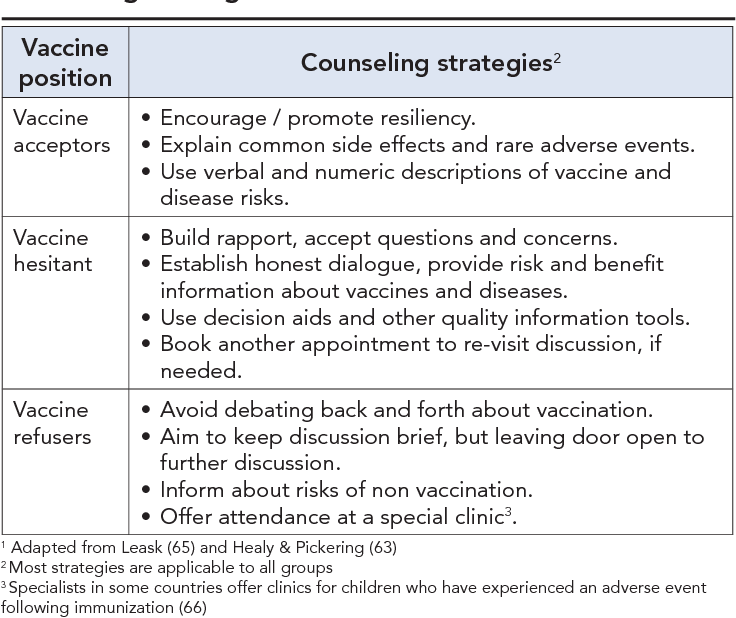
That said, studies show that Canadian parents still consider healthcare providers their most trusted sources of information and advice about vaccination. Messaging that advocates vaccination too strongly may be counterproductive for those who are already hesitant. Many tools exist to help providers in their discussions with vaccine-hesitant or vaccine-refusing patients; common characteristics include the importance of maintaining a trustworthy patient provider relationship and the need to tailor communication to patients' specific concerns and doubts (see Table 1 above and in the paper).
The paper concludes with a call for additional research: "Systematic theory-driven research on the determinants of vaccine acceptance and uptake, overall and by vaccine type at the public, provider and system levels are needed to inform policy and interventions. Evaluation research and randomized trials are also needed to assess the effectiveness of interventions, acquire insights on how they work and identify which approaches are most effective for different groups and populations."
Canada Communicable Disease Report 2016;42(12):246-51. https://doi.org/10.14745/ccdr.v42i12a02
- Log in to post comments