










































When Celebrities Speak: A Nationwide Twitter Experiment Promoting Vaccination in Indonesia
World Bank (Alatas, Paladines); Stanford University (Chandrasekhar); National Bureau of Economic Research, or NBER (Chandrasekhar, Olken); Abdul Latif Jameel Poverty Action Lab, or J-PAL (Chandrasekhar, Olken); Microsoft Research, New England (Mobius); Massachusetts Institute of Technology, or MIT (Olken)
Social media have allowed celebrities to take an increasing role in social discourse in that they have a direct channel to spread messages on a wide variety of issues, many of which are far removed from their original reason for fame. This paper asks whether celebrity endorsement per se has an effect beyond the fact that their statements are seen by many, and whether on not their statements actually lead people to change their beliefs and offline behaviour. To do so, the researchers conducted a nationwide Twitter experiment in Indonesia with 46 high-profile celebrities and organisations who agreed to let the researchers randomly tweet or retweet content promoting immunisation from their accounts. The experimental design involved randomising the content and timing of tweets and retweets among participants.
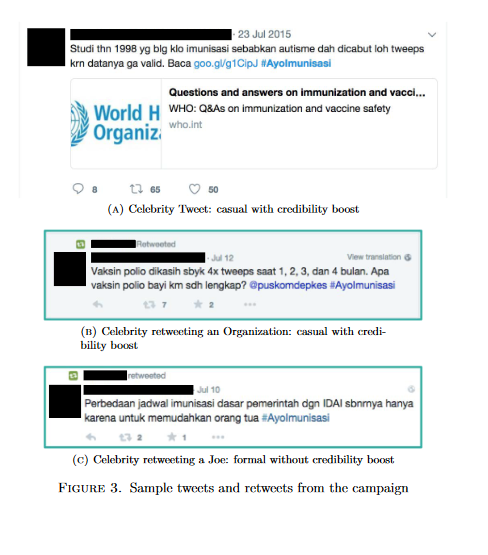
Specifically, the researchers conducted an experiment through a nationwide immunisation campaign on Twitter from 2015-2016 in collaboration with the Indonesian Government's Special Ambassador to the United Nations for Millennium Development Goals. A set of 550 tweets was developed in close coordination with the Ministry of Health that included: information about access to immunisation (e.g., immunisations are free and available at government clinics); information about the importance of immunisation (e.g., immunisations are crucial to combat child diseases); and information designed to combat common myths about immunisation (e.g., vaccines are made domestically in Indonesia and are therefore halal, or permissible in Muslim law). For each tweet, the researchers also identified a source (either a specific link or an organisation's Twitter handle). All tweets included a common hashtag, #AyoImunisasi ("Let's Immunize"). Each tweet was written in Indonesian, and 2 versions were prepared: 1 using formal Indonesian, and 1 using casual/street Indonesian, to match the written tweeting styles of the participants.
Working with the Special Ambassador, the researchers recruited 46 high-profile celebrities and organisations, with a total of over 7.8 million followers, each of whom gave them access to send up to 33 tweets or retweets promoting immunisation from their accounts. The researchers randomly chose the content and timing of each of these tweets from the set of tweets approved by the Indonesian Ministry of Health, as described above. All participants joined knowing they would not be able to control the text or timing of the tweets.
The experiment randomly varied the tweets along 3 dimensions in order to address these questions: (i) Did the celebrity/organisation send the tweet from their account, or did they retweet a message (drawn randomly from the same tweet library) sent by the researchers from an an ordinary (non-celebrity) user's account?; (ii) Did the tweet explicitly cite a source to bolster its credibility?; (iii) Which days of the campaign did this influencer-tweet/retweet event happen? This design exploits the structure of what information is passed on along a retweet chain on Twitter to parse reach versus endorsement effects.
In short, the researchers found strong evidence that the celebrity’s endorsement per se matters. In particular, they found that, when an individual observes a given message through a retweet, and that message was randomised to be composed by a celebrity as compared to an ordinary individual, there is a 70% increase in the number of likes and retweets, compared to similar messages when the celebrity's involvement was masked.
By contrast, explicitly citing sources in the tweets actually reduces diffusion. That is, messages are less likely to be passed along if they are randomly assigned a source. This is true regardless of whether the tweet was composed by the celebrity themselves or composed by an ordinary person and retweeted by a celebrity. The magnitudes are substantial: For instance, randomly attaching a source to a tweet that the celebrity retweets corresponds to a 50% decline in the subsequent retweet rate. One interpretation is that the information is less novel if it is sourced.
Another piece of the online analysis is to examine exposure effects: Does hearing a message multiple times (from multiple different sources) have linear, concave, or convex effects on the probability of passing on the message? This is important because if an individual passes on messages after a single exposure (simple contagion) versus requiring many exposures (complex contagion), the diffusion processes wind up being very different. In the latter case, central individuals such as celebrities may matter more. The researchers found evidence consistent with complex contagion, but with concave effects: While going from 1 to 2 messages increases the probability of retweeting 2-fold, and going from 1 to 3 increases the probability by 2.5-fold, the effect flattens out after that.
Taken together, the findings suggest that celebrity involvement is crucial - not only for their direct broadcast effect but for their endorsement effects as well. In contrast, sources can actually slow down a campaign. And at the margin, efforts should be placed not on repeated messaging but, rather, on wider messaging: A budget of messages should be spread out to maximise repeated exposure.
A natural next question is whether such a campaign has effects on real-world beliefs, knowledge, and behaviour. To study this, the researchers used the timing of the tweets to randomly generate differences in exposure to the immunisation campaign. Specifically, they randomised the celebrities into 2 groups, with the first group assigned to tweet during July and August 2015 (Phase I) and the second group assigned to tweet from November 2015 to February 2016 (Phases II and III). They conducted a phone survey of a subset of followers of the celebrities in between these 2 groups of tweets. Since they knew which of the celebrities each of thise followers followed at baseline, this randomisation into 2 phases generated random variation in how many immunisation-related tweets from the campaign each individual had potentially been exposed to as of the time of the survey.
The evidence using this variation indicates that exposure to celebrity endorsements does have measurable effects. A 1-standard-deviation increase in exposure to the campaign due to the randomisation, equivalent to about 15 tweets or retweets showing up on a user's Twitter feed over a period of about 1 month, corresponds to:
- a 20% increase in the probability that the respondent in the phone survey knew about the hashtag, #AyoImunisasi;
- an 11% increase in the probability they had heard about immunisation through Twitter; and
- a 14% increase in the number of times they reported having heard about immunisation through Twitter.
The researchers then show that exposure to the campaign may have increased knowledge about immunisation. They asked phone respondents a number of factual questions about immunisation, all of which were addressed in some of the campaign tweets. A 1-standard-deviation increase in exposure to the campaign corresponded to a 12% increase in the probability that the respondent knew that vaccines are domestic and thus halal (on a base of 58% in knowledge in the whole sample).
Furthermore, the researchers asked whether knowledge of immunisation behaviour of members of each of the neighbour, friend, and relative networks increased, which is a soft measure of offline discussion about immunisation in their respective networks. Again they found effects of the celebrity pro-immunisation campaign: A 1-standard-deviation increase in exposure corresponds to a 23% increase in the probability of knowing about one's neighbours' recent immunisation behaviour. The researchers found no increases in knowledge for friends and relatives. The idea that one would learn about immunisation decisions of neighbours is consistent with immunisation practices in Indonesia, which take place at posyandu meetings, staffed by a midwife, that occur each month in each neighbourhood (dusun or RW) of Indonesia.
In conclusion, the researchers found consistent evidence that in each type of network - neighbours, relatives, and friends - of those exposed to the Twitter campaign, those exposed were more likely to report that their network members actually immunised their children. In sum, while the estimates in each domain are suggestive, taken together, there is consistent evidence that celebrity endorsements actually may affect a combination of offline knowledge about facts and the knowledge of health status and health-seeking behaviour by one's neighbour, friend, and relative network members. Taken together, the findings suggest an important role for celebrity endorsement.
Cornell University website, February 21 2019.
- Log in to post comments