











































Women's Empowerment in Agriculture Index (WEAI)
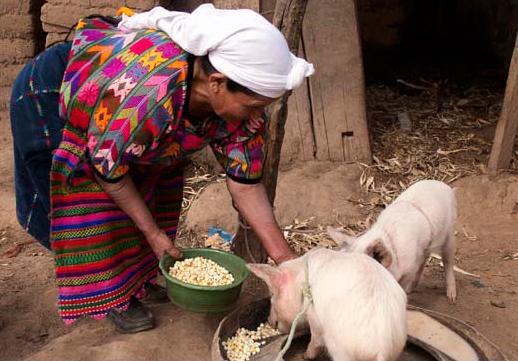
Women’s Empowerment in Agriculture Index (WEAI) is a measure designed to directly capture women’s empowerment and inclusion levels in the agricultural sector. The WEAI aims to increase understanding of the connections between women’s empowerment, food security, and agricultural growth. The index is the product of a partnership between the United States Agency for International Development (USAID), the International Food Policy Research Institute (IFPRI), and the Oxford Poverty and Human Development Initiative (OPHI) of Oxford University, in support of US President Obama’s Feed the Future initiative to combat global hunger and poverty. The WEAI Resource Center website includes training materials, publications, fellowship information, and a video introduction also available below.
An index called the 5DE sub-index of the WEAI was constructed using a multidimensional methodology known as the Alkire Foster Method. It measures the roles and extent of women’s engagement in the agriculture sector in five domains: (1) decisions about agricultural production, (2) access to and decision-making power over productive resources, (3) control over use of income, (4) leadership in the community, and (5) time use. Women are considered to be empowered if they have adequate achievements in four of the five areas.
The Gender Parity Index, a second sub-index of the WEAI, is a relative inequality measure that reflects the inequality in 5DE profiles between the primary adult male and female in each household, based on asking women and men the same survey questions. The GPI shows the percentage of women who have achieved parity with respect to their male counterparts.
Piloted in three countries with diverse socioeconomic and cultural contexts - Bangladesh, Guatemala, and Uganda - the index was developed to track the change in women’s empowerment that occurs as a direct or indirect result of US government intervention under the Feed the Future initiative. The pilot phase refined the survey questions and followed up with case study methodology among selected women and men in the same sites, using narratives to validate and explain answers and describe the individual women’s daily lives, as well as conceptualise women’s empowerment in agriculture.
Press release from the IFPRI on February 27 2012 and email from Marcia MacNeil to The Communication Initiative on September 28 2015. Image credit: Alfonso Porres
- Log in to post comments