










































Young Voices: A Global Campaign for Equality
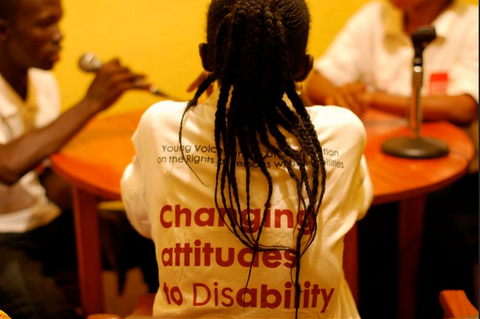
Since 2005, groups of young people aged 16 to 25 with disabilities in 22 countries across in Africa, Asia, and the Americas have come together in Young Voices, a global project that campaigns for countries to sign, ratify, and implement the United Nations Convention on the Rights of Persons with Disabilities (UNCRPD), which came into force in 2008. Through interacting with their peers, engaging in advocacy, and producing films, radio programmes, and theatrical productions, young people with disabilities have the chance to share their experiences, to speak out against discrimination, and to influence government decisions that impact on their lives. The campaign is led by Leonard Cheshire Disability.
The Young Voices project works to increase the capacity for active citizenship by working with disabled young people to develop their understanding of human rights and advocacy, as well as develop potential leaders in the disability field with campaigning, advocacy, and media skills. The project is intended to equip these young people with the knowledge and experience to hold their governments to account for the implementation of the UNCRPD. Through the global network, youth are learning how to organise themselves. Young people with disabilities meet to share their experiences, plan, and execute campaigns and push for ratification of the Convention with senior politicians. This includes organising street demonstrations and using radio, television, theatre, and music to get their message out to the general public and share their experiences of discrimination, barriers to access, and negative attitudes. Developing their leadership, campaigning, and advocacy skills has been the key focus.
With support from local Cheshire services and Leonard Cheshire Disability, Young Voices groups identify issues that are important to their members and set their own advocacy agendas. Groups also choose their own working style. Some work in concert with disabled people's organisations, while some take part in United Nations initiatives and make links with development agencies. Others contact and petition government officials themselves. All work to raise the profile of disabled people’s rights and influence their governments. Those trained then pass their skills on to new members.
In May 2008, one delegate from each of the 18 Young Voices countries studied filmmaking with Sorious Samura and Ron McCullagh, award-winning documentary makers. Held at the United Nations Economic Commission for Africa in Ethiopia, the training was part of a conference on the Convention run jointly with Leonard Cheshire Disability. Since then, trainees and other group members have used cameras to document their own experiences, their surroundings, and their campaigns, chronicling disability around the world. These videos are available on the Young Voices You Tube page.
In December 2011, a week-long studio training seminar was held in Zambia for musically talented Young Voices members from Kenya, Sierra Leone, Liberia, and Zambia. Using professional equipment, they learned how to produce their own songs, which will be released globally via Itunes and Amazon. The music training project was intended to enable Young Voices members’ to express themselves and their campaigning messages through music.
The country pages of the Young Voices website includes stories and information about what is happening in individual countries, as each country develops unique strategies, supported by Leonard Cheshire Disability. The following are a few examples:
- In Zimbabwe, Young Voices held a training workshop to identify barriers to signature and ratification, including access to the Convention itself. Even before leaving the workshop, they gained a promise from the UN representative in attendance to translate the Convention into local languages. A similar initiative was taken up by Young Voices in Botswana, who also lobbied for a Braille translation.
- Young Voices in Sierra Leone broadcast weekly programmes on ratification on three radio stations. Most of the Convention's articles have been discussed including those on the right to education, vital in a country where 76% of disabled children do not go to school.
- In Swaziland, Young Voices wrote and produced their own plays about rights of persons with disabilities and the Convention so that the public could understand the need for signature and ratification. Drama also helps the actors engage the public in exploring disability in their communities in a non-threatening way.
Disability, Rights, Youth
The United Nations Convention on the Rights of Persons with Disabilities (UNCRPD) provides an opportunity for people with disabilities to build awareness of their rights in the wider community and to prompt and encourage governments to act on their good intentions. However, experience has shown from earlier Conventions that the ratification of human rights treaties does not, in itself, guarantee that governments will implement or fund their commitments. Implemented properly, the Convention can bring about a real change for the better in the daily experiences of the millions of people with disabilities around the globe.
Young Voices website, Young Voices: Speak Out [PDF], and Hear Us: Young Voices [PDF] on February 4 2013.
- Log in to post comments