










































Evaluating Approaches to Designing Effective Co-Created Hand-Hygiene Interventions for Children in India, Sierra Leone and the UK
De Montfort University
"...by adopting a Co-Creation approach, the on-going relationships with each collaborator ensures the shared-ownership and sustainability of the resources and enables the opportunity for further resources to be continually adapted and developed for their contexts."
The COVID-19 pandemic has brought to global attention the importance of hand hygiene in disease control and prevention, especially in the absence of an effective vaccine or antiviral medication. This paper describes and evaluates a set of educational resources and workshop activities ("A Germ's Journey") for young children initially developed in the United Kingdom (UK) that was adapted for use in Sierra Leone and India. After a discussion of the importance of hand hygiene to international public health, the paper examines how public health resources for young children can be developed through community engagement. It then details a study to investigate the understandings, facilitators, and challenges involved in co-creation in an international context.
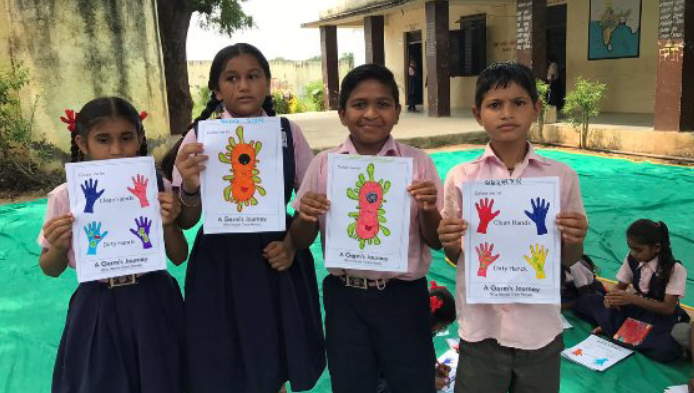
In 2017, a team of researchers (including a microbiologist and educationalist) from De Montfort University, UK, developed a range of child-friendly educational resources with the aim of teaching young children about germ transmission and handwashing. Specifically designed to be engaging and interactive for children to use alongside their parents/teachers, the resources include books, website games, posters, handwashing songs, and colouring sheets. Information for adults about the topic and how to use the resources with their children/pupils has also been made available and has been shown to be an important element of promoting children's understanding and behaviours.
An initial evaluation of A Germ's Journey featured workshops with UK children in the Early Years Foundation Stage (EYFS). Groups of children each took turns to complete 4 activities, each supervised by a trained adult: (i) interactive book reading; (ii) web-games, such as the "find the germs" game, in which children expose the "hidden" germs within a cafe setting; (iii) the handwashing activity, which involves children rubbing their hands with glow-in-the-dark gel as a visual representation of germs; and (iv) colouring. Based on the finding that the learning resources were found to have increased young children's awareness and understanding of germs and handwashing, the researchers worked to develop culturally relevant educational resources for children in low- and middle-income countries (LMICs), where knowledge of germs and correct handwashing practice can be life-saving. Thus far, the book, posters, and parent guides have been adapted and translated.
The paper turns to discussing some of the methodological frameworks used in developing public health interventions through community engagement. Pivotal to contemporary understandings of co-creation is the principle that end-users play an active role throughout the process. This approach to paedagogic practice actively involves individuals or groups of people in educational contexts, including curriculum design or lesson planning. When developing culturally relevant resources for India and Sierra Leone, the team worked in partnership with the end-users (local children, teachers, and professionals). It was vital that the collaborators had joint agency and an ongoing working relationship with the researchers in order to follow the democratic philosophy underpinning the co-creation approach, dismantling traditional researcher-participant relations and instead enabling a shared power in the research process. This is in keeping with the fundamental ethos of theorists such as Friere.
As part of the process, UK team members visited areas of socio-economic disadvantage in India and Sierra Leone. Previous epidemics of Ebola in Sierra Leone and polio in India have had an impact on these communities' views towards aid workers during the epidemics/pandemics; thus, "it was important for the researchers to guard against issues of the White Saviour Complex and Imperialist/Colonial discord, hence the use of Co-Creation." That is, the team was aware and had to make clear that they were not visiting the LMICs to "teach children and teachers how to wash hands properly" (or to create and donate resources based on Western ideologies and viewpoints) but instead were committed to working in collaborative partnership with local researchers to ensure that their shared motivation, knowledge of culture, and context informed all aspects of intervention design, adaptation, and evaluation. Within research in LMICs in particular, "power is habitually operated in covert ways with the researchers often holding this 'colonialist' power and locus of control. This study wanted to disrupt this historically dominant discourse with the use of the Co-Creation process, enabling for an open and more democratic approach to research."
For the present study, the team conducted interviews with 5 key stakeholders who were involved in development of resources for the UK and adaptation of resources to the Sierra Leonean and Indian contexts. These core data are supplemented with focus group data (N = 37) collected from 5 groups held with early years educators in Makeni, Sierra Leone and data from open-ended questionnaires collected from early years teachers in Gujarat, India (N = 66) and the UK (N = 63). Data were analysed using thematic analysis; 3 themes, each with 3 constituent subthemes, are presented:
- Representations of and unique approaches to co-creation: Explores the ways in which co-creation was constructed in relation to teamwork, practice, and evaluation. Two elements were reported to make the enterprise more productive: ensuring that all participants and end-users were active throughout the process, and identifying more systematic ways of working. The collaborators highlighted the importance of working cooperatively and utilising different skill sets of the team in order to spark creativity. Continuous evaluation and inclusive decision-making is understood to be an important factor within the co-creation process, particularly when the outcomes will have a direct impact on the end-user's lives.
- Advantages of co-creation: Considers issues around shared ownership, improved outcomes, and more meaningful insights - alongside the mitigation of risks and short-circuiting of problems. One interviewee (India) commented on a direct outcome of the book that was co-created with the A Germ's Journey team: "We used this book with our Anganwadi kids (pre-school) of 3 to 5 years and also with kids of 6 to 10 years. Often our teachers use this book to spread awareness about the importance of handwashing in daily life, and they are successful passing this message amongst the children and through children the message will reach to their parents. We noticed that the majority of children have now adopted the habits of hand washing not only at the centres but at home as well. I think the habits adopted in childhood will remain forever."
- Challenges of co-creation: Discusses issues around timing and organisation, attracting and working with appropriate partners, and understanding the importance of local context with inherent social, economic, and structural barriers, especially in LMICs. One insight: "The balance of who and how many people to involve, so as not to stunt the progression yet still ensuring an inclusive process, alongside ensuring the process is driven forward by somebody taking the lead role can, as noted by the collaborators, pose a challenge, as can the selection of less motivated partners."
The researchers reflect on managing the potentially conflicting goals of the ethical and participatory values of co-creation with pragmatic considerations about ensuring an effective final "product". Recommendations for future work include developing measures to ensure accountability to populations and moving toward a more robust community action plan model. Within the time frame of this research, community feedback loop measures were not possible; however, the goal is to address these issues in future work to ensure greater engagement with the wider community and to ensure sustainability of the project.
PLoS ONE 15(9):e0239234.https://doi.org/10.1371/journal.pone.0239234; and A Germ's Journey website, September 23 2020. Image credit: A Germ's Journey
- Log in to post comments