










































Digital Safety Kit
"Assume that every call, SMS message and unencrypted email can be intercepted."
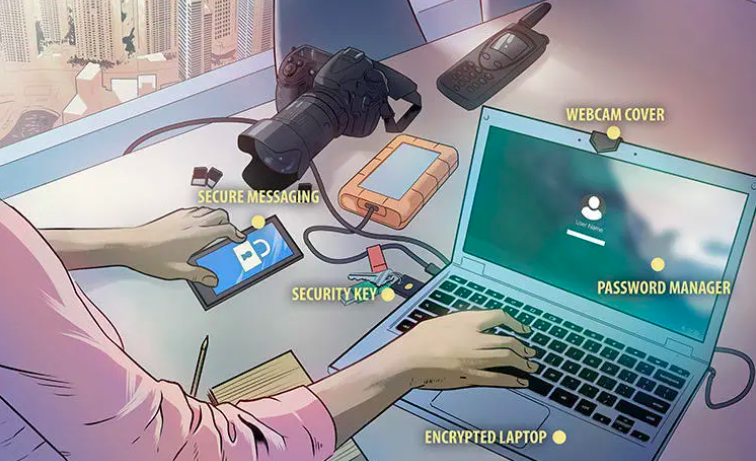
This Digital Safety Kit is intended for journalists looking to better protect themselves, their sources, and their information from digital threats. The kit, produced by the Committee to Protect Journalists (CPJ)'s Emergencies Response Team, includes six safety notes that deal with topics such as protection from malware or spyware, encrypting of information, and staying safe when online and when going through border controls.
As explained by CPJ, "Journalists should protect themselves and their sources by keeping up to date on the latest digital security news and threats such as hacking, phishing, and surveillance. Journalists should think about the information they are responsible for and what could happen if it falls into the wrong hands, and take measures to defend their accounts, devices, communications, and online activity."
The kit contains the following sections, with each section containing a list of tips and guidance:
- Protect your accounts: Journalists use a variety of online accounts that hold both personal and work-related information on themselves and their colleagues, families, and sources. Securing these accounts and regularly backing up and removing information will help protect that data.
- Phishing: Journalists often have a public profile and share their contact details to solicit tips. Adversaries looking to access journalists' data and devices can target them - or a colleague or family member - with phishing attacks in the form of tailored email, SMS (short messaging service/text), social media, or chat messages designed to trick the recipient into sharing sensitive information or installing malware by clicking on a link or downloading a file. There are many types of malware and spyware that range in sophistication, but the most advanced can grant a remote attacker access to the device and all its contents.
- Device security: Journalists use a wide range of devices to produce and store content and to contact sources. Many journalists, especially freelancers, use the same devices at home as well as at work, potentially exposing a vast amount of information if they are lost, stolen, or taken. Journalists are advised to encrypt computer hard drives, phones, tablets, and external storage devices, especially when they travel, to ensure that others will not be able to access this information without a password.
- Encrypted communications: Journalists can communicate with sources more securely using encrypted messaging apps or software that encrypts email so only the intended recipient can read it.
- Secure internet use: Journalists rely on the internet but may not want to share their online activity with every internet service provider, internet cafe, or hotel with free WiFi. Criminals, as well as sophisticated adversaries, can steal information or monitor journalists using insecure websites or public WiFi connections.
- Crossing borders: Many journalists cross borders carrying work and personal information that they may not want others to access on electronic devices. If border guards take a device out of a journalist's sight, they have an opportunity to search it, access any accounts, copy information, or install spyware.
Publishers
English, Amharic, Arabic, Burmese, French, Portuguese, Russian, Somali, Spanish, and Ukrainian
CPJ website, March 22 2022. Image credit: Jack Forbes (artist)
- Log in to post comments