










































Health Exchange - Spring 2010 - Increasing Access to Medicines

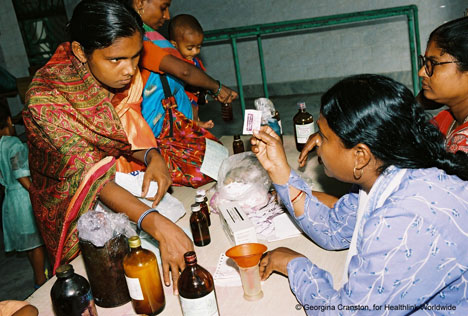
Health Exchange is a collaborative online forum/space for the health sector developed by the United Kingdom (UK)-based Healthlink Worldwide, RedR, and Merlin. The Spring 2010 issue focuses on responses to increasing access to medicines. As indicated here, 1 in 3 of the world's population does not have access to essential medicines, defined as those necessary to satisfy the priority health care needs of the population. This edition of Health Exchange raises some of the issues and looks at initiatives that are focusing on particular aspects of improving and increasing access to medicines.
Selected communication-related elements highlighted within contributions to the publication include:
- In "Medicines and the MDGs", Andrew Chetley argues that "New ways of engaging with stakeholders in the system need to be developed - such as the Medicines Transparency Alliance, which brings together public, private and civil society actors in a dialogue to focus on key changes to the way in which medicines are produced, sold and used. All these initiatives take political will and a strong voice from those who currently lack a regular supply of the medicines that are a fundamental part of their right to health."
- In "Hands-off Medicines: A Global Campaign to Improve Dispensing Practices", Judy Wang, Alison Wong, Sarah Morrison, and Tina Brock from Management Sciences for Health (MSH) advocate a comprehensive approach to addressing the challenges to good dispensing practices. They urge that dispensers need to be provided with more knowledge about handling medicines properly through formal and informal training. Another communication-related suggestion: public awareness campaigns about access to good quality medicines play an important role.
- In "Stop Stock-outs: A Campaign for Access to Medicines", Denis Kibira describes a campaign in 5 African countries - Kenya, Malawi, Uganda, Zambia and Zimbabwe - to combat "stock-outs" (when a pharmacy temporarily has no medicine on the shelf). He writes: "The campaign, launched in March 2009, has used a variety of approaches. These have included the use of publicity material like t-shirts, banners, fact sheets, fliers and policy briefs. A local artist, Bobi Wine, and a woman member of parliament were approached to champion the cause. The campaign has undertaken various activities including: press statements and conferences, public rallies, radio talk shows and media articles to generate public debate in the media and other fora. One of the most interesting things we did was to organise something called a Pill Check Week in June 2009, ...[which] used a Google map to identify where the stock outs were a reality."
- In "Fighting Counterfeits: Without Endangering Public Health", Christa Cepuch explores the counterfeit medicines, with a focus on Health Action International (HAI) Africa and its network partners, whose approach has been "raising awareness of the dangerous rhetoric on how a new anti-counterfeit approach will be a solution to public health and safety. So what does 'counterfeit' mean? And why are some approaches to stop counterfeiting a threat to public health?"
- In Access to Medicines Now and in the Future: Addressing the Challenge of Drug Resistance", Emma Back and Eva Ombaka argue that a systematic global response to the challenge of drug resistance is needed. At the community and health care facility level, they say, "One of the most important things that prescribers and dispensers can do is to take time with each patient to explain how they must take their medicines and to stress the importance of completing their course of treatment."
- In "Collaboration, Exchange and Partnership: A New Approach to Clinical Pharmacy in Kenya", Imran Manji explains that, in Kenya, the Indiana University School of Medicine (IUSM), the Purdue University School of Pharmacy and Pharmaceutical Sciences (PUSOPPS), and the Moi Teaching and Referral Hospital (MTRH) are collaborating and working with national and international partners to provide pharmacy services to thousands of patients. Specifically, American and Kenyan students are paired up to facilitate the provision of these services at MTRH. "This includes providing drug information to physicians, nurses and patients; updating medication administration records; ensuring appropriate dosages of all medication; as well as monitoring drug therapy. The students also participate jointly in daily patient discussions, case conferences and journal clubs, with practitioners from other disciplines and other countries."
- In "Essential Medicines: Why Do We Need Them?", Alison Dunn, Editor of Health Exchange, talks with Hans Hogerzeil, Director of Essential Medicines and Pharmaceutical Policies at the World Health Organization (WHO) about essential medicines. Hogerzeil notes that "An important part of creating an essential medicines list is having a good committee in place to make decisions....There should be transparency in all processes of application, review and decision-making. The decision is made by a group, but arguments in favour or against the inclusion of any medicine should be on record and available to be viewed by the outside world."
- In "Private Pharmacists: The Missing Link in TB Control", Manjiri S. Gharat of the Indian Pharmaceutical Association (IPA) the TB Fact Card project (2005-2006) in Mumbai, which focused on creating awareness about tuberculosis (TB) and monitoring TB patients' Directly Observed Treatment Short course (DOTS). In 2007-2008, the IPA organised training for 40 pharmacists in Mumbai and Kalyan. Pharmacists were provided with small posters about DOTS to put in their pharmacies. Trained pharmacists' names were included in the DOTS directory of local TB offices, and the IPA stayed in touch with the pharmacists by telephone to prompt them about DOTS-related work. The pharmacists who perform well in DOTS are recognised at pharmacists' meetings and conferences. "This honours their work and motivates other pharmacists to get involved."
- In "Why We Need Better Medicines for Children - A Paediatrician's Perspective", Shalini Sri Ranganathan and Suzanne Hill identify several proposed solutions for improving children's access to medicines in developing countries. Amongst the communication-related ideas: creating and disseminating widely a separate list of essential medicines for children; advocating for essential medicines for children to be available at different types of hospitals and primary care facilities; sensitising policymakers and regulators about the issue of children's medicines; and empowering parents to demand better medicines for their children.
Email from Deepthi Wickremasinghe to The Communication Initiative on April 27 2010; and Health Exchange website, May 3 2010. Image credit: Georgina Cransto for Healthlink Worldwide
- Log in to post comments