











































India Polio Communication Update, June 2012
Date
Summary
Despite India having stopped polio transmission, every effort is still being made to identify and reach populations on the move with oral polio vaccine at railway stations, bus stops, and other transit sites. This is one of the messages shared in an update, one of a series produced by the United Nations Children's Fund (UNICEF) India in consultation with polio partners as part of the global effort to eradicate polio. The following topics are covered in this issue:
- What now for a polio-free India? - In addition to its work to guard against importation of wild poliovirus (WPV), the India programme has been tasked with sharing innovations and lessons learned with the remaining polio-endemic and re-established transmission countries. Technical support visits have been conducted to Pakistan and Nigeria, while monitoring and evaluation (M&E), capacity building, and media and advocacy modules, as well as formats and work plans, have been shared.
- Expert group recommends "eternal vigilance" - The India Expert Advisory Group (IEAG) on polio eradication, in its first meeting after India's removal from the World Health Organization (WHO)'s list of polio endemic countries, underlined the need for continuing the momentum of activities. For example, IEAG recommended that the Social Mobilization Network (SMNet) and other ground-level initiatives through Accredited Social Health Activists (ASHAs) and Anganwadi workers "should be maintained in traditional polio reservoirs and in newly emerging high-risk areas until the risk is gone. Appropriate social network research should be carried out in the key high-risk areas to inform programme actions." Furthermore, the IEAG asked for documenting and sharing experience and best practices, including elements of the SMNet, media engagement, and utilisation of data for tracking and engagement of high-risk populations in order to benefit other countries still dealing with the scourge of polio and also other programmes within India. "The expert group strongly recommended that all communication efforts, including SMNet, at all levels, should adopt the promotion of routine immunization [RI] as a primary message in all public communication."
- SMNet promoting institutional delivery among pregnant migrant workers in Bihar - Alongside acceptance of oral polio vaccine (OPV) and RI, SMNet is increasingly promoting institutional deliveries among migrant workers working in brick kilns in Bihar, who are among the populations at highest risk of infant and maternal deaths. The SMNet has put in place mechanisms to track and counsel them to ensure that all pregnant mothers are aware of and utilise the existing institutional delivery schemes.
- Polio workers build platform of hope in Bihar - This article reports on a visit by UNICEF Regional Director for South Asia, Ms. Karin Hulshof, to an isolated brick kiln in Bihar to meet with the polio team. Amongst her activities: meeting with women from SMNet, who went house to house ensuring that children were not only immunised against polio, but against all 7 vaccine-preventable diseases. Ms. Hulshof met with UNICEF Community Mobilization Coordinators (CMCs).
- Rotary International Convention celebrates India's polio-free status - At the 3-day convention, amidst celebration, speakers cautioned that the ultimate goal is yet to be reached, as Pakistan, Afghanistan, and Nigeria continue to remain polio endemic.
- Australia clean bowled by Chandra - polio's smiling survivor - On January 13 2012, one year to the day since India recorded its last case of polio, Indian cricketing legend and polio survivor Bhagwath (B.S.) Chandrasekhar came for the third "test match" in Perth, Australia. To symbolise the milestone, both teams of players wore "End Polio Now" ribbons, as did the umpires and the TV cricket commentators and presenters in both Australia and India. Chandra was interviewed by media on both sides of the Indian Ocean.
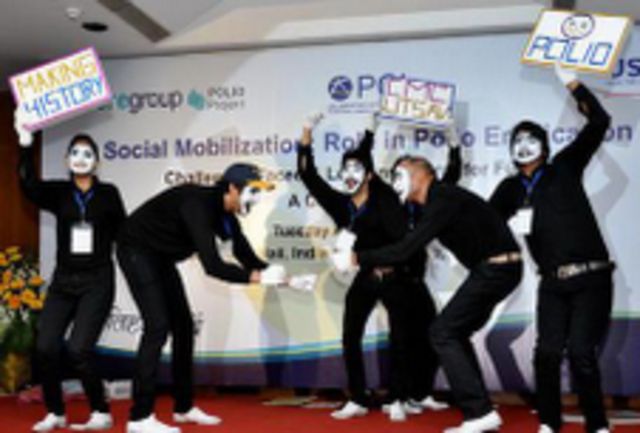
- From 'No' to 'Know' - A Consultation, "Social Mobilization: Role in Polio Eradication - Challenges Faced & Lessons Learnt for Future", at the India Habitat Centre, New Delhi, brought together public health experts, partner organisations, and the community to discuss how social mobilisation in polio eradication can lead to effective and lasting solutions for other public health issues. A theatrical performance was performed at the event with a narrator. This 45-minute wordless performance ("Pantomime") outlined the 11-year journey of engaging the community in polio eradication and overcoming communication challenges encountered by mobilisers and vaccinators. The panel discussions highlighted how the polio programme has been able to bring together various government departments toward changed behaviour, demand generation, higher utilisation of services - ultimately, as stated here, leading to universal coverage and empowerment of communities.
To request the full bulletin, please see the contact information, below.
Source
Email from Lieven Desomer to The Communication Initiative on July 9 2012.
- Log in to post comments