











































It's All in the Detail: Developing Effective Health-related Job Aids
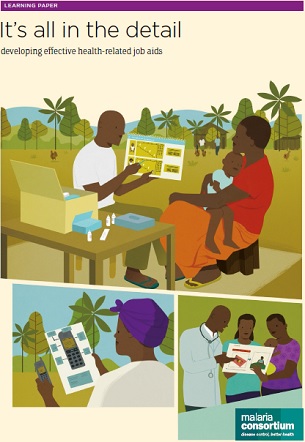
This 36-page learning paper discusses Malaria Consortium’s experience developing, implementing, and evaluating job aids for community health workers (CHWs) and health facility workers in Mozambique, Nigeria, South Sudan, and Uganda. The paper notes that job aids are commonly accepted ways to enhance health worker performance, yet little assessment or guidance is available related to their development. This paper was produced to share Malaria Consortium’s lessons learned about what has worked, and to provide tips for developing effective job aids. According to the paper, job aids can be used by health workers to be able to prevent, diagnose, treat, and care for groups most at risk of malaria and other communicable diseases.
As stated in the brief, job aids are used to help support training and on the job performance by communicating information, such as instructions with a sequence of steps, and reinforcing adherence messages. Job aids can "help to enhance memory, reduce errors, and improve job performance. When used regularly, they can promote passive learning through behavioural conditioning of performing a task until the aid is no longer needed. In addition, when combined with training and supervision, they have been shown to enhance a health worker’s ability to perform specific tasks correctly."
The following six criteria are identified by the Malaria Consortium to be critical for well-designed job aids, and are based on recommended behavioural and communication theories:
- Communicate complex information accurately and in an easy-to-understand format: The content should be simple, direct, and contain only key information. A key purpose of the job aid is to prompt the health worker's memory, and so the messages, instructions, illustrations, and symbols should serve as cues to remind the user of the knowledge and skills they acquired during training, which they are passing along to the patient.
- Content must be current, accurate, and consistent with health policies and guidelines: Job aids often contain new technical content and/or new guidelines and policies which need to be followed exactly as they are written. It is therefore important that the content is accurate and consistent with national or international policies, as the aids also become a guide to quality standards.
- Provide clear options for critical decision pathways:Needs will differ from patient to patient, therefore job aids must provide clear decision pathways for the health worker to follow. This involves translating complex clinical processes or algorithms into simple and clear instructions, which contain start and end points, and as far as possible are colour-coded so that the critical flow can be followed easily.
- Describe processes and procedures in alignment with the training curriculum and existing healthcare practices and tasks:When developing the job aids, the flow of information and visual cues follow the same order in which the procedures and patient consultations occur. Job aids should serve as a tool to enhance learning during and after training, so the tool must align with both the training and what happens in the real world.
- Include culturally and literacy appropriate language, illustrations, and symbols to communicate key messages:The content of the job aid should be relevant to the language, culture, and educational and literacy level of the intended audience. As much as possible, few words should be used with appropriate drawings and symbols that clearly communicate the message or cue. This includes using action images or context images to show what is happening and avoid miscommunication. To ensure this, there is a need for formal qualitative pre-testing and, if possible, evaluation of the job aid and other materials to confirm comprehension of the messages.
- Produce cost-effective quality materials.Job aids are not intended as a replacement to cut the costs of training or supervision of health workers. "A well-designed job aid can maximise the cost and impact of training by enhancing memory and retention, improving daily job performance, and facilitating supervision of standard procedures and assuring the delivery of quality care."
For more information, please contact learninpapers@malariaconsortium.org
Malaria Consortium website on April 15 2014.
- Log in to post comments