










































Excess production of foods: brings positive or negative impact for farmers???
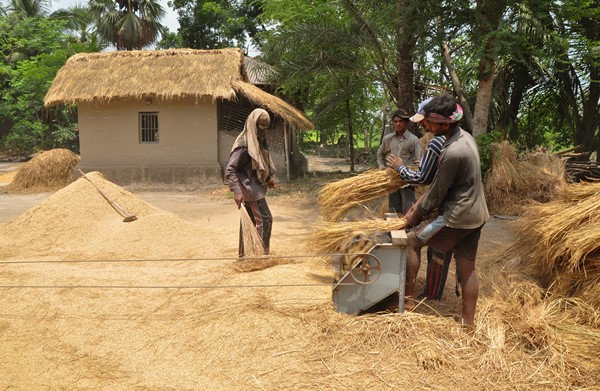
Author: Suman Chowdhury (Mony), August 18 2014 - Recently in Bangladesh, some agricultural farmers showed their agitation against the government by throwing tons of paddy [rice in the husk before processing] in the main road of the capital city. The cause of their grief was that they couldn’t make a profit by selling paddy, due to the high production costs and also excess production of paddy in this year (2012). Last winter, some vegetable farmers also threw tons of tomatoes in the roads of several cities of Bangladesh due to same cause.
Every farmer, also the government of every country, wishes to produce an excess production of crops and foods and any other productive goods in every year. It helps the poor farmers to earn more money, and they can lead their life smoothly and gracefully and get the opportunity to gradually abolish their poverty. It is also very true that excess production of crops is one of the most valuable indicators for creating and establishing food security for the future. And it helps to reduce food prices. It is also true that when food or any goods' prices stay in lower positions on the cost of living scale, then every person of a country can increase their savings of money and solvency and lead their life more pleasantly.
But does this production always bring positive and helpful result for every farmer, especially in undeveloped and developing countries?
Maybe not. Developed countries have sufficient capacity and strategy to give subsidies to the farmers to reduce their production costs. But it is not so easy to execute in undeveloped and developing countries because of their poor economic condition. Sometimes the mentalities of those governments are not friendly to poor farmers rather than the middle men/brokers or businessmen who are the partisans of those governments. Corruption is one of the main obstacles for every kind of good action in those countries.
When the production costs of crops exceed the selling prices, then the farmers suffer. They lose their money rather than profit. It is very hard for them to gain the benefits of excess production. They become disappointed about future production.
If the government wishes to solve these problems and wants to continue the excess production of crops for building up a strong food security for their country, they should develop work-friendly policies for their farmers, not for their so-called partisans, who work as a middle men, brokers or businessmen and wear away the profits. The government of an undeveloped and developing country like Bangladesh can do something good for farmers and agricultural laborers.
- Give subsidy on production costs of crops.
- Take the initiative of lending the agricultural sector microcredit and SME [small and medium enterprise] loans, where interest rates will be lower and reasonable and have the opportunity for a grace period in repayment of the loan to the lender.
- Start or manage micro insurance, crop insurance, etc., for farmers and agricultural laborers.
- Fix up selling prices for a period - which are profitable for farmers - and take proper initiatives so that the government institutions and businessmen are willing to buy crops and foods at those fixed prices.
- Collect and preserve more crops and food items for the future by buying those items at fixed prices.
- Export the excess foods and crops and earn foreign currency to strengthen the economic conditions.
- Encourage the private sectors and businessmen to collect, preserve and export the excess foods and crops.
- Think about the farmers, not partisans. Government should do everything in favor of farmers, laborers and producers.
Click here to read the original blog, posted on July 19 2012.
Image credit: Balaram Mahalder
- Log in to post comments