










































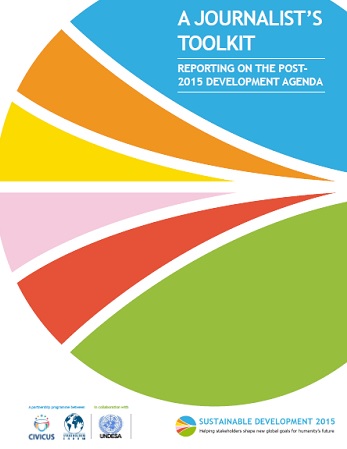
A Journalist's Toolkit: Reporting on the Post-2015 Development Agenda
Image
SummaryText
This toolkit is intended for journalists who are covering, or would like to cover, stories relating to sustainable development and the design and implementation proposed for the Sustainable Development Goals (SDGs) and related framework of policies. It has been prepared to help clarify background issues and provide some international facts and figures to guide journalists reporting on the post-Millennium Development Goals (MDGs) agenda and the proposed SDGs, which will replace the MDGs in 2015.
The toolkit was "prepared by journalists who understand how difficult it can be to engage audiences in broad, overarching topics such as poverty, good governance or climate change." Rather than focus on each of the proposed goals in turn, it highlights real-life issues that form the focus of the currently proposed SDGs highlights and links the proposed SDGs with broader issues.
These global issues form each section in the toolkit:
The toolkit was published by Sustainable Development 2015 (SD2015), a multi-stakeholder engagement programme run by Stakeholder Forum and CIVICUS, in collaboration with the United Nations Department of Economic and Social Affairs (UN DESA). SD2015 aims to increase stakeholder participation in the process to negotiate a Post-2015 development agenda. It provides "tools and opportunities for all stakeholders to input to this agenda and help build a more sustainable future, through five focus areas: raising awareness; increasing engagement; empowering stakeholders; coordinating advocacy; and strengthening governance."
The toolkit was "prepared by journalists who understand how difficult it can be to engage audiences in broad, overarching topics such as poverty, good governance or climate change." Rather than focus on each of the proposed goals in turn, it highlights real-life issues that form the focus of the currently proposed SDGs highlights and links the proposed SDGs with broader issues.
These global issues form each section in the toolkit:
- Poverty eradication and gender equality
- Food security and sustainable agriculture
- Healthy lives and sustainable living environments for all
- Education and lifelong learning
- Water and sanitation for a sustainable world
- Sustainable economic growth, energy and industrialisation
- Sustainable consumption and production (SCP)
- Climate change
- Marine resources, ecosystems and biodiversity
- Peaceful and inclusive societies, means of implementation, and global partnership
The toolkit was published by Sustainable Development 2015 (SD2015), a multi-stakeholder engagement programme run by Stakeholder Forum and CIVICUS, in collaboration with the United Nations Department of Economic and Social Affairs (UN DESA). SD2015 aims to increase stakeholder participation in the process to negotiate a Post-2015 development agenda. It provides "tools and opportunities for all stakeholders to input to this agenda and help build a more sustainable future, through five focus areas: raising awareness; increasing engagement; empowering stakeholders; coordinating advocacy; and strengthening governance."
Languages
English
Number of Pages
50
Source
Sustainable Development 2015 website on March 17 2015.
- Log in to post comments