










































Reaching the Unreached with Polio Vaccine and Other Child Survival Interventions through Partnership with Military in Angola
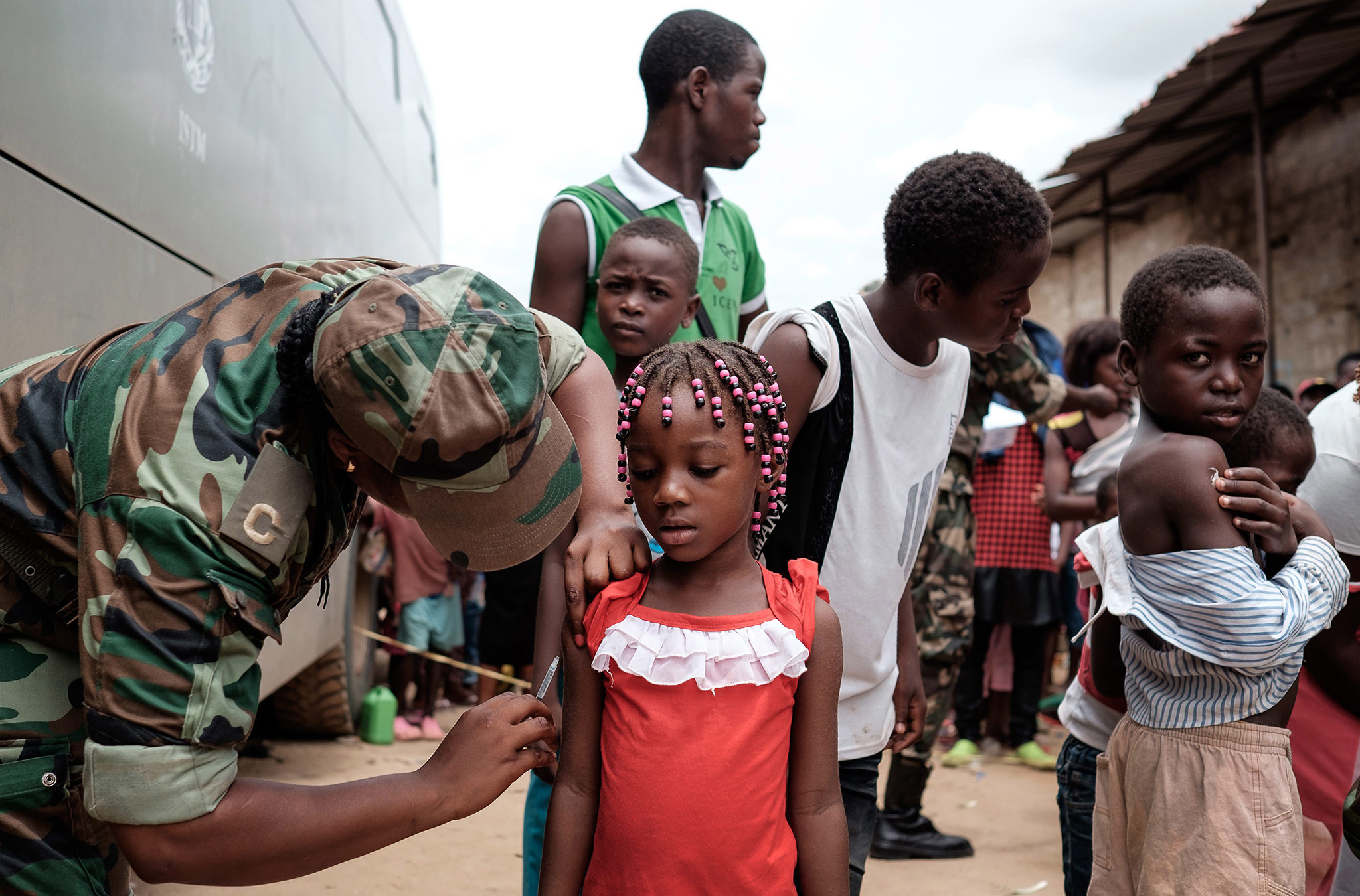
World Health Organization (Fekadu, Okeibunor, Kipela, Mkanda, Mihigo); Global Public Health Solutions (Nsubuga)
"Using this partnership it was possible to reach a significant number of children in insecure and hard to reach areas with polio vaccine and other child survival interventions. The military partnership also contributed in increasing the demand and addressing rejection for the polio vaccine."
Growing conflict and insecurity in 2013 played a major role in precipitating polio outbreaks in the Horn of Africa and the Middle East. In Angola, the early post-conflict situation was characterised by the presence of many inaccessible zones and districts due to insecurity and poor infrastructure. Partnership with the Angolan Army health service (AAHS) was one of the strategies that the Polio Eradication Initiative (PEI) introduced into the country to support the polio vaccination campaigns in insecure and hard-to-reach zones. The partnership with AAHS was initiated in 1999, when Angola experienced the biggest poliomyelitis epidemic ever recorded in the African Region, with 1,117 cases and 113 deaths caused by wild poliovirus type 1 and 3. The principal supports provided by the AAHS were the administration of oral polio vaccine (OPV) through Supplementary Immunization Activities (SIAs) designed to reach children who would have otherwise been missed, as well as vitamin A, deworming agents, social mobilisation, monitoring campaign quality, and surveillance. Distribution of logistics using military vehicles and helicopters to hard-to-reach and insecure zones was also part of the support. This paper explores that partnership strategy and its effectiveness.
As reported here, before embarking on creating this partnership, it was essential to undertake high-level advocacy with top military decision makers to engage the leadership in the process. The Director of AAHS is a member of the Inter-Agency Coordination Committee (ICC) for polio and vaccine-preventable diseases. The Minister of Health chairs the ICC, which is composed of top public health officers and the representatives of United Nations partner agencies [World Health Organization (WHO) and United Nations Children's Fund (UNICEF)], CORE Group (a United States Agency for International Development (USAID)-funded non-governmental organisation), Rotary, Angolan Red Cross, Social Society, and AAHS. The military vaccination teams were composed of 2 persons as any other vaccination team. The partnership allowed the use of military vehicles and helicopters to transport vaccines, health workers, and other logistics. Joint planning with this military team was an integral part of the strategy: Mapping and updating of the hard-to-reach villages located uphill or in the mountains and insecure zones was accompanied by micro planning for logistics, materials, and personnel.
Military vaccinators were trained by municipal-level officers supported by provincial-level supervisors at least 1 day before the implementation of the campaign in their local quarters. The training included a practical demonstration using recording and reporting formats, vaccines, and leaflets elaborated to guide civil vaccinators. The leaflets covered several topics as the intended population, the importance of the vaccine, the dose to be administered, the route of administration, and other technical issues. The leaflets also covered social mobilisation issues and community case definitions for immediately reportable diseases. Though military vaccinators had to use their uniform when acting as vaccinators, during deployment in the field, they received polio campaign T-shirts and caps (usually white in color with the campaign logo) to help the community identify them as vaccinators. The military teams vaccinated children by house-to-house visits and conducted active case search at the same time by asking the families for the presence of any affected person with immediately notifiable diseases like Acute Flaccid Paralysis (AFP), suspected measles cases, and others. Each military group deployed had an officer in charge to supervise and coordinate support with the municipal technical team. At the local level, coordination was done with the health facility in charge of the vaccination area.
Another component of the military partnership is their involvement in the implementation of independent monitoring of the polio campaign coverage. Administrative data of the number of vaccinated children came from daily tally sheets filled in by vaccination teams and summarised sequentially by villages, coordination areas, and communes. Concern for the quality of this data due to poor recording, consolidation, and transcription of data led the CORE group to carry out an independent monitoring (IM) survey of unvaccinated children in each province through visits to a certain number of houses in selected villages to determine the proportion of children missed during the campaign. AAHS provided personnel to assist in this complementary monitoring and evaluation mechanism.
An evaluation of this partnership process found that the military vaccinators reached children not only in security-compromised and hard-to-reach areas but also in areas poorly covered by vaccination volunteers. During every polio campaign, more than 265,000 children in 76 districts were reached through military partnership. The average number of children vaccinated per day by a military vaccination team was found to be double than the other volunteer vaccinators. It was also witnessed that there were fewer missed children in military-covered areas than in areas covered by vaccination volunteers. Furthermore, "[d]uring independent monitoring surveys, less rejection is witnessed in areas covered by military vaccinators than areas covered by other volunteers." The authors of this paper suggest one possible reason: "In Angola,...[t]he volunteers are usually young and less responsible contributing to an increased number of missed children and to the high rate of rejection of the vaccination by the community. The military vaccinators being matured and responsible, they manage to reach those under-immunized children and improve the confidence of the community in the service. In this regard, the military partnership not only helps to reach the unreached, but also improve the ownership and collaboration by the community and family members." There is, however, a limitation implied here in that some families may consider the service as being mandatory, given that it is provided by the military.
"Military is a potentially productive force that can be used for any development activities in any country. The Angolan experience has demonstrated that it is possible to form a partnership with the military for basic health intervention activities with little training and investment."
Vaccine. 2016 Jun 25. pii: S0264-410X(16)30395-4. doi: 10.1016/j.vaccine.2016.05.069 [Epub ahead of print] - sourced from ChildSurvival.net, accessed July 26 2016. Image caption/credit: "A Angolan military administers a yellow fever vaccine to a child at 'Quilometro 30' market, Luanda, Angola". Joost De Raeymaeker/EPA
- Log in to post comments