










































Towards A Safer City: Sexual Harassment in Greater Cairo: Effectiveness of Crowdsourced Data
"Sexual harassment is underreported all over the globe. Stigma and shame prevent many targets of sexual harassment from talking about or reporting these crimes. New technologies and social media platforms open up possibilities to overcome some of the barriers to data collection on sexual harassment."
In this report, the Cairo, Egypt-based HarassMap examines the use of crowdsourcing (information collected through social media platforms and text messaging) for collecting data and reporting incidents of sexual harassment. The report also provides insights into the perceptions and experiences of Egyptian women and men on sexual harassment in Greater Cairo. HarassMap conducted this research in collaboration with Youth and Development Consultancy Institute (Etijah) with support by the International Development Research Center (IDRC).
HarassMap is a volunteer-based initiative founded in late 2010 with a mission of creating an environment that does not tolerate sexual harassment. (See Related Summaries, below.) One of their methods of generating data is to crowdsource reports of sexual harassment and display them on a searchable map. Specifically, the Map utilises both geographic information system (GIS) and SMS (text messaging) technologies to record where incidents of harassment occur across the country, allowing all to see which areas to-date have the most reports on sexual harassment. Individuals who either experience or witness sexual harassment are able to anonymously submit reports directly through the web interface, through Facebook or Twitter, or by sending an SMS using the short code 6069. In addition, the Map documents the scope and seriousness of the problem by publicising actual stories of harassment that have been submitted. In turn, those who submit their stories of harassment receive information on how to access free psychological and legal services. Map reports and information are displayed via an open source platform to allow Egyptians to obtain information about sexual harassment and support those who are harassed in their neighbourhoods. The Map serves multiple functions, such as: providing testimony by those who experience or witness sexual harassment as to the seriousness of the problem, serving as data for understanding how sexual harassment is evolving in Egypt, providing HarassMap with information that can be used to tailor communication campaigns and research programmes, and serving as a tool for community outreach teams to motivate the public to stand up against sexual harassment.
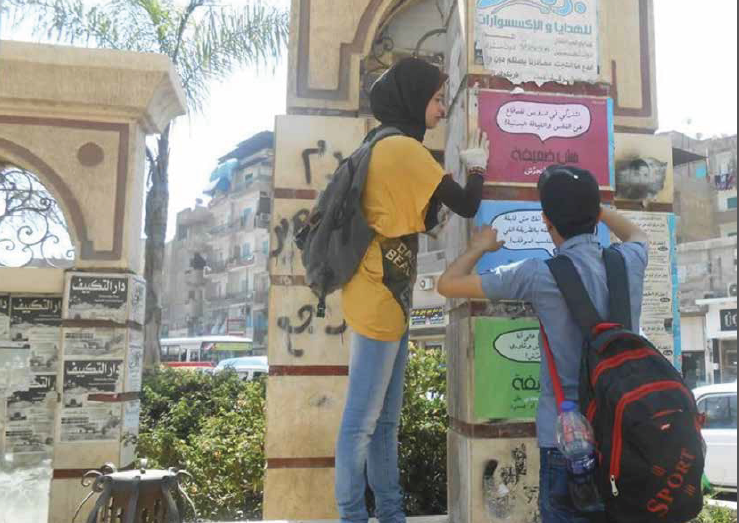
To elaborate on the latter, HarassMap actively engages with community members interested in making change by training them to encourage bystanders to speak up against harassment when it occurs. This involves working with shopkeepers, police, doormen, schools and universities, large and small-scale businesses, and others in creating safe zones and zero-tolerance areas for sexual harassment. Community outreach efforts include workshops and camps to train volunteers to be leaders in the fight against sexual harassment in their communities, additional training for community leaders and new volunteers nationwide, and monthly outreach campaigns by community teams. By early 2014, there were more than 1,500 volunteers across 20 governorates involved in running outreach campaigns in their neighbourhoods and cities. The purpose of the campaigns is to encourage those who witness or experience harassment to speak out, report what happened, and break stereotypes with the goal of making a collective stand against sexual harassment in Egypt.
Chapter 1 discusses in detail the socio-political context of sexual harassment in Egypt, offers a review of the previous literature on crowdsourcing, and provides an outline of the research methodology, challenges faced and limitations of the study, and ethical considerations. The crowdsourced data was derived from reports received via HarassMap's online Map, while other data came from focus group discussions (FGDs), in-depth interviews (IDIs), and questionnaires. The research was conducted in 6 administrative units of Greater Cairo (Helwan, Imbaba, Masr Elgedida, Masr El-qadima, Shubra El-kheima, and Shubra Masr) covering a range of socio-economic backgrounds.
Select findings offered throughout subsequent chapters include:
- Sexual harassment in Egypt is a widespread phenomenon that restricts women's access to public spaces and is associated with a range of negative physical and psychological consequences.
- Both crowdsourcing and IDIs reveal that more than half of harassers are youth below 25 years old.
- Sexual harassment is conceptualised, experienced, and narrated differently by men and women. The majority of women tend to define a broad range of actions as sexual harassment, including catcalls, comments, looks, noises, and gestures. Many men on the other hand perceive these acts as fun, innocent teasing or compliments. At the same time, they both agree that sexual assault and rape are types of sexual harassment. In particular, younger and more highly educated Egyptians consider sexual harassment to include unwanted touching, verbal comments, and facial expressions.
- Although conceptualised and portrayed in different ways, sexual harassment in Egypt is a display of gendered power and the result of underlying sexist, patriarchal social and cultural discourses and performances.
- Participants frequently attributed sexual harassment to economic and political conditions, citing reasons such as "high unemployment", "poor religious values", "lack of manners", and "lack of security and appropriate legislation".
- The idea that harassment is a violation of the woman's rights was rarely seen in the Map data, being more common in the IDI data (although it often only emerged after probing).
- Men and women are aware of the short- and long-term consequences of sexual harassment. They spoke about fear, guilt, sexual dysfunction, depression, and physical stress. Women are concerned about having to make lifestyle changes as a result of frequent exposure to sexual harassment by taking actions such as changing their style of dress or avoiding certain streets or modes of transport. Men are more concerned with consequences that might threaten intimate women-men relations, suggesting in focus groups and interviews that "women might become suspicisious of men's intentions", "women might restrict their encounters with men", "women might not trust men", or "women might not want to have sex with their husband in the future as result of their exposure to sexual harassment".
- However, people are not aware of the extent to which this practice is becoming endemic and mainstreamed and its grave impact on women's lives, dismissing, silencing, or playing down incidents on the assumption that public forms of sexual harassment are usually "trivial", "minor", or "benign".
- Male participants were generally reluctant to discuss in detail incidents where they had harassed women in the past, although many did admit having done so. Many female respondents were willing to discuss their experiences of harassment in the FDGs, although some stated they had not discussed the issue with family members due to fears that their mobility or style of dress would subsequently be restricted. The stigma attached to speaking about or reporting harassment was a recurring theme and seems to be one of the main reasons for low reporting levels.
- Few respondents reported filing official reports, typically due to fear of a scandal. Nearly half the sample, however, considered that police stations were the best places to report harassment.
- 83.3% of the study participants said they would not report incidents of sexual harassment using an online reporting system, as they did not believe that it would be able to guaranetee confidentiality. Men were generally more accepting of the idea of reporting harassment online than women.
- Different types of harassment were reported more commonly depending on the method used. Catcalls and ogling were more commonly reported in interviews, while touching and physical assault were reported more frequently in crowdsourced data gathered online.
- Fuller and more comprehensive reports were received via the Map than in the interviews, which may represent a major advantage of the Map over traditional methods. The Map offers a space where individuals can speak relatively freely and anonymously, although the Map is not a perfect method for data collection, as a great deal of information was lacking in the Map data set.
Chapter 5 presents study recommendations for tackling sexual harassment in Egypt:
- Further qualitative and ethnographic research should be encouraged to better understand how different factors, such as religion, age, and social class, affect how women and men understand and conceptualise sexual harassment. In particular, organisers suggest exploring the effect of religious discourses and messages on constructing certain stereotypical gender images.
- The new sexual harassment law should be operationalised, and the process of filing reports agains harassers should be simplified.
- A more positive role of police stations should be constructed, and they should be promoted as entities that provide services for all Egyptian citizens.
- Positive images of women should be promoted and the importance of their participation in public space highlighted through mass media channels.
- Collaboration between state institutions and organisations and non-governmental organisations (NGOs) working on sexual harassment should be fostered.
- Sensitisation of goverment officials, media personnel, and members of the public to the extent of sexual harassment in Egypt is needed.
- Community interventions and programmes encouraging both women and men to stand up and speak against sexual harassment and to intervene to help the harassed should be encouraged in order to break the silence and eliminate the stigma around the issue.
- Greater efforts should be made to reach out to younger people through unconventional methods such as social media platforms to further encourage a debate about sexual harassment and the constructed images of women and their role in the society that leads to positive behaviour change.
- More online platforms should be created for people, male and female, to discuss their experiences and perceptions and tell their stories about sexual harassment.
Email from Liane Cerminara to The Communication Initiative on September 1 2016, emails from Noora Flinkman to The Communication Initiative on September 2 2016 and September 15 2016, and IDRC website, September 6 2016.
- Log in to post comments