










































Citizen Engagement in Peacebuilding: A Communication for Development Approach to Rebuilding Peace from the Bottom-Up
University of New South Wales School of the Arts & Media
"Through participatory communication and a tailored use of the media and technology, C4D can create new platforms and channels for citizens to be agents in the national reconstruction."
This article demonstrates how a communication for development (C4D) approach to engaging citizens in peacebuilding can contribute to strengthening the reconstruction process at the end of large-scale violence, while engendering a bottom-up process based on dialogue and inclusivity. Author Valentina Baú also puts forward some reflections on C4D's contribution towards participatory governance. On the whole, this article provides the theoretical foundations for further research on the application of C4D methods and their effectiveness in strengthening local peacebuilding initiatives encouraged from the grassroots.
Baú begins by offering a brief overview of peacebuilding and development in violent contexts. In the aftermath of civil conflict, she says, the reconstruction process that needs to take place requires careful planning in order to avoid producing new causes of tension. The literature on conflict makes a practical distinction on the basis of the actors involved. More specifically, track 1 peacebuilding sees the state as the main implementer of negotiations and other activities that are primarily outcome-oriented. Tracks 2 and 3, on the other end, can be looked at as relationship-oriented and seek the engagement of non-state actors at different levels, from organised civil society for the former to more grassroots association for the latter. Initiating a transition process from violence to peace is problematic due to the low level of trust that citizens have towards the government, Baú explains. "It is only through a participation in governance that the government will begin to be held accountable to respond to the needs of all citizens, and that confidence in state institutions will be rebuilt." In violent contexts, particularly in the aftermath of conflict, the ability of the state to gain legitimacy in driving the reconstruction process can be an issue. One way of strengthening this legitimacy is by addressing informal institutions and community representatives, so that new institutions based on bottom-up, community-oriented values and traditions can participate in the process.
The article then presents a theoretical discussion that brings to the surface not only the role of C4D in facilitating citizens participation in government decision making, but also its significance in creating an inclusive peacebuilding process that starts from the community. Previous research has shown how communication mechanisms and targeted use of the media play an important role in the achievement of good governance by engaging citizens in influencing attitude, behaviour, and even policy, contributing to an improved system. Baú cites studies such as those carrried out by the World Bank's CommGAP programme, which has analysed the role communication plays in strengthening good governance - e.g., how elements such as free media and access to information can create a link between citizens, media, and government and facilitate the establishment of a vibrant civil society. Another avenue includes the area of media development. In relation to peacebuilding, research has focused particularly on the role of information and communication technologies (ICTs) in engaging people and communities. Baú notes, however, that "the description and investigation of individual case studies and programmes provided in the literature - characterized by a lack of examination of the wider context and of a critique of prior theory - is not sufficient to determine the role that technology plays in governance processes in fragile environments."
Thus, Baú suggests broadening the thinking away from a focus on ICTs toward an approach that adopts C4D - "two-way communication systems that enable dialogue and that allow communities to speak out, express their aspirations and concerns and participate in the decisions that relate to their development" - as the guiding lens for the design of media and communication activities aimed at engaging citizens in peacebuilding. Within this view, which Baú elaborates through a review of various literatures, communication gains a more holistic dimension that is not simply confined to persuasion and behaviour change; it involves deeper mechanisms such as building trust, exchanging knowledge and stories, identifying problems, and defining solutions. Agencies such as the World Bank (CommGAP, 2007) have recognised "local participation and community empowerment as one of the entry points to good governance." From a C4D perspective, this includes elements of participatory communication, deliberative decision-making, community media, community-level consultations, and ICTs. Applying these to the peacebuilding design allows citizens to take an active part in the process and opens the path towards a participatory type of governance. Within this framework, citizens have access to spaces, which can be either opportunities or channels, that they can use to address policies, discourses, and decisions that have an impact on their lives.
In examing the literature, Baú explores several examples that show possible applications of participatory communication, encouraging study of a more strategic framework for C4D to engage citizens in peacebuilding. During the peace process in Guatemala, for example, a Civil Society Assemble was created under the leadership of the Catholic Church. This brought together a large number of social, economic, and religious organisations to discuss the main issues on the negotiating agenda and to submit a consensus paper to the relevant parties. National dialogues have been another avenue for participation in the peace process. Rios (2014) recounts the experience of the Basque Social Forum held in 2013: "More than 700 people took part in two sessions, with 12 international experts speaking on subjects such as disarmament, reintegration of prisoners, human rights, and dealing with the past, memory and reconciliation. The organisers opened different channels of participation so that all interested people and groups could contribute. In addition to the event's web page, there was intensive work on social networks like Twitter and Facebook." Baú explains that, as a result of the forum, issues that were not previously included gained a place in the agenda, and cooperation between people espousing different ideologies was achieved.
This discussion demonstrates how the strengths of C4D in citizen engagement for peacebuilding can be found primarily within 2 concepts:
- Dialogue - the process of creation, sharing, and contestation of meanings and values. What is integral to the dialogic model is the context in which communication occurs, where economic, social, political, and cultural factors play an important part. Baú unpacks this concept and explores its connection to participatory governance, which is strengthened by a growth in confidence between the various stakeholders. Approaches can range from simple information dissemination from the government, to formal and informal consultations, debates, and discussions with the final aim of decision-making. These C4D components are "essential in the formulation of policies that do not reproduce the causes that led to violent conflict."
- Inclusivity - reformulation of peacebuilding as a process that is locally owned and locally led, and which rejects what is merely a symbolic engagement of local stakeholders. This idea is connected to the concept of participatory governance, which has, among its objectives, that of offering citizens the opportunity to have their views integrated in government's decision-making. Ideally, this community-centred approach will progressively lead to the formulation of policy that is in line with the real needs of people and that will prevent any further conflict. "When designing individual approaches for C4D in citizen engagement, attention must be paid to a country's historical background, the nature of the conflict that has ended, the communication ecology of that reality and the communication barriers that might be present for certain groups as a result of the conflict dynamics, particularly at the cultural and social level."
Next, Baú lays out some considerations on the limitations of C4D to engage citizens in peacebuilding. For example, the economically poor and disadvantaged often do not have the resources to take action and/or speak out in their best interests. It is important to not take for granted citizens' interest and capacity for participation, as this may often be constrained by a lack of time as well as work and social commitments. Even when local participatory peacebuilding approaches are adopted, the participatory spaces are not inevitably neutral, as the power relations that shape them decide not only what is possible to do within those realms, but also who can enter those spaces.
Baú concludes that, despite its challenges and limitations, a C4D design for citizen engagement in peacebuilding facilitates both the inclusion of different stakeholders and the creation of a space for their interaction. In post-conflict realities, reframing citizen engagement through a participatory C4D approach allows us to begin to rebuild peace from the bottom up and to place the voice of local communities at the centre of the reconstruction process - where the way in which governance is exercised plays a significant role for the achievement of a stable peace.
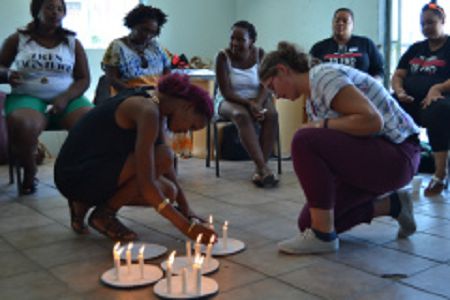
Progress in Development Studies, Vol. 16, No. 4, pp. 1–13. doi 10.1177/1464993416663052 - sent from Valentina Baú to The Communication Initiative on November 23 2016. Image credit: Western Cape Network for Community Peace and Development
- Log in to post comments