











































The Anti-vaccination Movement: A Regression in Modern Medicine
Xavier University School of Medicine (A. Hussain); Stony Brook University (Ali); Touro College of Osteopathic Medicine (Ahmed); Teachers College (S. Hussain)
Considering that a drop in immunisations poses a threat to herd immunity, this paper evaluates and reviews the origins of the anti-vaccination movement, the reasons behind the recent strengthening of the movement, the role of the internet in the spread of anti-vaccination ideas, and the repercussions in terms of public health and safety.
The authors explain that vaccines have contributed to decreasing rates of common childhood diseases, even wiping out diseases such as smallpox and nearly eradicating malaria and polio. Nonetheless, opposition to vaccines goes as far back as the 18th century when, for example, Reverend Edmund Massey in England called the vaccines "diabolical operations". In contemporary times, the anti-vaccination movement was most strongly rejuvenated by the publication of Andrew Wakefield's paper, since retracted, in The Lancet, which suggested credence to the later-debunked claim of a connection between the measles, mumps, and rubella (MMR) vaccine and development of autism in young children. The myth spread to many different parts of the world, especially Western Europe and North America, leading to multiple breakouts of measles and even causing deaths.
Opposition to the MMR vaccine among parents raises ethical, religious, and legal issues. For instance, the principle of autonomy holds that patients are entitled to the right to refuse vaccination, while health care providers are morally obligated to treat everyone with non-maleficence and avoid harm to society at all costs. At the individual level, religion is a common reason to refuse vaccination. For example, the MMR vaccine, combined with the rubella vaccine, was originally derived from the cells of aborted fetal tissue. Hindu, Protestant, Muslim, and Jewish communities are generally opposed to abortion for moral reasons based on religious teachings; thus, individuals from these communities may cite religious reasons for filing vaccine exemptions. At the forefront of the legal complications lie state-regulated vaccinations for all children attending school. The principles of autonomy and rule utilitarianism frequently are in tension here. In the times that herd immunity has been achieved, there remain these questions: Can legal exemptions still be justified? Should these exemptions be limited to religious reasons, or should they include secular reasoning as well? The authors contend that, "If the waivers are given to a small number of individuals who sincerely need them rather than ones who are inconvenienced by them, waivers may be ethically and legally sound."
Complicating these dilemmas is the fact that access to medical information online has altered the dynamics of the healthcare industry and patient-physician interactions. Accessibility of medical knowledge to the layperson with access to (often false and misleading) information on the internet and via social media, has shifted the balance of power and facilitated shared decision-making between patients and their physicians. While this is beneficial in some ways, parents can be mobilised to refuse consent for their child's vaccination due in part to the tactics online anti-vaccination authors use to further their agendas. These tactics include skewing science, shifting hypotheses, censoring opposition, attacking critics, claiming that vaccines are toxic or unnatural, and more. Various studies are cited here to back the claim that "The role of the online access to false anti-vaccination information just cannot be understated in examining the rise and spread of the anti-vaccination movement."
In conclusion, the authors suggest that all stakeholders in the medical world - physicians, researchers, educators, and governments - should unite to curb the influence of the anti-vaccination movement. "A qualitative study that explored how parents respond to competing media messages about vaccine safety concluded that personal experiences, value systems, and level of trust in health professionals are essential to parental decision making about immunization. Therefore, to combat the anti-vaccination movement, there must be a strong emphasis on helping parents develop trust in health professionals and relevant authorities, educating them on the facts and figures, debunking the myths peddled by the anti-vaccination movements, and even introducing legislation that promotes vaccination, if not mandating it."
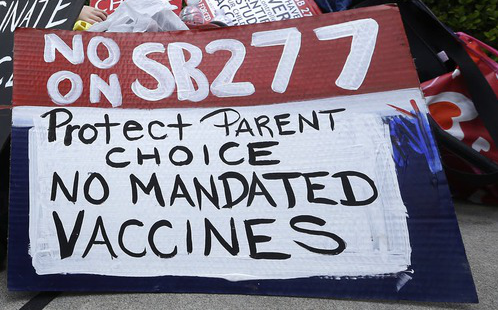
Cureus 10(7): e2919. doi: 10.7759/cureus.2919. Image credit: AP Photo/Rich Pedroncelli
- Log in to post comments